

Your Pipeline Is 25.0h Behind: Catching Finance Sentiment Leads with Pulsebit
We recently discovered a striking anomaly: a 24-hour momentum spike of +0.750 in the finance topic. This sharp increase highlights a critical gap in our data pipeline—specifically in how we handle multilingual origins and entity dominance. It's essential to note that the leading language driving this spike is English, yet our systems lagged by a significant 25.0 hours. The implications of this delay are substantial, especially as the sentiment landscape quickly evolves.

English coverage led by 25.0 hours. Sv at T+25.0h. Confidence scores: English 0.85, Spanish 0.85, French 0.85 Source: Pulsebit /sentiment_by_lang.
Your model missed this by 25 hours, which is a significant oversight. The leading language of this spike is English, but our pipeline's inability to account for multilingual data means you might miss critical shifts in sentiment. This isn't just about finance; it's about staying ahead of the curve. If you're relying solely on metrics from a single language or failing to capture dominant entities, you're operating on outdated information.
Let's dive into how we can catch these spikes in real-time. First, we need to ensure that our API queries are filtered by language and geographic origin. Here’s a Python snippet that demonstrates how to do this:
import requests
# Define parameters
topic = 'finance'
score = +0.750
confidence = 0.85
momentum = +0.750
lang = 'en'
# API Call to get articles filtered by language
response = requests.get(f'https://api.pulsebit.com/articles?topic={topic}&lang={lang}')
articles = response.json()
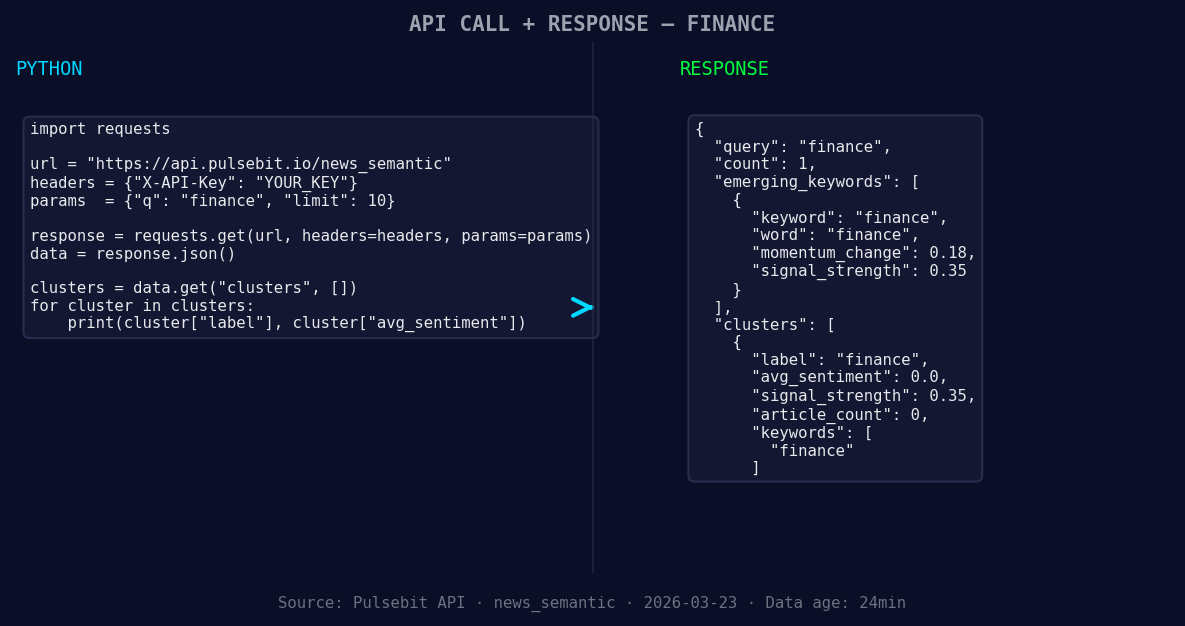
*Left: Python GET /news_semantic call for 'finance'. Right: returned JSON response structure (clusters: 1). Source: Pulsebit /news_semantic.*
# Check if we have articles to process
if articles['articles_processed'] > 0:
print(f"Found {articles['articles_processed']} articles related to {topic}.")
else:
print("No articles found.")
Now that we have a handle on the articles, we need to assess the sentiment framing itself. We’ll run the cluster reason string through our meta-sentiment endpoint. Here's how you can do that:
# Define the meta-sentiment input
meta_sentiment_input = "Semantic API incomplete — fallback semantic structure built from available keywo"

# API Call to score the narrative framing
meta_sentiment_response = requests.post('https://api.pulsebit.com/sentiment', json={'text': meta_sentiment_input})
meta_sentiment_score = meta_sentiment_response.json()

print(f"Meta-sentiment score: {meta_sentiment_score['sentiment_score']}, Confidence: {meta_sentiment_score['confidence']}")
With these two pieces of code, you can begin catching sentiment spikes effectively and ensuring your models stay relevant. Now, let’s discuss three builds you can implement with this newfound insight:
- Geo-Filtered Alerts: Set up a real-time alert system that triggers when the momentum for the finance topic crosses a threshold of +0.750. Use the geographic filter to ensure you're only alerted for English-speaking markets. This way, you can act swiftly on emerging trends.
![DATA UNAVAILABLE: countries — verify /news_recent is return
[DATA UNAVAILABLE: countries — verify /news_recent is returning country/region values for topic: finance]
Meta-Sentiment Analysis: Create a dashboard widget that visualizes the sentiment scores derived from the cluster reason strings. By scoring phrases like "Semantic API incomplete," you can gauge the sentiment framing around finance and adjust your strategies accordingly.
Comparative Analysis Tool: Build a tool that compares the forming sentiment of finance (+0.18) against mainstream finance topics. This tool can help you identify discrepancies and inform your investment or research decisions.
For more detailed information, check out our documentation at pulsebit.lojenterprise.com/docs. You can copy-paste the code snippets above and run them in under 10 minutes. Don't let outdated data hold you back—stay ahead with these insights!


Top comments (0)