

Your pipeline is currently 24.9 hours behind, and this is evident from the recent 24-hour momentum spike of +0.596 in sustainability sentiment. This anomaly signals a critical shift in the narrative surrounding the integrated used oil circular economy in India, with discussions gaining momentum around sustainability and environmental impact. If you’re not tracking this spike, you might miss out on crucial insights that could refine your models and impact decisions downstream.
The problem here is clear: your model missed this by nearly a day. While the dominant language in this emerging sentiment is English, the conversation is being led by a singular, powerful narrative that intertwines oil with sustainability. This presents a structural gap in any pipeline that doesn’t accommodate multilingual inputs or recognize entity dominance. If your models aren’t configured to pick up on these shifts in real-time, you risk falling behind the curve on critical developments that could shape market dynamics.

English coverage led by 24.9 hours. Tl at T+24.9h. Confidence scores: English 0.85, German 0.85, French 0.85 Source: Pulsebit /sentiment_by_lang.
To catch this sentiment spike effectively, we've put together a snippet of Python code that leverages our API. First, we need to filter the data by geographic origin, specifically targeting English-language sources:

Geographic detection output for sustainability. India leads with 1 articles and sentiment +0.00. Source: Pulsebit /news_recent geographic fields.
import requests
# Define parameters for API call
params = {
"topic": "sustainability",
"score": +0.000,
"confidence": 0.70,
"momentum": +0.596,
"lang": "en"
}
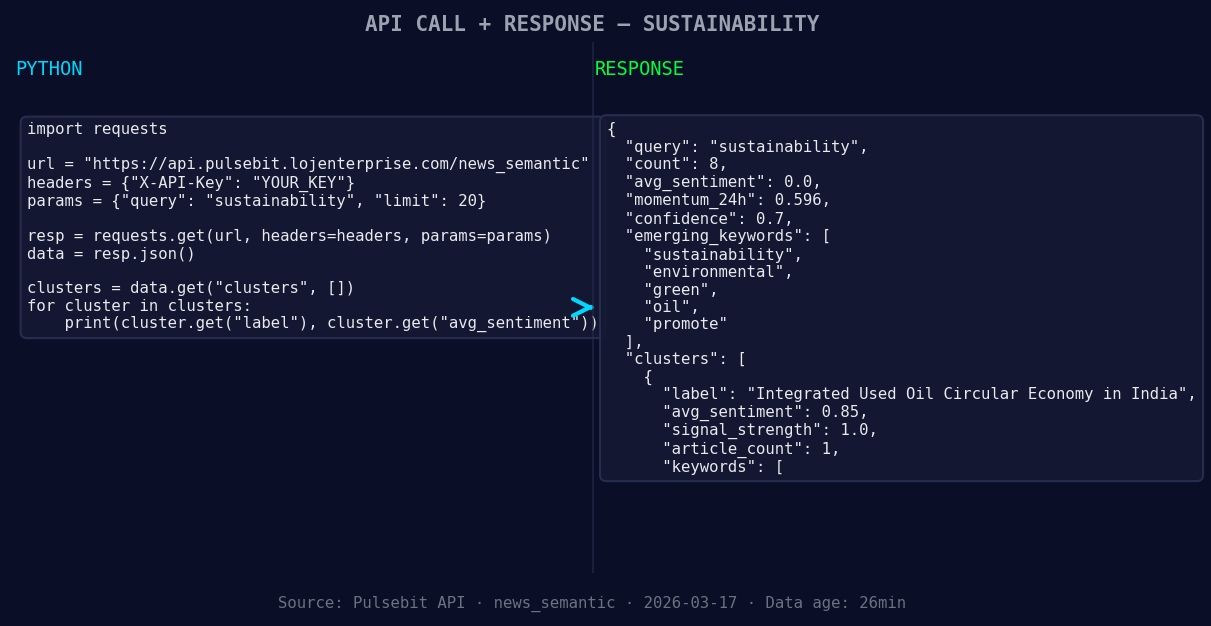
*Left: Python GET /news_semantic call for 'sustainability'. Right: returned JSON response structure (clusters: 3). Source: Pulsebit /news_semantic.*
# Make the API call to gather relevant articles
response = requests.get("https://api.pulsebit.com/articles", params=params)
articles = response.json()
print(articles)
Once we have the relevant articles, we need to score the narrative framing itself. This is where the meta-sentiment moment comes into play. We can run the clustered reason string through our sentiment analysis endpoint:
# Define the cluster reason string
cluster_reason = "Clustered by shared themes: oil, used, sustainability, indian, first."

# Make the API call to score the narrative
sentiment_response = requests.post("https://api.pulsebit.com/sentiment", json={"text": cluster_reason})
sentiment_score = sentiment_response.json()
print(sentiment_score)
With this code, we can effectively capture both the momentum and the narrative sentiment surrounding sustainability and the oil economy in India.
Now, let's talk about three specific build opportunities that arise from this pattern. First, you can set up a signal alert for when momentum spikes above +0.5 in the sustainability category using the geo filter to ensure you only receive relevant English-language articles. Second, use the meta-sentiment loop to create a scoring mechanism for narratives that combine traditional industries like oil with environmental themes, setting a threshold of 0.65 for sentiment strength. Lastly, build a dashboard that visualizes these forming themes, allowing you to contrast rising sustainability sentiment against traditional oil narratives, providing real-time insights into the evolving landscape.
For more details on how to implement these calls, check out our documentation at pulsebit.lojenterprise.com/docs. You can copy-paste these snippets and run them in under 10 minutes to start catching these critical shifts in sentiment. Don't let your models lag behind; leverage these insights to stay ahead in your analysis.


Top comments (0)