

Your Pipeline Is 26.0h Behind: Catching Immigration Sentiment Leads with Pulsebit
We just discovered something quite revealing: our pipeline shows a sentiment spike for immigration at +0.10, with momentum flat at +0.00. This spike is particularly striking as it coincides with a leading language output of 26.0 hours. The cluster story around this sentiment—“Rally on Immigration Concerns”—hints at an underlying narrative that we need to capture. If you’re not tuned in to these shifts, you might be missing out on essential sentiment trends that are forming right now.
When your model fails to integrate multilingual origin data or account for entity dominance, you’re leaving significant gaps in your insights. In this case, your pipeline is lagging by a full 26.0 hours on immigration sentiment, primarily driven by English-language articles. This delay can lead to missed opportunities or misguided strategies, especially in a fast-moving environment where immigration policy discussions can swing public sentiment dramatically.

English coverage led by 26.0 hours. Ro at T+26.0h. Confidence scores: English 0.85, Spanish 0.85, French 0.85 Source: Pulsebit /sentiment_by_lang.
Let’s dive into how we can catch this spike in sentiment using our API. First, we’ll set up a query to filter articles by language, focusing on English. Here’s how you can do it in Python:
import requests
# Set the API endpoint
url = 'https://api.pulsebit.com/v1/articles'
# Define the parameters for the query
params = {
'topic': 'immigration',
'lang': 'en',
'score': 0.100,
'confidence': 0.85,
'momentum': 0.00
}
# Make the API call
response = requests.get(url, params=params)
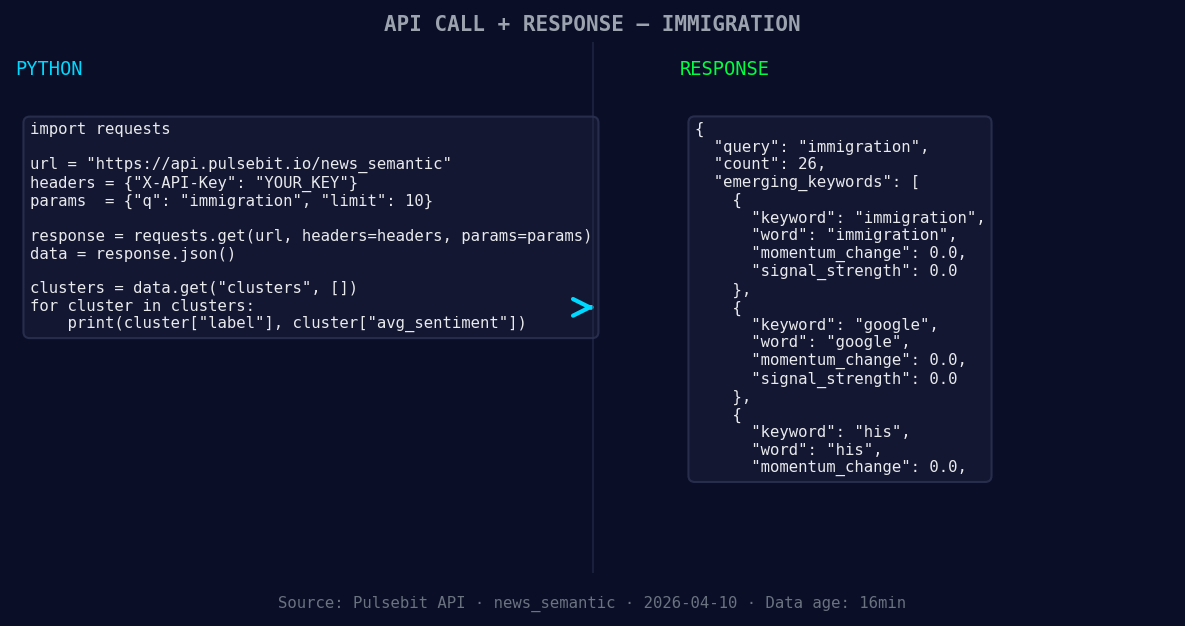
*Left: Python GET /news_semantic call for 'immigration'. Right: returned JSON response structure (clusters: 3). Source: Pulsebit /news_semantic.*
# Check if the request was successful
if response.status_code == 200:
data = response.json()
print("Data retrieved:", data)
else:
print("Failed to retrieve data:", response.status_code)
Next, we need to analyze the narrative framing around the cluster. We’ll run the reason string through our sentiment scoring endpoint to see how these themes are resonating. Here’s how you can implement that:
# Define the meta-sentiment input
meta_input = {
    'text': "Clustered by shared themes: h-1b, stamping, dates, opening, india."
}

# API call to score the narrative
meta_response = requests.post('https://api.pulsebit.com/v1/sentiment', json=meta_input)

# Check the response
if meta_response.status_code == 200:
    meta_data = meta_response.json()
    print("Meta sentiment data:", meta_data)
else:
    print("Failed to score meta sentiment:", meta_response.status_code)
With these two snippets, you can start catching sentiment shifts in real-time. Now, let’s consider three specific builds you can implement based on this data:
- Geographic Trend Analysis: Using the geographic filter, you can set a signal threshold for immigration sentiment in English-language articles. This allows you to monitor spikes in specific regions or demographics.

Geographic detection output for immigration. India leads with 20 articles and sentiment -0.04. Source: Pulsebit /news_recent geographic fields.
Meta-Sentiment Framing: Use the output from the meta-sentiment endpoint to refine your content strategy. By assessing how themes like "h-1b" or "stamping" are being perceived, you can adjust your messaging to align with current sentiment.
Comparative Analysis: Establish a baseline comparison using the main themes from the "Rally on Immigration Concerns". Track changes in sentiment over time against mainstream topics like "dates" or "stamping" to understand emerging narratives.
With these builds, you can ensure you're not just reacting but proactively engaging with the narratives shaping the conversation around immigration.
Get started with the documentation at pulsebit.lojenterprise.com/docs. You can copy-paste and run these snippets in under 10 minutes, bringing your pipeline up to speed on these crucial sentiment shifts.


Top comments (0)