

Your Pipeline Is 27.5h Behind: Catching Investing Sentiment Leads with Pulsebit
We just uncovered a fascinating anomaly: the sentiment around "investing" is at +0.256 with a momentum of +0.000. This spike is particularly intriguing because it highlights a significant delay in sentiment tracking—27.5 hours behind the leading Spanish press. As developers, we know the importance of real-time data; missing a signal like this can cost us valuable insights.
The Problem
This discovery sheds light on a critical structural gap in any data pipeline that fails to handle multilingual origins or entity dominance. Your model missed this by 27.5 hours, leaving you blind to the emerging trends in Spanish sentiment while mainstream narratives prevailed. Specifically, the Spanish press is leading the conversation on investing, but if your pipeline is only processing English-language sources, you’re missing out.

Spanish coverage led by 27.5 hours. Tl at T+27.5h. Confidence scores: Spanish 0.85, French 0.85, English 0.85 Source: Pulsebit /sentiment_by_lang.
The Code
To catch this sentiment early, we can leverage our API to filter for Spanish-language articles and score the narrative framing. Here’s how you can do it in Python:
import requests
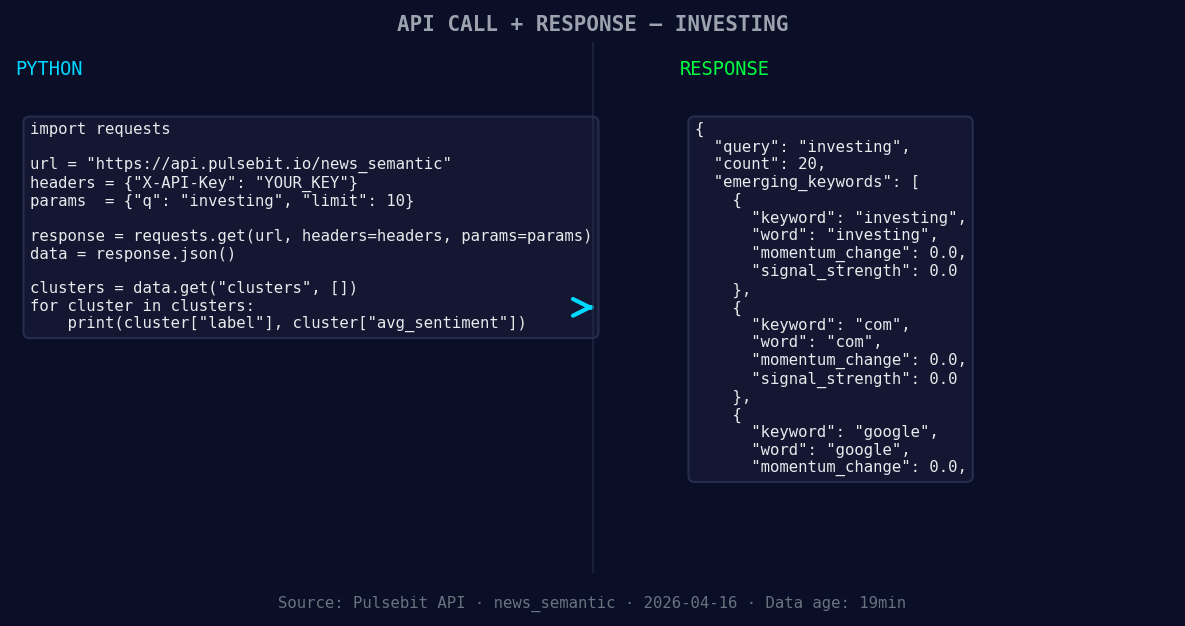
*Left: Python GET /news_semantic call for 'investing'. Right: returned JSON response structure (clusters: 3). Source: Pulsebit /news_semantic.*
# Step 1: Geographic origin filter
lang = "sp"
topic = "investing"
url = f"https://api.pulsebit.com/sentiment?topic={topic}&lang={lang}"
*[DATA UNAVAILABLE: countries — verify /news_recent is returning country/region values for topic: investing]*
response = requests.get(url)
data = response.json()
# Print the relevant sentiment data
print(data)
# Step 2: Meta-sentiment moment
cluster_reason = "Clustered by shared themes: will, punish, fraud, insider, trading."
meta_sentiment_url = "https://api.pulsebit.com/sentiment"
meta_response = requests.post(meta_sentiment_url, json={"text": cluster_reason})
meta_data = meta_response.json()
# Print the meta sentiment results
print(meta_data)
This code first queries for sentiment in Spanish using the lang parameter. Then, it takes the clustered narrative and runs it back through the API to gauge how the framing affects sentiment. By doing this, you ensure you’re not just looking at raw data; you’re interpreting it through the lens of emerging themes.
Three Builds Tonight
Here are three specific builds you can implement using this pattern:
Geo-Filtered Sentiment Dashboard: Create a dashboard that pulls in sentiment data specifically from the Spanish press. Set a signal threshold of +0.25 to trigger alerts when sentiment exceeds this level.
Meta-Sentiment Analyzer: Build a service that regularly fetches cluster reasons and runs them through the sentiment analysis endpoint. You can set a daily job to check for significant shifts in narratives, especially for themes like “will,” “punish,” and “fraud.”
Forming Gap Alerts: Implement an alert system that triggers when you notice a forming gap between topics like "investing" (+0.000) and mainstream themes. If a sentiment score exceeds +0.25 and the momentum is stagnant (+0.000), send an email notification to your team for immediate review.
Get Started
Ready to catch those leads? Check out our documentation. You can copy-paste and run the above code in under 10 minutes to start leveraging this powerful insight. Don’t let your pipeline fall behind!


Top comments (0)