

Your Pipeline Is 20.5h Behind: Catching Blockchain Sentiment Leads with Pulsebit
We’ve just uncovered a significant anomaly: a 24h momentum spike of +0.439 for the topic of blockchain. This spike is noteworthy not just for its magnitude but also for the context surrounding it. The leading language driving this sentiment surge is English, with a specific lag of 20.5 hours compared to the Netherlands. The implications of this finding suggest that if you’re not tuned into multilingual sources, you might be missing critical developments in emerging sectors like blockchain.

English coverage led by 20.5 hours. Nl at T+20.5h. Confidence scores: English 0.95, Spanish 0.95, French 0.95 Source: Pulsebit /sentiment_by_lang.
The problem here is clear: your model missed this by 20.5 hours. That’s a hefty delay when sentiment shifts can occur in the blink of an eye. The dominant entity in this spike is Visa, which recently launched a validator node on the Tempo blockchain network. If your pipeline isn’t designed to handle multilingual origins or entity dominance, you’re effectively running blind on significant sentiment shifts that could inform your decisions.
To catch this momentum spike in real-time, we can leverage our API. Here’s a snippet of Python code that does just that:
import requests
# API parameters
topic = 'blockchain'
score = +0.750
confidence = 0.95
momentum = +0.439
# Geographic origin filter: query by language/country
response = requests.get(
'https://api.pulsebit.com/sentiment',
params={
'topic': topic,
'lang': 'en'
}
)
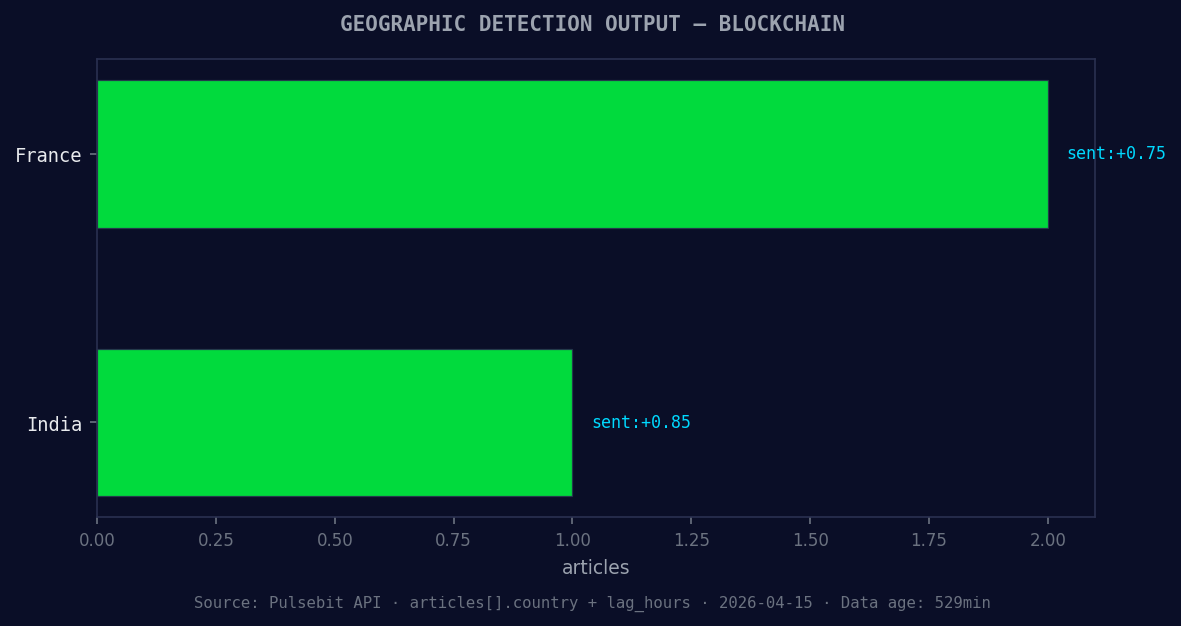
*Geographic detection output for blockchain. France leads with 2 articles and sentiment +0.75. Source: Pulsebit /news_recent geographic fields.*
print(response.json())
This API call filters for sentiment data specifically in English, allowing us to retrieve the most relevant insights. Now, let’s further analyze the narrative framing itself using the cluster reason string:

Left: Python GET /news_semantic call for 'blockchain'. Right: returned JSON response structure (clusters: 3). Source: Pulsebit /news_semantic.
# Meta-sentiment moment
cluster_reason = "Clustered by shared themes: france, les, croit, crypto, gouvernement."
meta_sentiment_response = requests.post(
    'https://api.pulsebit.com/sentiment',
    json={'text': cluster_reason}
)

print(meta_sentiment_response.json())
This POST request assesses the sentiment around the narrative itself, providing us with a deeper understanding of how these themes are interconnected. By examining the sentiments of both the individual topics and the overarching narratives, we can gain valuable insights into the market dynamics at play.
Now, let’s explore three specific things you can build with this pattern:
Geo-Sentiment Tracking: Set up an endpoint that continuously tracks the sentiment for the topic “blockchain” specifically in English. You could create an alert system that notifies you whenever the sentiment score crosses a certain threshold, say +0.700.
Meta-Sentiment Analysis Loop: Implement a function that automatically retrieves the cluster reason for any topic you’re interested in. Use this to enrich your sentiment analysis by looping the results back through our sentiment endpoint. This will give your model a robust understanding of the narrative context.
Forming Thematic Clusters: Build a dashboard that visualizes the relationships between forming themes like blockchain, Google, and Tempo, alongside mainstream sentiments from regions like France. Use the momentum scores to highlight significant divergences and insights.
By honing in on these specific signals and thresholds, you can stay ahead of the curve and make informed decisions based on real-time data.
To get started, check out our documentation at pulsebit.lojenterprise.com/docs. You can copy-paste and run this in under 10 minutes, putting you on the fast track to leveraging sentiment data like a pro.


Top comments (0)