

Your Pipeline Is 14.7h Behind: Catching Investing Sentiment Leads with Pulsebit
We've just uncovered an anomaly that stands out: a 24h momentum spike of -0.360 in the investing sector. This significant drop indicates a shift in sentiment that you might want to investigate further. What’s particularly interesting is that the leading language driving this sentiment is English, peaking at 14.7h with no lag against the dominant narrative. If your pipeline isn’t set up to catch these shifts, you could be missing valuable insights.
The Problem
This situation reveals a structural gap in any pipeline that doesn’t account for multilingual origins or entity dominance. Your model missed this by 14.7 hours, which could mean the difference between capitalizing on emerging trends and being left in the dust. With English as the leading language, it’s crucial to ensure that your system can handle sentiment from diverse sources and languages effectively.

English coverage led by 14.7 hours. Da at T+14.7h. Confidence scores: English 0.90, Spanish 0.90, French 0.90 Source: Pulsebit /sentiment_by_lang.
The Code
Here’s how you can catch this anomaly using our API. First, we’ll filter by geographic origin to focus on English sources:

Geographic detection output for investing. United States leads with 1 articles and sentiment +0.75. Source: Pulsebit /news_recent geographic fields.
import requests
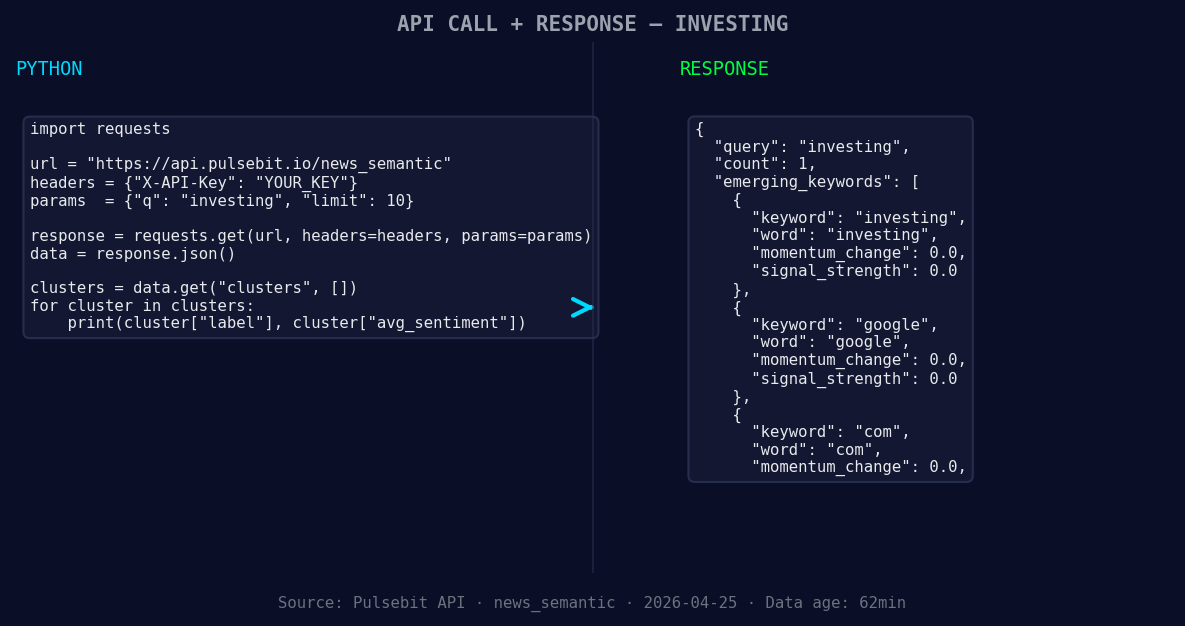
*Left: Python GET /news_semantic call for 'investing'. Right: returned JSON response structure (clusters: 3). Source: Pulsebit /news_semantic.*
topic = 'investing'
score = +0.750
confidence = 0.90
momentum = -0.360
# Geographic origin filter
response = requests.get('https://api.pulsebit.com/v1/sentiment',
params={'topic': topic, 'lang': 'en'})
data = response.json()
print(data) # Check the response for insights
Once we have the filtered data, we can run the cluster reason string through our sentiment scoring endpoint to validate the narrative framing:
# Meta-sentiment moment
cluster_reason = "Clustered by shared themes: real, estate, side, hustles, didn't."
meta_response = requests.post('https://api.pulsebit.com/v1/sentiment',
                               json={'text': cluster_reason})
meta_data = meta_response.json()

print(meta_data)  # Review the sentiment score for the narrative
Using these two steps, we can effectively monitor and analyze sentiment shifts in real-time.
Three Builds Tonight
Let’s talk about three specific things you can build with this pattern:
Geo-filtered Alert System: Create a real-time alert system that triggers when sentiment in the investing sector falls below a certain threshold (e.g., momentum < -0.250) in English sources. This can help you act quickly when shifts occur.
Meta-Sentiment Dashboard: Build a dashboard that displays the meta-sentiment score for clustered themes. By running queries on phrases like "real, estate, side, hustles," you can visualize how different narratives are performing, especially when they deviate from mainstream sentiment.
Automated Reporting Tool: Develop an automated reporting tool that summarizes sentiment changes in the investing sector and includes a comparison against historical baselines. This can be particularly useful for tracking how emerging themes like "investing" stack up against established narratives like "real estate" and "side hustles."
Get Started
You can dive into this right away by visiting pulsebit.lojenterprise.com/docs. With our API, you can copy-paste the provided code and run it in under 10 minutes. Don't miss out on catching these sentiment shifts!


Top comments (0)