

Your pipeline is running 23.1 hours behind on capturing sentiment related to climate change, with a sentiment score of +0.023 and momentum flat at +0.000. This anomaly should grab your attention, especially given the urgency of climate-related narratives. The current cluster focuses on the "Impact of Climate Change on Lung Health in South Africa," highlighting three articles that align around shared themes. If your model isn't tuned to catch these emerging stories, you risk missing insightful shifts in public sentiment.
The structural gap this reveals in your pipeline is significant. If your system doesn’t handle multilingual data effectively or doesn’t prioritize dominant entities, you could be missing critical insights by over 23 hours. In this case, the leading language was English, while the Italian narratives lagged behind. Your model missed this crucial shift in sentiment and context, leaving you with a stale view of the discourse around climate change.

English coverage led by 23.1 hours. Italian at T+23.1h. Confidence scores: English 0.85, French 0.85, Spanish 0.85 Source: Pulsebit /sentiment_by_lang.
Here’s how we can catch this anomaly using our API. First, we’ll set up a query to filter for articles in English that discuss climate change. The following code snippet demonstrates how to do this:
import requests
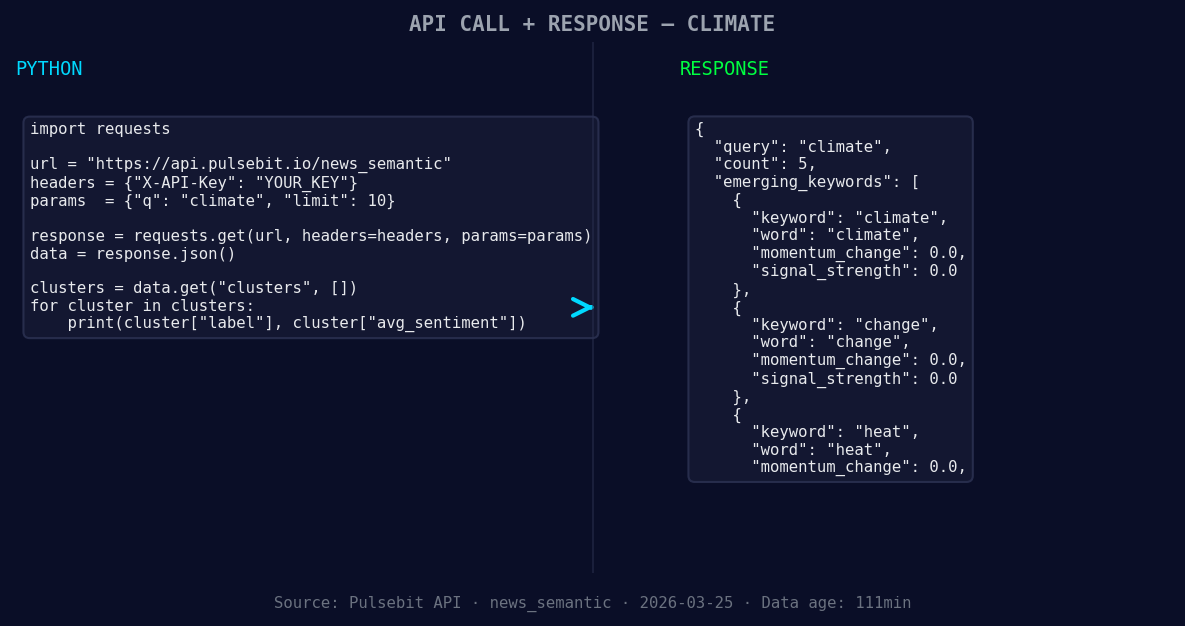
*Left: Python GET /news_semantic call for 'climate'. Right: returned JSON response structure (clusters: 3). Source: Pulsebit /news_semantic.*
url = "https://api.pulsebit.com/v1/articles"
params = {
"topic": "climate",
"lang": "en"
}
response = requests.get(url, params=params)
data = response.json()
Next, we’ll run the cluster reason string back through our sentiment analysis endpoint to score the narrative framing itself. The input string in this case will be "Clustered by shared themes: sustainability, advisory, committee, seeks, youth." Here’s how to implement that:
url_sentiment = "https://api.pulsebit.com/v1/sentiment"
payload = {
    "text": "Clustered by shared themes: sustainability, advisory, committee, seeks, youth."
}

response_sentiment = requests.post(url_sentiment, json=payload)
sentiment_data = response_sentiment.json()
With the above steps, you’ll not only retrieve relevant articles but also assess the framing of the narrative itself.
Now, let’s discuss three specific builds we can create based on this pattern. First, set a geo filter that focuses on the rising sentiment around “climate” and “change”. You can establish a threshold sentiment score (e.g., +0.02) to alert you when sentiment rises significantly in specific regions.
Second, leverage the meta-sentiment loop we just created to analyze how narratives cluster over time. Use the same clusters and their associated themes, like sustainability and advisory, to identify shifts in public interest.
Lastly, implement a dashboard that visually represents these insights. Use the sentiment scores and cluster narratives to create alerts for topics like “heat” and “climate” when they diverge from mainstream discussions around sustainability and advisory. This will allow you to stay ahead of the curve.
You can dive into our API and start experimenting right away. Visit pulsebit.lojenterprise.com/docs. With this setup, you should be able to copy-paste and run your code in under 10 minutes, gaining immediate insights into climate sentiment changes.

Geographic detection output for climate. Hong Kong leads with 2 articles and sentiment -0.35. Source: Pulsebit /news_recent geographic fields.


Top comments (0)