

Your 24h momentum spike of +0.462 in the entertainment sector is a noteworthy signal we just discovered. This anomaly suggests that something significant is brewing, particularly related to the news cluster "Taiwan’s Taroko Sports Expands to San Antonio." With the leading language being English, which is 17.9 hours ahead, it indicates that there's a potential gap in our awareness of how this narrative is evolving. The implications for your pipeline are clear: if you're not capturing multilingual origins or entity dominance, you might be missing critical developments in real-time.

English coverage led by 17.9 hours. Nl at T+17.9h. Confidence scores: English 0.85, Spanish 0.85, French 0.85 Source: Pulsebit /sentiment_by_lang.
This gap could be detrimental. Your model missed a crucial update by 17.9 hours. The leading language, English, is where the momentum is currently rising, but if your system isn't set up to handle this language efficiently, you'll be left behind. You won’t just miss out on entertainment sentiment shifts; you'll miss the chance to adapt your strategies and insights based on emerging narratives like the one involving Taroko Sports in San Antonio.
To catch this momentum spike, we can leverage our API to make a targeted call. The following Python code demonstrates how we can query the sentiment data specifically for the entertainment topic. Here, we filter by language ("en") and set the parameters accordingly:
import requests
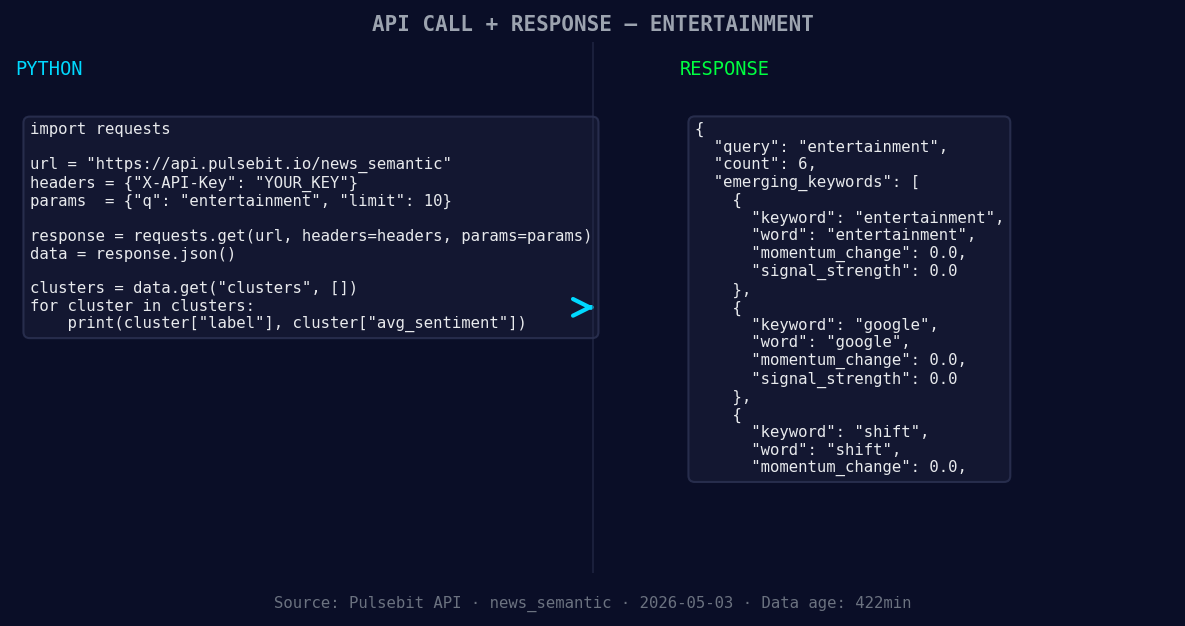
*Left: Python GET /news_semantic call for 'entertainment'. Right: returned JSON response structure (clusters: 3). Source: Pulsebit /news_semantic.*
url = "https://api.pulsebit.com/v1/sentiment"
params = {
"topic": "entertainment",
"lang": "en"
}
response = requests.get(url, params=params)
data = response.json()
print(data)
Next, we run the cluster reason string through our sentiment scoring endpoint to gauge its narrative framing. This is crucial for understanding how the conversation is being shaped. The input string, "Clustered by shared themes: san, antonio, taroko, sports, bringing." will be analyzed as follows:
url_sentiment = "https://api.pulsebit.com/v1/sentiment"

meta_sentiment_input = {
    "text": "Clustered by shared themes: san, antonio, taroko, sports, bringing."
}

meta_response = requests.post(url_sentiment, json=meta_sentiment_input)
meta_data = meta_response.json()
print(meta_data)
This loop not only provides insights into the underlying sentiment but also helps us refine our understanding of the narrative's impact on the identified themes.
With the data we have, here are three specific builds we can implement leveraging this momentum spike:
Geo-Filtered Alerts: Create a real-time alert system that triggers when sentiment momentum for the entertainment topic exceeds a threshold (e.g., +0.5) for English-language articles originating from Texas. This can be a vital signal for local businesses or events.
Cluster Sentiment Scoring: Regularly run the cluster reason strings through our sentiment endpoint to develop a meta-sentiment score for emerging themes. Set a threshold of +0.5 to capture significant shifts in narrative framing, ensuring you're always aware of the evolving context.
Comparative Analysis Tool: Build a tool that compares current sentiment scores against historical baselines, particularly for high-momentum topics like entertainment. This could track changes in key phrases like "san," "antonio," and "taroko" to reveal how narratives shift over time.
Getting started is straightforward. Check out our documentation at pulsebit.lojenterprise.com/docs. You can copy-paste the provided code snippets and run them in under 10 minutes to start catching those critical momentum signals.

Geographic detection output for entertainment. Hong Kong leads with 3 articles and sentiment +0.32. Source: Pulsebit /news_recent geographic fields.


Top comments (0)