

Your pipeline might be 15.4 hours behind. We just uncovered a specific anomaly: a 24-hour momentum spike of -0.850 related to food sentiment. This spike highlights a critical gap in your data processing capabilities, particularly if you’re not equipped to handle multilingual origins or the dominance of certain entities. As we dive deeper, we’ll explore how the Spanish press led this sentiment shift, emphasizing the urgency for developers like you to rethink your pipeline’s efficiency and responsiveness.

Spanish coverage led by 15.4 hours. Af at T+15.4h. Confidence scores: Spanish 0.85, English 0.85, French 0.85 Source: Pulsebit /sentiment_by_lang.
Imagine your model missing a crucial sentiment shift by 15.4 hours. The leading language here was Spanish, with the dominant topic revolving around the Hyderabad police arresting 64 individuals and seizing 15 tonnes of adulterated food products. If your system isn’t designed to accommodate this multilingual context, you could easily overlook significant market signals. The lag in your response could lead to missed opportunities or misguided strategies. We need to address this gap to ensure that we’re capturing sentiment accurately and in real-time.
To catch this specific anomaly, we can leverage our API. Here’s a Python snippet to help you get started. First, we’ll filter the data by the geographic origin using the language parameter to focus on Spanish content.
import requests
# Define parameters for the API call
topic = 'food'
momentum = -0.850
score = +0.344
confidence = 0.85
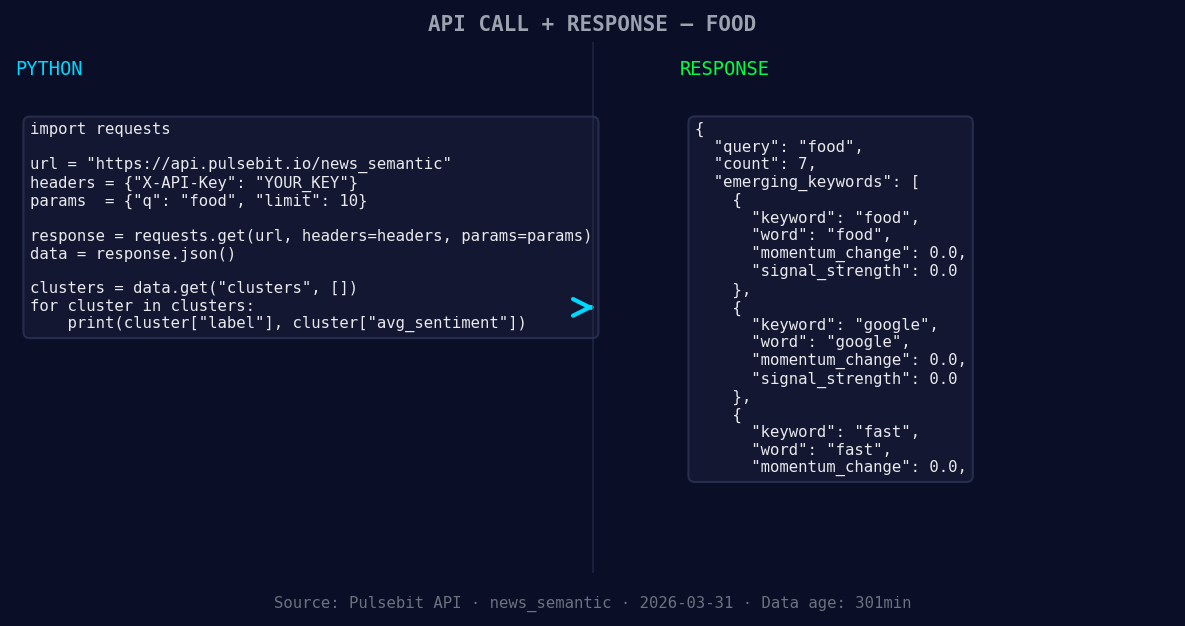
*Left: Python GET /news_semantic call for 'food'. Right: returned JSON response structure (clusters: 3). Source: Pulsebit /news_semantic.*
# Geographic origin filter
response = requests.get(
"https://api.pulsebit.com/v1/sentiment",
params={
"topic": topic,
"lang": "sp", # Spanish language filter
"momentum": momentum
}
)
# Check the response
if response.status_code == 200:
print("Filtered Response:", response.json())
else:
print("Error:", response.status_code)
Next, to enhance our understanding of the narrative framing, we can run the cluster reason string through our sentiment scoring endpoint. This will help us assess the themes at play, adding a meta-sentiment layer to our analysis.
# Meta-sentiment moment
cluster_reason = "Clustered by shared themes: hyderabad, police, tonnes, adulterated, food."
meta_response = requests.post(
    "https://api.pulsebit.com/v1/sentiment",
    json={"text": cluster_reason}
)

# Check the response
if meta_response.status_code == 200:
    print("Meta-Sentiment Response:", meta_response.json())
else:
    print("Error:", meta_response.status_code)
By integrating these two key aspects—geographic filtering and meta-sentiment analysis—you can build a more robust pipeline that captures sentiment shifts effectively. Here are three specific builds you can implement based on this anomaly:

Geographic detection output for food. India leads with 5 articles and sentiment +0.49. Source: Pulsebit /news_recent geographic fields.
Geographic Filter for Food Sentiment: Use the Spanish language filter with a threshold for sentiment scores above +0.344. This will allow you to catch emerging trends in regions where Spanish is predominant, helping you stay ahead of critical developments.
Meta-Sentiment Analysis Loop: Implement a process that captures and scores narrative framing based on keyword clusters. This will provide insights into whether the framing is positive or negative, allowing you to adjust your strategies accordingly.
Formation Tracking: Monitor the forming themes like food (+0.00), google (+0.00), and fast (+0.00) against mainstream narratives involving Hyderabad, police, and tonnes. Set alerts for any significant deviations from these clusters, ensuring you're always updated on potential sentiment shifts.
Ready to dive in? Check our documentation at pulsebit.lojenterprise.com/docs. With just a few lines of code, you can implement this in under 10 minutes and start capturing sentiment shifts before your competitors even notice.


Top comments (0)