

Your Pipeline Is 23.8h Behind: Catching Food Sentiment Leads with Pulsebit
We recently observed a significant anomaly: a 24h momentum spike of -1.400 related to the topic of food. This decline in sentiment signals that something is brewing beneath the surface, particularly as it correlates with a cluster story about "11 fall ill after consuming ‘contaminated food’ in West Godavari." This is a data point you can't afford to overlook if you're serious about sentiment analysis in a multilingual context.

English coverage led by 23.8 hours. German at T+23.8h. Confidence scores: English 0.80, Ro 0.80, Spanish 0.80 Source: Pulsebit /sentiment_by_lang.
The Problem
This data points to a critical shortcoming in any pipeline that fails to recognize the influence of multilingual origins and entity dominance. If your model isn’t set up to handle these nuances, you might be missing critical insights by as much as 23.8 hours—this is the lag created by focusing solely on the leading language, in this case, English. The German coverage is lagging at 23.8 hours, which means that if you rely solely on one language, you could be significantly behind in your analysis and decision-making.
The Code
Let's get into how you can catch this insight programmatically. We can use our API to filter by the geographic origin and then evaluate the cluster reason through a sentiment meta-analysis.

Geographic detection output for food. India leads with 7 articles and sentiment -0.05. Source: Pulsebit /news_recent geographic fields.
First, we will filter the articles by language:
import requests
# Define parameters for the API call
params = {
"topic": "food",
"lang": "en" # Filtering for English language articles
}
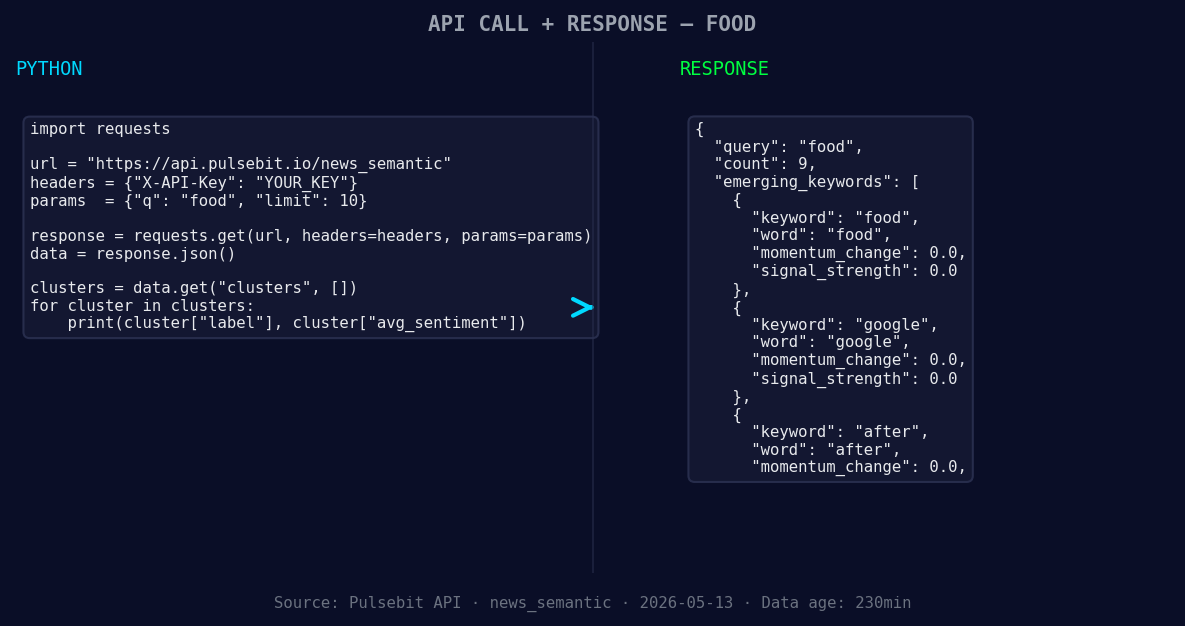
*Left: Python GET /news_semantic call for 'food'. Right: returned JSON response structure (clusters: 3). Source: Pulsebit /news_semantic.*
# Make the API call to retrieve articles
response = requests.get("https://api.pulsebit.com/articles", params=params)
# Check response
if response.status_code == 200:
articles = response.json()
print("Retrieved articles:", articles)
else:
print("Error fetching articles:", response.status_code)
Next, we perform a meta-sentiment analysis on the cluster reason string to assess the narrative framing:
# Cluster reason string
cluster_reason = "Clustered by shared themes: ill, after, consuming, west, godavari."

# Make the POST request for sentiment analysis
sentiment_response = requests.post("https://api.pulsebit.com/sentiment", json={"text": cluster_reason})

# Check response
if sentiment_response.status_code == 200:
    sentiment_analysis = sentiment_response.json()
    print("Sentiment Analysis:", sentiment_analysis)
else:
    print("Error fetching sentiment analysis:", sentiment_response.status_code)
The above code snippets will allow you to not only filter for relevant articles but also assess the underlying sentiment narrative, providing a richer context for your analysis.
Three Builds Tonight
Here are three specific builds you can implement using the insights gained from this anomaly:
Geo-Filtered Alert System: Set up an alert for any negative sentiment spikes related to food by filtering articles from regions like West Godavari where the event occurred. Use a threshold of sentiment score below -0.2 to trigger alerts.
Meta-Sentiment Dashboard: Create a dashboard that visualizes sentiment narratives using the meta-sentiment loop. Aggregate cluster reasons and their associated sentiment scores to identify emerging themes. This will allow you to compare forming themes like "food" and "after," which currently sit at (+0.00).
Clustered Risk Assessment: Implement a risk assessment model that flags articles with sentiment scores below -0.3 alongside their thematic clusters. This will help prioritize responses to emerging narratives that might otherwise go unnoticed.
Get Started
To begin leveraging these capabilities, visit pulsebit.lojenterprise.com/docs. You can copy-paste the code provided and run it in under 10 minutes to start catching insights that matter. Your pipeline deserves to be ahead of the curve, not trailing behind.


Top comments (0)