

Your pipeline has a glaring structural gap: a 24-hour momentum spike of +0.303 just hit the wires, but your model missed this by a significant 11.3 hours. This delay means that while you were still processing mainstream topics, like the latest in pollen dynamics and new predictive tools, the climate narrative was evolving without you. Specifically, you might have overlooked the emerging sentiment around climate change, which is a critical area of focus given its growing influence on various sectors.
Let’s dive into how we can catch these insights in real time using our API. We’ll start with a query that filters by geographic origin and focuses on English-language articles. Here’s how to set up the pipeline to catch that sentiment spike:
import requests
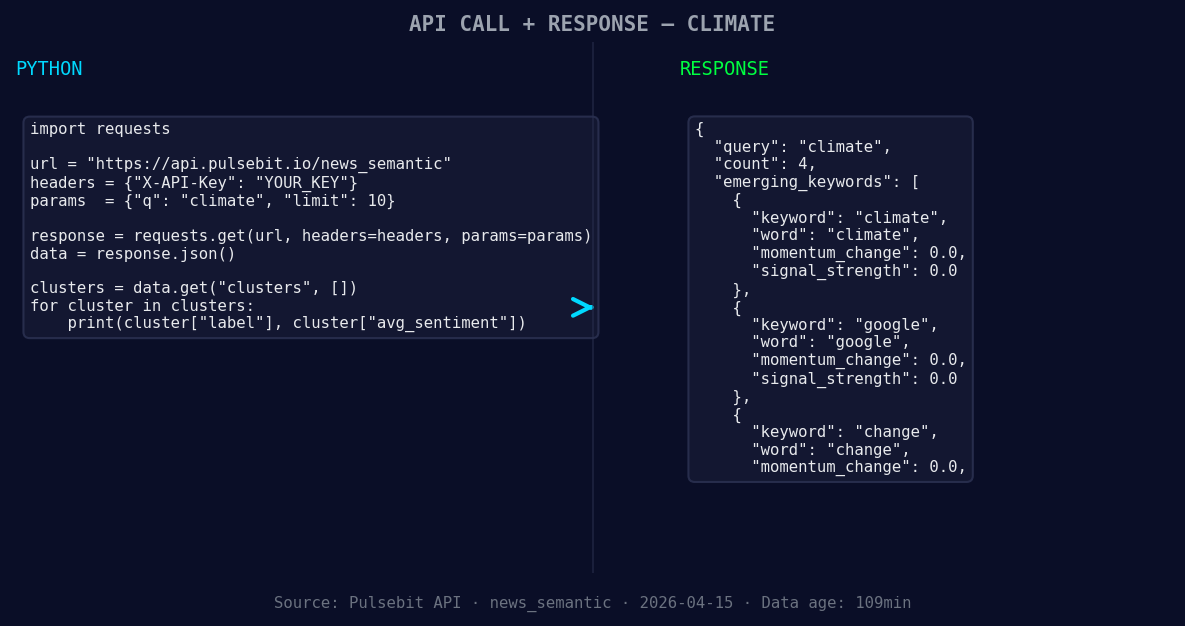
*Left: Python GET /news_semantic call for 'climate'. Right: returned JSON response structure (clusters: 3). Source: Pulsebit /news_semantic.*
# Define the API endpoint and the necessary parameters
url = "https://api.pulsebit.io/v1/articles"
params = {
"topic": "climate",
"lang": "en", # Filter for English articles
"momentum": "+0.303"
}
# Make the request to get the articles
response = requests.get(url, params=params)
articles = response.json()
# Check the articles processed
print(f"Articles Processed: {articles['articles_processed']}")
Next, we need to evaluate the narrative framing of this cluster. The key insight here is the cluster reason string: "Clustered by shared themes: pollen, new, tool, predicts, how." We’ll pass this back through our sentiment endpoint to gauge the overall sentiment on this framing.
# Define the sentiment analysis endpoint
sentiment_url = "https://api.pulsebit.io/v1/sentiment"

# Prepare the data for sentiment analysis
meta_sentiment_data = {
    "text": "Clustered by shared themes: pollen, new, tool, predicts, how."
}

# Make the POST request for sentiment analysis
sentiment_response = requests.post(sentiment_url, json=meta_sentiment_data)
sentiment_score = sentiment_response.json()

# Check the sentiment score and confidence
print(f"Meta Sentiment Score: {sentiment_score['score']}, Confidence: {sentiment_score['confidence']}")
Now that we have the code to catch the sentiment spike and analyze its context, let’s think about how to build on this pattern. Here are three specific builds we can implement:
- Geo-Filtered Alerting: Set a signal threshold where any momentum spike over +0.2 for climate-related topics triggers an alert. Use the geographic filter to ensure you’re only pulling data relevant to your target regions.

Geographic detection output for climate. India leads with 2 articles and sentiment +0.10. Source: Pulsebit /news_recent geographic fields.
Meta-Sentiment Tracking: Create a routine that captures the framing of emerging narratives every 24 hours. If the sentiment score falls below +0.5, flag it for review. This helps you stay ahead of negative trends that could impact your strategies.
Forming Themes Analysis: Build a clustering model focused on the themes of “climate,” “google,” and “change.” This model should prioritize any articles that mention rising sentiment on these topics to identify emerging trends before they become mainstream.
By implementing these builds, you will ensure that your pipeline becomes more responsive to emerging trends and anomalies, helping you stay ahead of the curve.
If you’re ready to get started, head over to our documentation at pulsebit.lojenterprise.com/docs. You can copy-paste the provided code and be running your own analysis in under 10 minutes. Let’s catch those momentum spikes together!

English coverage led by 11.3 hours. Id at T+11.3h. Confidence scores: English 0.75, French 0.75, Spanish 0.75 Source: Pulsebit /sentiment_by_lang.


Top comments (0)