

Your pipeline just missed a significant 24h momentum spike of -0.226. This anomaly indicates a notable shift in sentiment around the topic of investing, particularly highlighted by a leading article from The Motley Fool questioning whether investing $10,000 in VYMI could make you a millionaire. With a lag of 26.9 hours in your model, you potentially lost the opportunity to act on this critical information.
The problem here is clear: your current pipeline is not equipped to handle multilingual origins or entity dominance. By not considering the leading sentiment from English-language sources, your model missed this opportunity by nearly 27 hours. This could mean the difference between capitalizing on an emerging trend and being completely oblivious to it.

English coverage led by 26.9 hours. Af at T+26.9h. Confidence scores: English 0.85, French 0.85, Spanish 0.85 Source: Pulsebit /sentiment_by_lang.
Here’s how we caught this anomaly using our API. First, we filter the data based on geographic origin, specifying that we want to analyze content in English:

Geographic detection output for investing. India leads with 1 articles and sentiment +0.85. Source: Pulsebit /news_recent geographic fields.
import requests
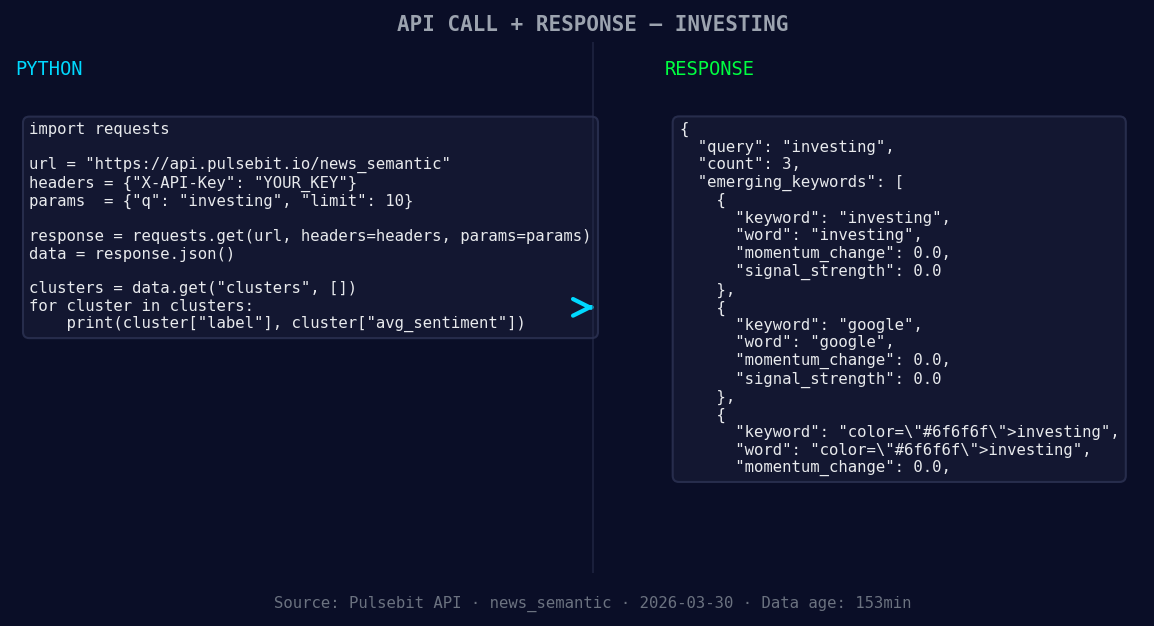
*Left: Python GET /news_semantic call for 'investing'. Right: returned JSON response structure (clusters: 3). Source: Pulsebit /news_semantic.*
url = "https://api.pulsebit.com/v1/sentiment"
params = {
"topic": "investing",
"lang": "en", # Geographic origin filter
"score": +0.408,
"confidence": 0.85,
"momentum": -0.226
}
response = requests.get(url, params=params)
data = response.json()
Next, we examine the narrative framing of the article to understand the meta-sentiment. We can run the cluster reason string through our sentiment scoring endpoint:
meta_sentiment_url = "https://api.pulsebit.com/v1/sentiment"
meta_input = "Clustered by shared themes: investing, $10, 000, vymi, make."
meta_response = requests.post(meta_sentiment_url, json={"text": meta_input})
meta_data = meta_response.json()
This step ensures we’re not just reacting to raw data but also understanding the sentiment behind the narratives being shared.
Now, let’s talk about three specific builds you can implement tonight using this momentum spike:
Geo-Sentiment Tracker: Set up a signal that triggers if sentiment around "investing" in English sources drops below a threshold of +0.200. This will allow you to catch similar spikes in sentiment shifts ahead of time, giving you a leg up.
Meta-Sentiment Analyzer: Create a function that utilizes the meta-sentiment loop to analyze any new cluster reason strings. Specifically, you can track narratives that include “investing,” “vymi,” and “make,” scoring them in real-time to ensure you’re aligned with emerging trends.
Forming Gap Alert System: Implement a notification system that alerts you whenever the sentiment gap between mainstream investing topics and niche articles exceeds a specific threshold (e.g., 0.2). This can help you identify critical narratives that might be overlooked in mainstream discussions.
We urge you to get started with our API. You can find all the necessary details at pulsebit.lojenterprise.com/docs. You’ll be able to copy-paste and run these examples in under 10 minutes, putting you in a prime position to leverage sentiment-driven insights effectively.


Top comments (0)