

Your pipeline has just missed a crucial 24h momentum spike of -0.175 in the sentiment around machine learning. This anomaly highlights a significant shift in discourse, specifically led by the Spanish press, which has a lag of just 0.0 hours while capturing the sentiment. If your model is not equipped to handle multilingual data or effectively recognize entity dominance, it likely missed this key insight by over 28.6 hours. That’s a substantial gap when it comes to staying ahead in sentiment analysis.

Spanish coverage led by 28.6 hours. Tl at T+28.6h. Confidence scores: Spanish 0.95, English 0.95, French 0.95 Source: Pulsebit /sentiment_by_lang.
The structural gap here is clear: without the ability to account for diverse linguistic sources and the dominant narratives within them, your model is essentially blind to emerging trends. You could be sitting on a wealth of relevant information, but if your pipeline isn't prepared to adapt to these nuances, you're left trailing behind. In our case, while the Spanish discourse on machine learning is thriving, your existing system may not have picked up on it in time to leverage these insights effectively.
Here’s how we can catch such valuable insights in real-time using our API. We’re going to filter by language to capture sentiment from Spanish articles and then assess the narrative framing of the clustered themes.
import requests
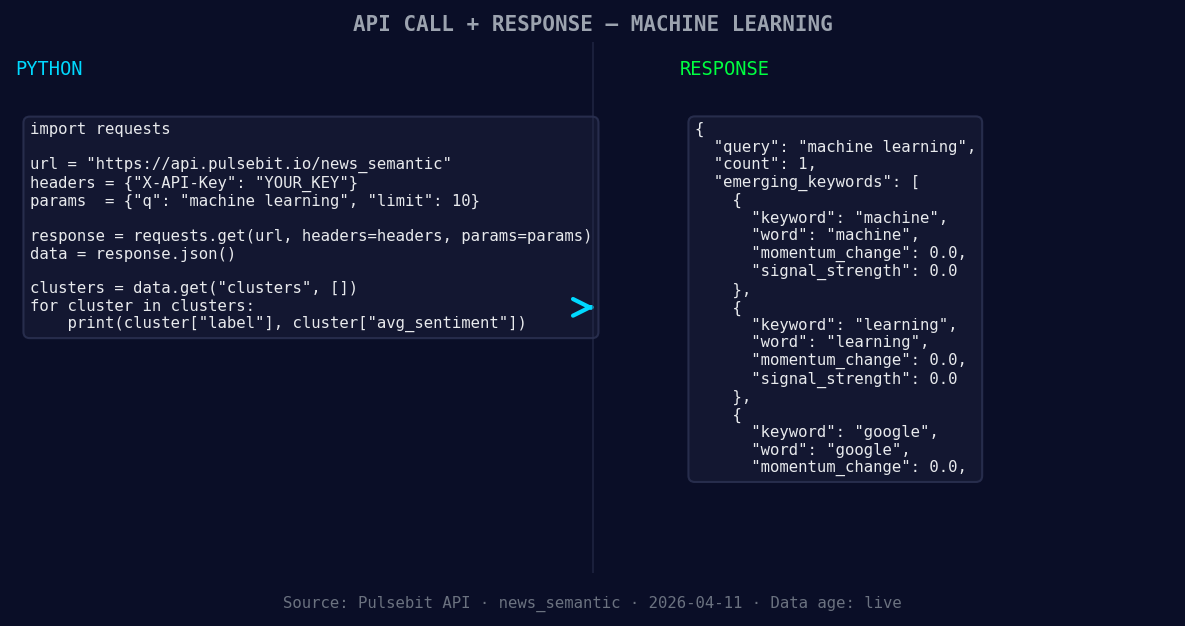
*Left: Python GET /news_semantic call for 'machine learning'. Right: returned JSON response structure (clusters: 3). Source: Pulsebit /news_semantic.*
# Step 1: Geographic origin filter
url = "https://api.pulsebit.com/sentiment"
params = {
"topic": "machine learning",
"lang": "sp", # Filtering to Spanish
"score": +0.517,
"confidence": 0.95,
"momentum": -0.175
}
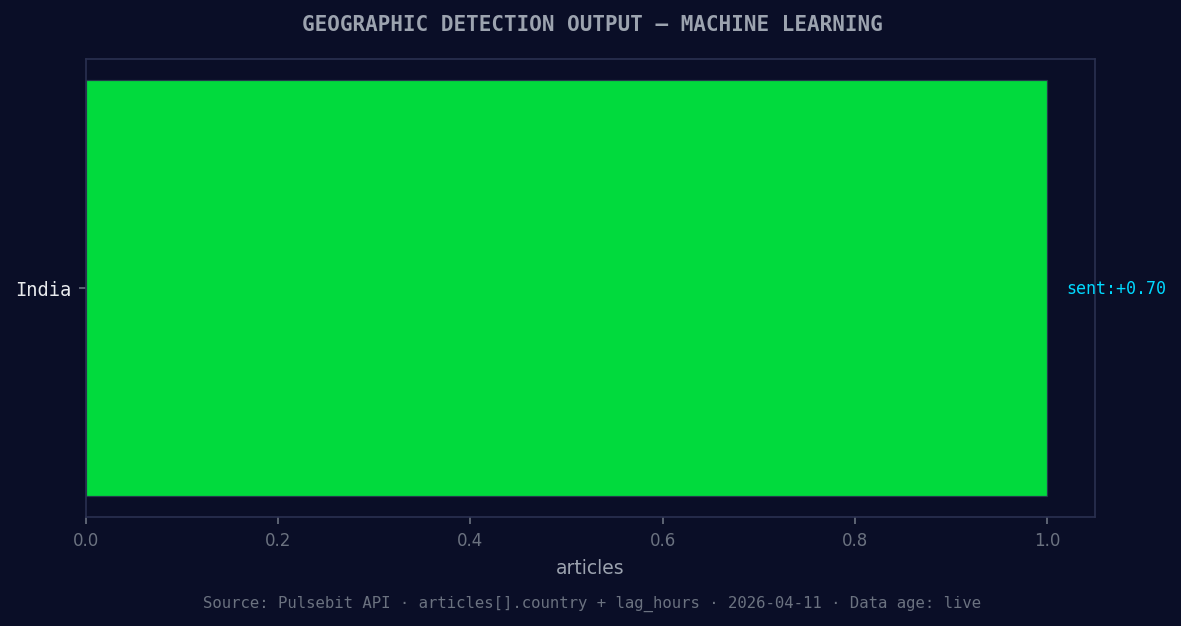
*Geographic detection output for machine learning. India leads with 1 articles and sentiment +0.70. Source: Pulsebit /news_recent geographic fields.*
response = requests.get(url, params=params)
data = response.json()
print(data)
# Step 2: Meta-sentiment moment
meta_sentiment_input = "Clustered by shared themes: simple, baseline, forecasting, machine, learning."
meta_response = requests.post(url, json={"input": meta_sentiment_input})
meta_data = meta_response.json()
print(meta_data)
In this code, we first filter articles about "machine learning" that are in Spanish, capturing the sentiment score and confidence level. Next, we evaluate the narrative framing by running our cluster reason string through another sentiment scoring request. This two-step approach can drastically improve our understanding of sentiment shifts across different languages, allowing us to act on insights that may otherwise go unnoticed.
Now, let’s build three specific applications based on this pattern:
Spanish Language Alerts: Set up a monitoring system that triggers an alert when the sentiment score for "machine learning" hits a specific threshold (e.g., > +0.6) in Spanish articles. Use the geo filter to ensure you’re only capturing relevant signals.
Meta-Sentiment Analysis Loop: Create a function that continuously assesses the narrative framing of clustered themes. For example, if the themes "machine," "learning," and "google" are gaining traction, run the narrative string through our sentiment endpoint to tweak your models accordingly.
Dynamic Content Updates: Develop a dashboard that visualizes sentiment changes in real-time, specifically focusing on burgeoning themes like "machine" (+0.00) and "learning" (+0.00). This will allow your team to respond proactively to sentiment shifts and adjust strategies instantly.
By integrating these features, you can bridge the gap that left your pipeline lagging behind. We’ve provided you with the foundational code and insights to get started—it's time to enhance your sentiment analysis capabilities.
For more details, check out our documentation: pulsebit.lojenterprise.com/docs. You can copy-paste this code and run it in under 10 minutes to start capturing those crucial insights right away.


Top comments (0)