

Your Pipeline Is 13.5h Behind: Catching Tech Sentiment Leads with Pulsebit
We just uncovered a striking anomaly: a 24-hour momentum spike of +1.050 in the tech sector. This spike is led by Spanish press coverage, with a 13.5-hour lead time over English sources. This is a clear signal that something significant is happening in the biotech landscape, and if your pipeline isn’t equipped to handle multilingual data or entity dominance, you might be missing critical insights.

Spanish coverage led by 13.5 hours. Et at T+13.5h. Confidence scores: Spanish 0.90, English 0.90, French 0.90 Source: Pulsebit /sentiment_by_lang.
Imagine your model is lagging by 13.5 hours, entirely missing out on the buzz generated by articles like "Biotech firm Odyssey targets $810 million valuation in US IPO." With the leading language being Spanish, your system could overlook vital trends if it’s only tuned for English data. This is a real problem if you’re trying to capture sentiment and momentum in a fast-evolving landscape.
To catch this momentum spike, we can leverage our API effectively. Here's how you can set it up in Python:
import requests
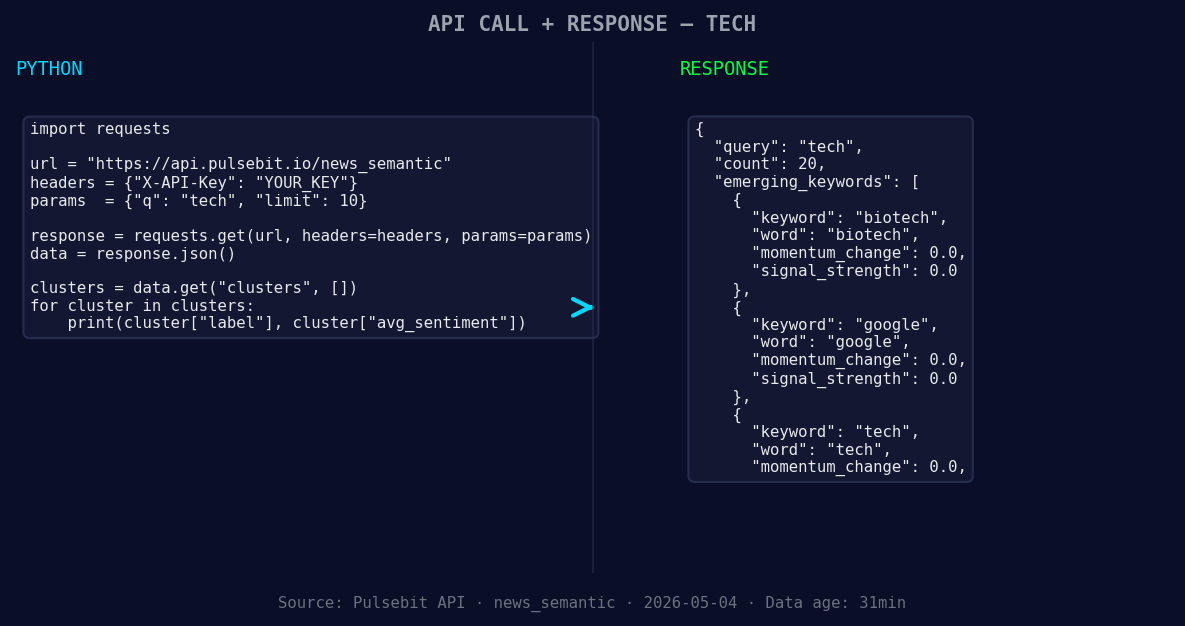
*Left: Python GET /news_semantic call for 'tech'. Right: returned JSON response structure (clusters: 3). Source: Pulsebit /news_semantic.*
# Step 1: Geographic origin filter
url = "https://api.pulsebit.com/v1/sentiment"
params = {
"topic": "tech",
"lang": "sp",
"score": +0.543,
"confidence": 0.90,
"momentum": +1.050
}
response = requests.get(url, params=params)
data = response.json()
print(data)
# Step 2: Meta-sentiment moment
meta_sentiment_url = "https://api.pulsebit.com/v1/sentiment"
meta_input = "Clustered by shared themes: edge, warfare, defence, rajnath, singh."
meta_response = requests.post(meta_sentiment_url, json={"input": meta_input})
meta_data = meta_response.json()
print(meta_data)
In the code above, we first filter for Spanish-language articles related to tech. The parameters include a score of +0.543 and a momentum of +1.050, allowing us to pinpoint emerging narratives. Then, we run the narrative framing through our sentiment analysis endpoint to gauge the overall sentiment surrounding the cluster themes.
With this discovery, we can explore three actionable builds:
- Geographic Filter for Biotech Trends: Create a live dashboard that tracks Spanish-language articles on biotech. Set a signal threshold of +1.000 momentum to alert you when significant shifts occur, ensuring you’re always several steps ahead.

Geographic detection output for tech. India leads with 3 articles and sentiment +0.77. Source: Pulsebit /news_recent geographic fields.
Meta-Sentiment Analyzer: Implement a function that runs sentiment analysis on clusters of themes every hour. For example, monitor narratives around "edge, warfare, defence" with a confidence threshold of 0.85 to evaluate how these themes resonate across different entities.
Real-time Monitoring of Google and Tech: Set up a comparative pipeline that analyzes sentiment for Google and other tech companies versus mainstream narratives. Use a signal threshold of +0.500 and a lag filter of 1 hour to catch emerging stories before they break into the mainstream.
You can start building this workflow in just a few minutes. Check out our documentation at pulsebit.lojenterprise.com/docs to get your code running. With these insights, you’ll be able to fine-tune your sentiment analysis and catch leads before your competition does.


Top comments (0)