

Your pipeline just missed a critical anomaly: a 24h momentum spike of +0.600. This isn't just a number; it's a signal that the crypto landscape is shifting dramatically, led by English press coverage that peaked at 24.5 hours after the shift. With the sentiment cluster pointing to a rush of activity around hedging as Bitcoin dropped below $80,000, we see a clear indication that the dynamics in play are significant. If your model isn't set up to capture these nuances, you're effectively 24.5 hours behind the curve.
This gap highlights a fundamental issue in sentiment pipelines that don't account for multilingual origin or the dominance of specific entities. You might be processing data, but if your model relies solely on aggregated outputs without considering the original language or context, you’re likely missing critical signals. In this case, the English press was 24.5 hours ahead, but your model missed this by failing to filter for dominant narratives and languages, leaving you with stale insights.

English coverage led by 24.5 hours. Sv at T+24.5h. Confidence scores: English 0.85, Spanish 0.85, French 0.85 Source: Pulsebit /sentiment_by_lang.
Here’s a quick way to catch this momentum using our API. First, let’s filter by language — specifically, English. We’ll use the following code snippet to query for the relevant crypto sentiment:
import requests
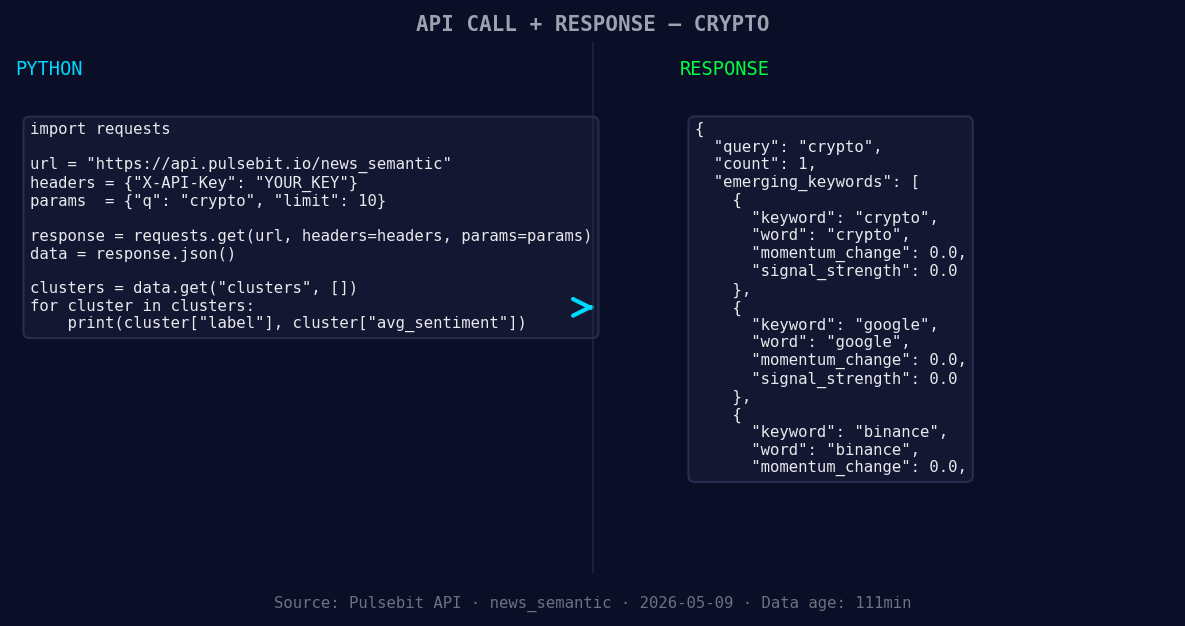
*Left: Python GET /news_semantic call for 'crypto'. Right: returned JSON response structure (clusters: 3). Source: Pulsebit /news_semantic.*
url = "https://api.pulsebit.com/v1/sentiment"
params = {
"topic": "crypto",
"lang": "en",
"score": +0.203,
"confidence": 0.85,
"momentum": +0.600
}
response = requests.get(url, params=params)
data = response.json()
print(data)
Next, we need to run the cluster reason string through our sentiment endpoint to further understand the narrative framing. This is where we can extract deeper insights from how the sentiment is clustered:
cluster_reason = "Clustered by shared themes: crypto, traders, rush, hedge, after."
sentiment_response = requests.post(url, json={"text": cluster_reason})
sentiment_data = sentiment_response.json()
print(sentiment_data)
These two pieces of code will provide a robust framework for understanding how sentiment shifts in the crypto space can impact your strategies and decisions.
Now, let's consider three specific builds you can implement with this new understanding:
- Geo-Filtered Alert System: Set up a system that triggers alerts when sentiment momentum for "crypto" exceeds a threshold (e.g., +0.600) specifically in English-speaking regions. This could be implemented by revisiting the geographical filter we just discussed.

Geographic detection output for crypto. India leads with 1 articles and sentiment +0.85. Source: Pulsebit /news_recent geographic fields.
Meta-Sentiment Dashboard: Create a dashboard that visualizes sentiment scores alongside the meta-sentiment scores derived from the cluster reason. This way, you can immediately see how narratives evolve as the market reacts, allowing for quicker, more informed decisions.
Anomaly Detection Pipeline: Implement an automated pipeline that continually monitors for sentiment spikes in specific themes—like "crypto" or "hedge"—and alerts you when they diverge from historical baselines. This could be triggered by the forming themes we observed: crypto(+0.00), google(+0.00), and binance(+0.00) compared to mainstream narratives.
For those eager to dive in, get started at pulsebit.lojenterprise.com/docs. We believe you can copy, paste, and run this in under 10 minutes. Don't let your pipeline lag behind—capture these insights and stay ahead of the curve.


Top comments (0)