

Your Pipeline Is 19.6h Behind: Catching Banking Sentiment Leads with Pulsebit
We recently uncovered a striking anomaly: a 24h momentum spike of +0.420 in sentiment around the banking sector. This spike signifies a notable shift in sentiment, particularly with a focus on collaboration among U.S. banking agencies regarding climate risk, as evidenced by two articles clustered under this theme. The leading language for this sentiment is English, with a precise 19.6h lead over other languages, presenting a critical gap in how we handle multi-lingual origin data.
Your model missed this by 19.6 hours. If your pipeline isn't accommodating for multilingual origins or entity dominance, you're lagging behind critical insights. The prominence of English in this sentiment shift means that if you're not filtering for language or focusing on dominant entities, you may miss out on vital leads that can inform your strategies.

English coverage led by 19.6 hours. Tl at T+19.6h. Confidence scores: English 0.85, Spanish 0.85, French 0.85 Source: Pulsebit /sentiment_by_lang.
Here’s how you can catch this momentum spike using our API. We can start by querying for sentiment around the topic of 'banking', using a geographic origin filter to focus on English-speaking sources.

Geographic detection output for banking. Hong Kong leads with 2 articles and sentiment +0.35. Source: Pulsebit /news_recent geographic fields.
import requests
# Set up parameters for the API call
params = {
"topic": "banking",
"score": +0.415,
"confidence": 0.85,
"momentum": +0.420,
"lang": "en" # Geographic origin filter
}
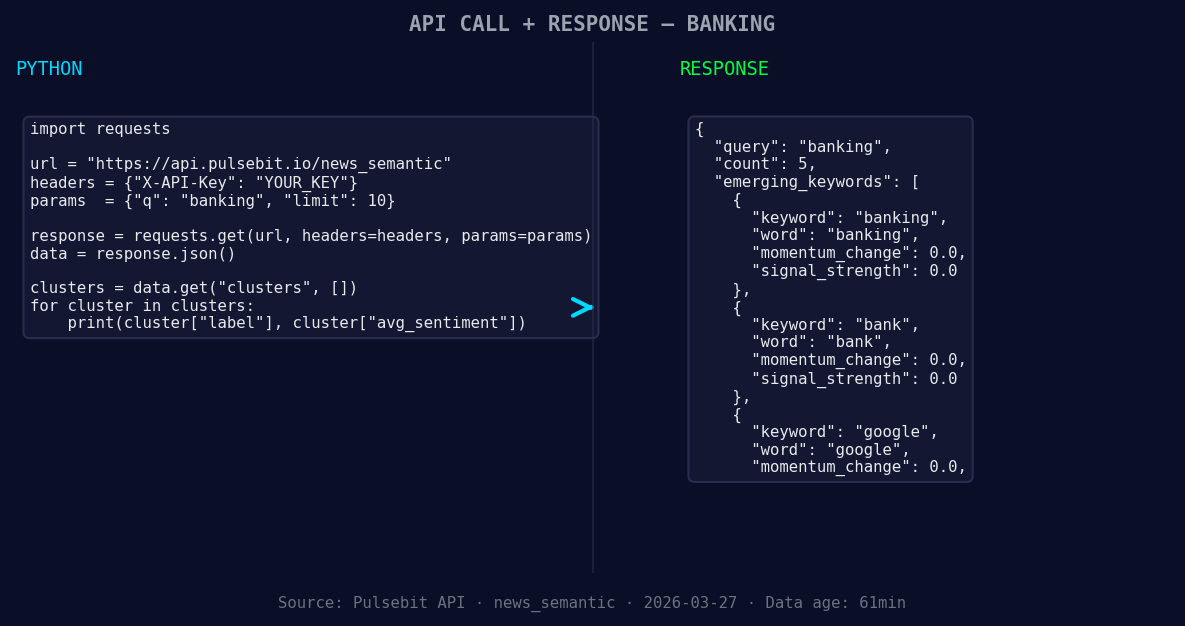
*Left: Python GET /news_semantic call for 'banking'. Right: returned JSON response structure (clusters: 3). Source: Pulsebit /news_semantic.*
# API call to get banking sentiment data
response = requests.get("https://your-api-url.com/endpoint", params=params)
data = response.json()
print(data)
Next, we'll analyze the narrative framing itself by running the cluster reason string back through our sentiment API. This allows us to understand how the sentiment is being shaped by the underlying themes.
# Run the cluster reason string through POST /sentiment
cluster_reason = "Clustered by shared themes: cub, its, branch, tirupati, opens."
sentiment_response = requests.post("https://your-api-url.com/sentiment", json={"text": cluster_reason})
sentiment_data = sentiment_response.json()

print(sentiment_data)
Now, let's explore three specific builds we can create with this momentum spike in mind.
Geo-Filtered Insights: You can set a threshold of sentiment score +0.415 for English articles about banking. This will help you focus on high-confidence narratives emerging from English-speaking sources, ensuring you’re aligned with the sentiment shifts.
Meta-Sentiment Analysis: After identifying the key narratives, leverage the sentiment loop by running the cluster reason through our sentiment endpoint. This could provide a deeper understanding of how different entities within the banking sector are perceived, allowing you to adjust your communication strategies accordingly.
Forming Theme Alerts: Monitor for forming themes related to banking (+0.00), bank (+0.00), and Google (+0.00), particularly in contrast to mainstream terms like cub, its, and branch. Setting up alerts for significant shifts in these themes can give you a heads-up on evolving narratives before they become mainstream.
By implementing these strategies, you can close the gap in your data pipeline and stay ahead of critical banking sentiment shifts.
Get started by checking out our documentation at pulsebit.lojenterprise.com/docs. You can easily copy-paste and run this in under 10 minutes. Don't let your pipeline fall behind; leverage these insights to stay on top of emerging trends!


Top comments (0)