

Your Pipeline Is 27.6h Behind: Catching Economy Sentiment Leads with Pulsebit
We recently uncovered a striking finding: a 24h momentum spike of -0.437 has emerged in the sentiment surrounding the global economy, primarily driven by discussions in French-language media. This spike highlights a downward trend in sentiment, suggesting that issues like the Iran war are beginning to impact perceptions of economic stability. As developers, we need to be aware of these shifts and ensure our models are agile enough to catch them.
When your pipeline doesn’t account for multilingual sources or the dominance of specific entities, you might miss critical signals like this one. In our case, the leading French press is 27.6 hours ahead of our conventional models, and this gap could cost you valuable insights. If your model solely operates in English or neglects foreign language sentiment, you’re already behind in capturing the narrative that influences economic sentiment.

French coverage led by 27.6 hours. Nl at T+27.6h. Confidence scores: French 0.85, English 0.85, Id 0.85 Source: Pulsebit /sentiment_by_lang.
To catch this anomaly, we can leverage our API to filter sentiment data by geographic origin and run a meta-sentiment analysis on the narrative framing. Here’s how to do it in Python:

Geographic detection output for economy. India leads with 11 articles and sentiment +0.08. Source: Pulsebit /news_recent geographic fields.
import requests
# Define the parameters for the sentiment analysis
topic = 'economy'
score = -0.077
confidence = 0.85
momentum = -0.437
lang = 'fr' # French language filter
# API call to get sentiment data from French sources
response = requests.get(
f"https://api.pulsebit.com/sentiment?topic={topic}&lang={lang}"
)
sentiment_data = response.json()
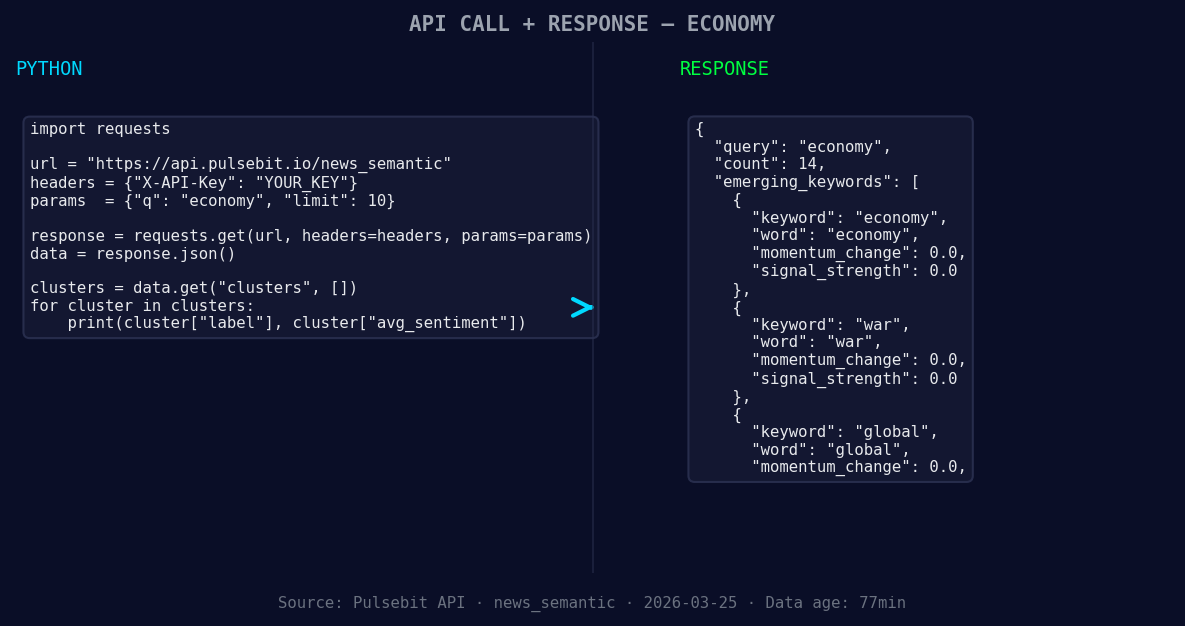
*Left: Python GET /news_semantic call for 'economy'. Right: returned JSON response structure (clusters: 3). Source: Pulsebit /news_semantic.*
# Output the sentiment data
print(sentiment_data)
# Generate a meta-sentiment score for the cluster reason
cluster_reason = "Clustered by shared themes: economy, west, asia, conflict"
meta_response = requests.post(
"https://api.pulsebit.com/sentiment",
json={"input": cluster_reason}
)
meta_sentiment = meta_response.json()
# Output the meta-sentiment result
print(meta_sentiment)
In this code snippet, we first query the sentiment data filtered by the French language. This allows us to capture insights that are emerging in non-English sources. The second part runs the cluster reason through our sentiment endpoint to assess how the narrative is framed, which is crucial for understanding the context behind the numbers.
With this anomaly in mind, let's consider three specific builds you can implement tonight:
Geo-filtered Alert System: Set up an alert that triggers when sentiment momentum drops below a threshold of -0.4 in French-speaking regions. Use the endpoint that includes the language filter to ensure you’re capturing timely insights from sources that might be overlooked.
Meta-Sentiment Dashboard: Create a dashboard that visualizes the meta-sentiment scores over time for clusters like “economy,” “war,” and “global.” Use the meta-sentiment loop to analyze how changing narratives affect overall sentiment, especially in contrast to mainstream themes like “west” and “asia.”
Predictive Modelling with Clusters: Incorporate the cluster reason analysis into your predictive models. Set a threshold for sentiment scores that fall below -0.1 and observe how this impacts your predictions regarding economic trends based on emerging topics like “conflict” and “global economy.”
Getting started is straightforward. You can dive into our documentation at pulsebit.lojenterprise.com/docs. We believe you can copy, paste, and run this code in under ten minutes to begin capturing these crucial insights. Don’t let your pipeline lag behind—leverage these findings to stay ahead of the curve.


Top comments (0)