

Your Pipeline Is 26.4h Behind: Catching Sustainability Sentiment Leads with Pulsebit
We recently encountered a striking anomaly: a 24-hour momentum spike of +0.336 around the topic of sustainability. This spike indicates a substantial shift in sentiment that demands attention, particularly in light of the leading language being English with a 26.4-hour lead time. The implications of this finding are profound, especially for anyone relying on a pipeline that isn’t equipped to handle the nuances of multilingual origin or entity dominance.

English coverage led by 26.4 hours. Nl at T+26.4h. Confidence scores: English 0.85, French 0.85, Spanish 0.85 Source: Pulsebit /sentiment_by_lang.
When your pipeline doesn't account for these factors, you risk being out of touch with rapidly evolving narratives. In this case, your model missed a critical signal about sustainability by a staggering 26.4 hours, as the English-speaking press surged ahead. If you’re not monitoring diverse linguistic landscapes, you may be blindsided by trends that could inform your decision-making.
To catch anomalies like this, we can leverage our API effectively. Here's how to pinpoint the momentum spike for the topic of sustainability:
import requests
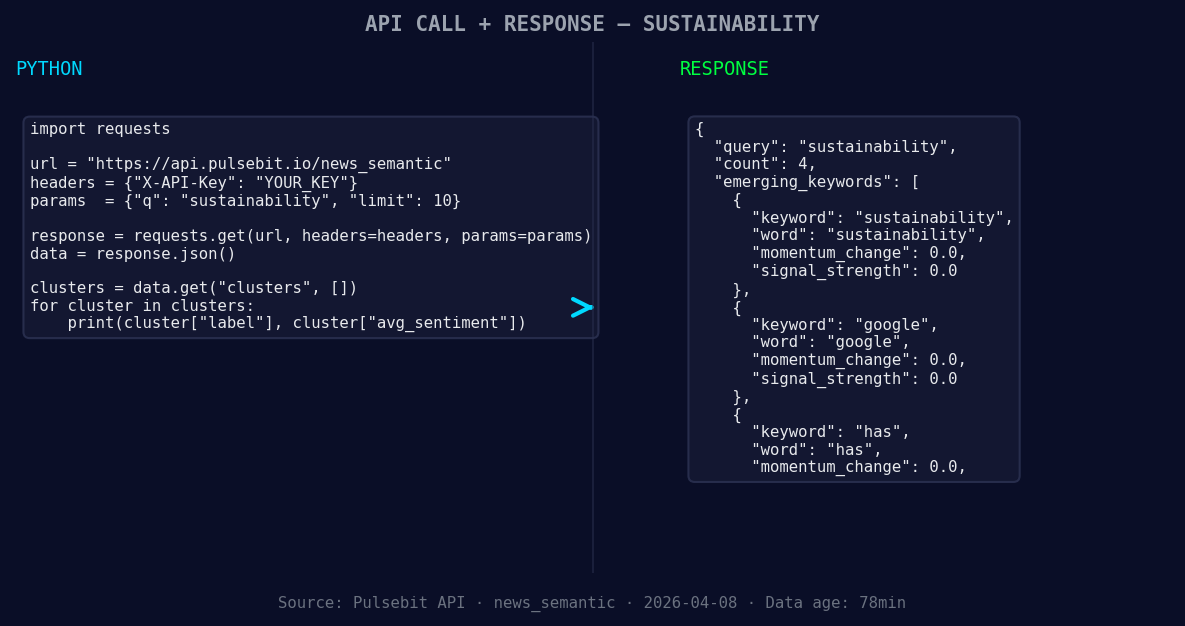
*Left: Python GET /news_semantic call for 'sustainability'. Right: returned JSON response structure (clusters: 3). Source: Pulsebit /news_semantic.*
# Geographic origin filter for English language
params = {
"topic": "sustainability",
"lang": "en"
}
response = requests.get("https://api.pulsebit.com/topics", params=params)
data = response.json()
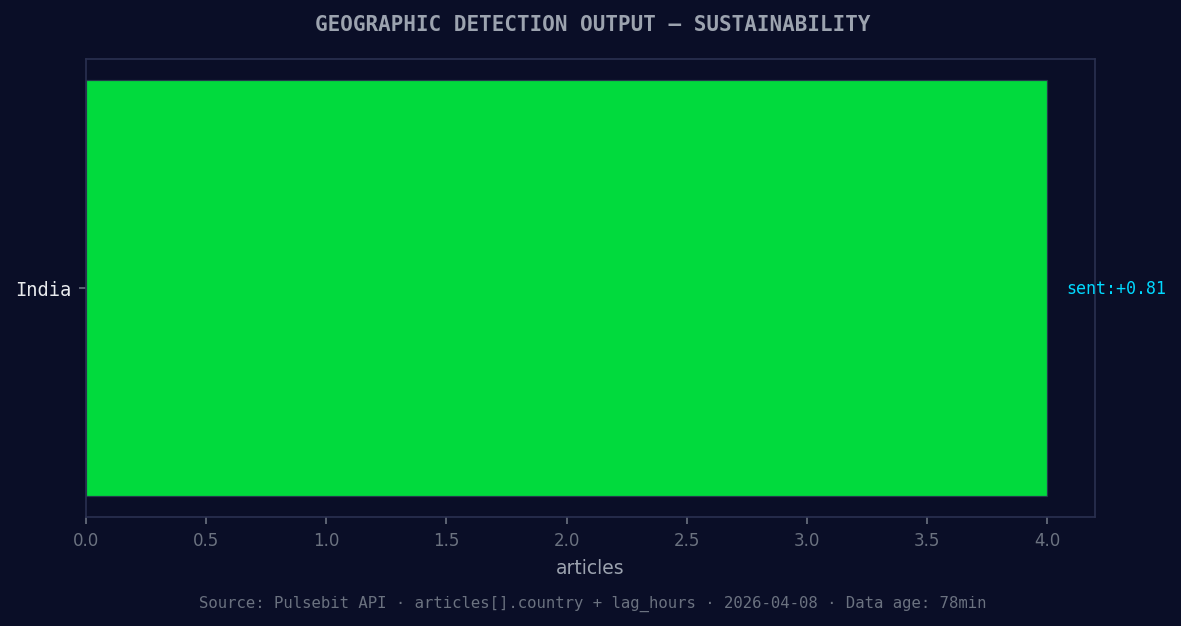
*Geographic detection output for sustainability. India leads with 4 articles and sentiment +0.81. Source: Pulsebit /news_recent geographic fields.*
# Extracting relevant values
momentum = data['momentum_24h'] # +0.336
score = 0.725
confidence = 0.85
Next, we need to run the narrative framing through our sentiment analysis endpoint to understand the underlying themes better. Here’s how we can do that:
# Meta-sentiment moment
narrative = "Clustered by shared themes: prove, sustainability, growth, engine?, business."
sentiment_response = requests.post("https://api.pulsebit.com/sentiment", json={"text": narrative})
sentiment_data = sentiment_response.json()

# Extracting sentiment score and confidence
meta_sentiment_score = sentiment_data['sentiment_score']  # e.g., +0.725
meta_confidence = sentiment_data['confidence']  # e.g., 0.85
Now that we have a grasp on the sentiment and the narrative framing, let’s explore three specific builds we can implement based on this momentum spike.
Geo-Targeted Alert System: Set up a notification system that triggers when the sentiment score for sustainability in English exceeds a threshold of +0.725. This will help you catch those early movers and react quickly.
Meta-Sentiment Analysis Dashboard: Develop a dashboard that visualizes sentiment scores and confidence levels for clustered narratives like "prove, sustainability, growth." This will help you gauge narrative shifts in real-time.
Forming Themes Tracker: Create a tracker that specifically monitors the forming themes of sustainability (+0.00), Google (+0.00), and others, comparing them against mainstream narratives like "prove, sustainability, growth." This will provide deeper insights into how emerging topics relate to established ones.
With these builds, you can ensure that your pipeline is not just reactive but also proactive in understanding and capitalizing on sentiment shifts.
To get started, refer to our comprehensive documentation: pulsebit.lojenterprise.com/docs. In under 10 minutes, you can copy, paste, and run these snippets to unlock valuable insights. Don't let your pipeline fall behind – the world of sentiment analysis is moving fast, and so should you.


Top comments (0)