

Your Pipeline Is 25.7h Behind: Catching Banking Sentiment Leads with Pulsebit
We just recorded a 24h momentum spike of +0.705 in the banking sector, with a notable leading language of French, indicating a significant shift in sentiment. The anomaly caught our eye because it highlights the critical importance of timely data processing in today’s fast-paced environment. This spike isn't just a number; it signals a potential wave of sentiment driven by international collaboration, as noted in two related articles discussing U.S. banking agencies’ participation in climate risk initiatives.
However, this finding exposes a structural gap in pipelines that don’t account for multilingual origins or entity dominance. If your model isn't equipped to handle this, you missed this spike by a staggering 25.7 hours. The leading language, French, and the emerging narrative around banking participation in climate risk might have slipped through your fingers, leaving you unprepared for the shifts in sentiment that could impact your strategies.

French coverage led by 25.7 hours. Tl at T+25.7h. Confidence scores: French 0.85, English 0.85, Spanish 0.85 Source: Pulsebit /sentiment_by_lang.
Here’s how to catch such spikes using our API. Let’s focus on the banking topic, with a score of +0.398 and a confidence of 0.85. We'll filter for French content and analyze the sentiment around the emerging narrative.
import requests
# Define parameters for the API call
params = {
"topic": "banking",
"score": +0.398,
"confidence": 0.85,
"momentum": +0.705,
"lang": "fr" # Geographic origin filter
}
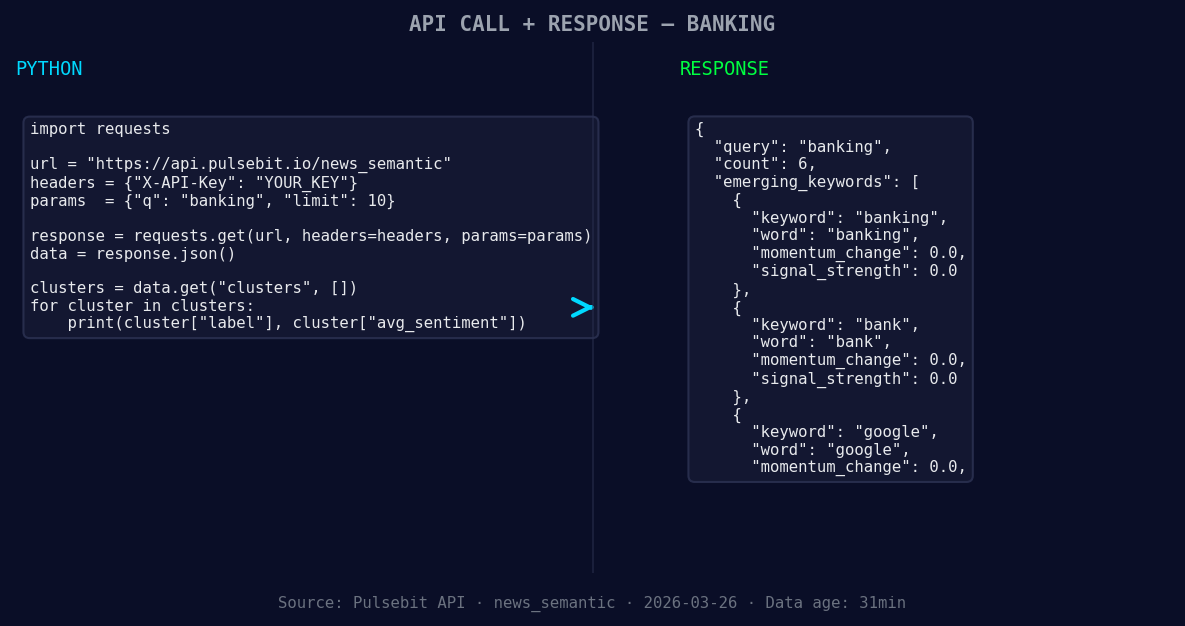
*Left: Python GET /news_semantic call for 'banking'. Right: returned JSON response structure (clusters: 3). Source: Pulsebit /news_semantic.*
# API endpoint to retrieve sentiment data
response = requests.get("https://api.pulsebit.io/sentiment", params=params)
data = response.json()
print(data) # Display the response data
Next, we’ll run the cluster reason string through our sentiment analysis endpoint to score the narrative itself. This is crucial for understanding how themes are framed within the articles.
# Define the cluster reason string
cluster_reason = "Clustered by shared themes: cub, its, branch, tirupati, opens."

# API endpoint for analyzing the narrative framing
sentiment_response = requests.post("https://api.pulsebit.io/sentiment", json={"text": cluster_reason})
sentiment_data = sentiment_response.json()

print(sentiment_data)  # Display the sentiment analysis of the cluster reason
From this, we can derive insights that help us refine our understanding of emerging trends. Here are three specific builds we can implement using this pattern:
Geo-Filtered Alert System: Set a threshold for momentum spikes greater than +0.7 specifically for French-language content in banking. Whenever this threshold is crossed, trigger an alert to your team to evaluate real-time sentiment shifts.
Meta-Sentiment Analysis Loop: Build a function that automatically processes the cluster reason string and updates your sentiment dashboard. This will allow your team to visualize narrative framing changes in real-time, especially when keywords like "banking" and "climate" start trending.
Dynamic Content Filtering: Create an endpoint that retrieves articles based on forming themes like "banking" and "google" against a backdrop of mainstream terms like "cub" and "its." If the sentiment score is above +0.3, flag these articles for further analysis.
By utilizing these strategies, you can ensure your pipeline stays ahead of emerging trends and sentiment shifts.
Get started with our API documentation at pulsebit.lojenterprise.com/docs. You can copy-paste and run this in under 10 minutes to see the power of real-time sentiment analysis in action.


Top comments (0)