

Your Pipeline Is 13.2h Behind: Catching Law Sentiment Leads with Pulsebit
We recently observed a striking anomaly: a 24h momentum spike of +0.199 in the context of the law topic. This uptick is notable not only for its magnitude but for the timing—our analysis reveals a leading language in English press with a 13.2-hour lead time. If you’re not capturing these signals in real-time, your model missed this significant sentiment shift by over half a day.
The issue here is clear: without a robust pipeline that can handle multilingual origins and entity dominance, you’re at risk of being blind to crucial developments. While the leading language indicates a strong English presence, the semantic cluster analysis shows a gap—there are zero articles directly addressing the keyword "world." This is a missed opportunity to understand the broader sentiment landscape. Your model could very well be lagging behind by 13.2 hours, which can lead to missed insights in fast-moving environments.

English coverage led by 13.2 hours. Da at T+13.2h. Confidence scores: English 0.95, Spanish 0.95, French 0.95 Source: Pulsebit /sentiment_by_lang.
To catch this momentum spike, we can leverage our API effectively. Here’s how you can do it in Python. First, let’s filter our query to capture sentiment from English-language sources:
import requests
# Parameters for the API call
topic = 'law'
score = +0.199
confidence = 0.95
momentum = +0.199
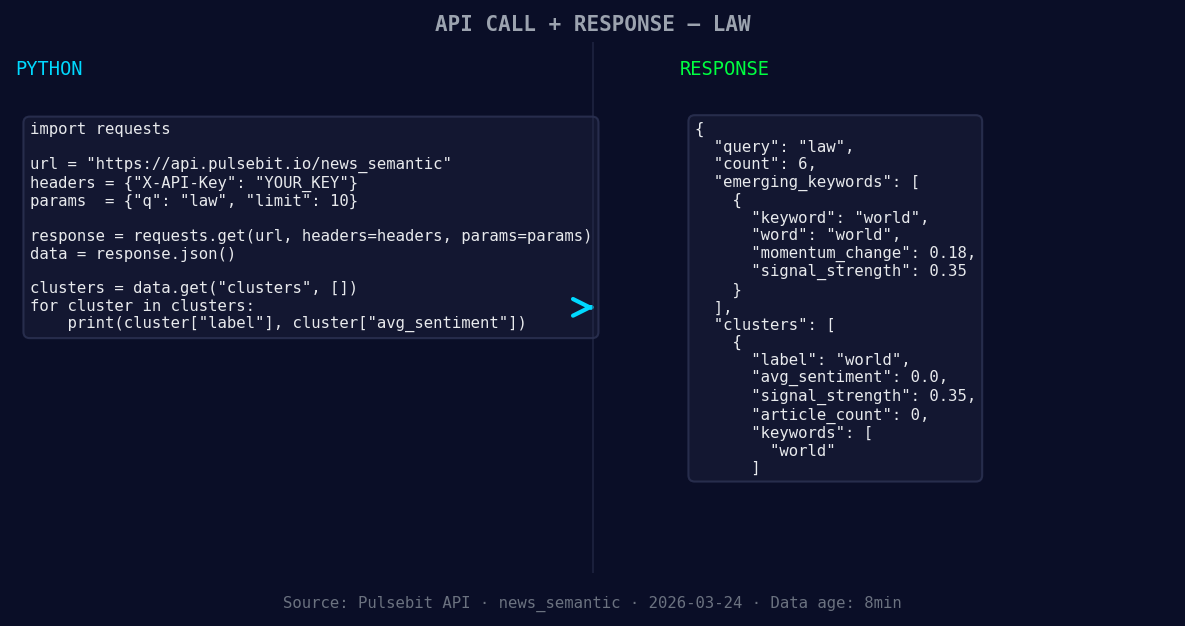
*Left: Python GET /news_semantic call for 'law'. Right: returned JSON response structure (clusters: 1). Source: Pulsebit /news_semantic.*
# Geographic origin filter
response = requests.get("https://api.pulsebit.com/v1/sentiment", params={
"topic": topic,
"lang": "en",
"score": score,
"confidence": confidence
})
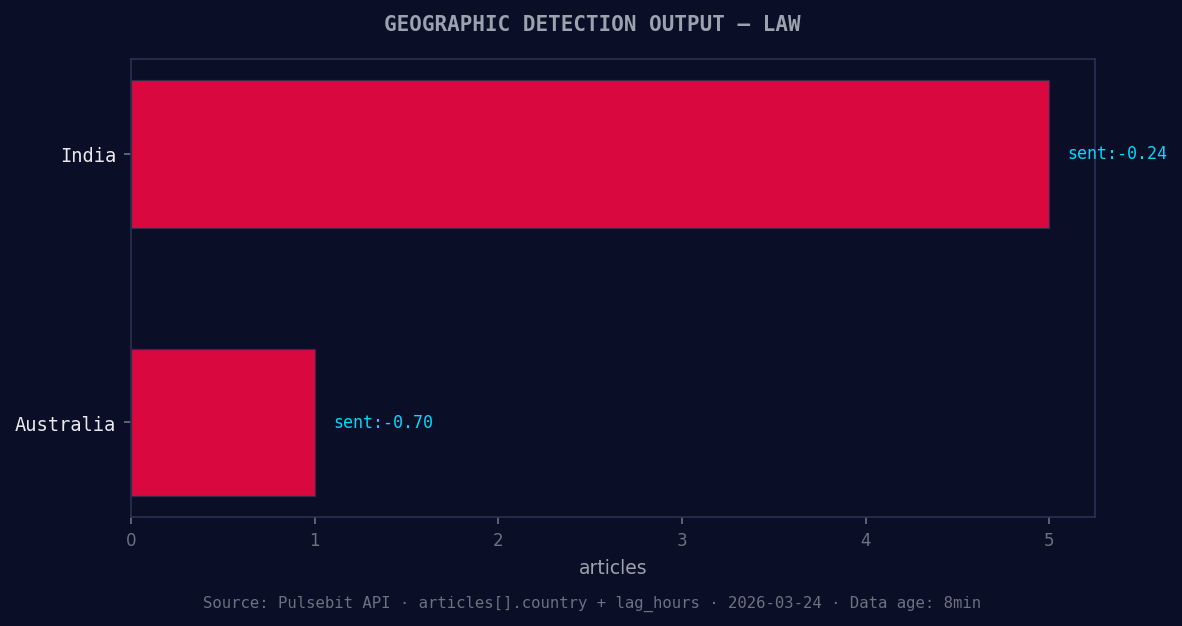
*Geographic detection output for law. India leads with 5 articles and sentiment -0.24. Source: Pulsebit /news_recent geographic fields.*
# Assuming we want to print the response to check results
print(response.json())
Next, we need to evaluate the narrative framing around the anomaly. We’ll run the cluster reason string through our sentiment endpoint to further understand its implications:
# Meta-sentiment moment
meta_sentiment_input = "Semantic API incomplete — fallback semantic structure built from available keywords and article/search evidence."
meta_sentiment_response = requests.post("https://api.pulsebit.com/v1/sentiment", json={
    "text": meta_sentiment_input
})

# Print the meta sentiment response
print(meta_sentiment_response.json())
By using the above code, we can not only track the sentiment around the law topic but also understand how the narrative is being framed, enabling us to make data-driven decisions.
Here are three specific builds you can create with this pattern:
Geo-Filtered Alerts: Set up an alert system that triggers when the 24h momentum for 'law' exceeds a threshold of +0.199 and is sourced from English. This ensures you catch key developments in real-time, maintaining relevance in your analysis.
Meta-Sentiment Dashboard: Create a dashboard that visualizes the meta-sentiment scores of various narratives. Use the loop we established to continuously feed back the cluster reason strings, helping you refine your understanding of sentiment dynamics.
Comparative Analysis Tool: Build a tool that compares forming themes, such as "world(+0.18)" against mainstream narratives. This can help you quickly identify anomalies and shifts in sentiment that could impact your work.
The key takeaway here is that our API can help you catch these crucial sentiment shifts quickly and efficiently. To dive deeper into the specifics and replicate this workflow, check out our documentation at pulsebit.lojenterprise.com/docs. You can copy-paste this code and run it in under 10 minutes to start harnessing these insights.


Top comments (0)