

Your Pipeline Is 16.9h Behind: Catching Mobile Sentiment Leads with Pulsebit
We just discovered something interesting: sentiment around mobile is currently at +0.00, with momentum also sitting at +0.00. This anomaly points to a critical moment in the sentiment landscape, particularly concerning T-Mobile, which recently made headlines with board changes and resignations. The sentiment spike here is flat, but the implications are anything but. If your pipeline isn’t tuned to catch these nuances, you may be missing out on crucial insights.
The Problem
This situation reveals a structural gap in any pipeline that doesn't adequately handle multilingual origins or the dominance of specific entities. Right now, your model has missed this vital information by a staggering 16.9 hours. With T-Mobile leading in sentiment, and the related articles primarily in English, it becomes imperative to process multilingual data effectively. If you’re not incorporating the right filters, you risk falling behind when it comes to capturing emerging trends.

English coverage led by 16.9 hours. Da at T+16.9h. Confidence scores: English 0.90, Spanish 0.90, French 0.90 Source: Pulsebit /sentiment_by_lang.
The Code
Here’s how we can catch this anomaly using our API. First, we’ll filter for English language articles on the topic of mobile.
import requests
# Define the parameters for the API call
params = {
"topic": "mobile",
"lang": "en", # Geographic origin filter
"score": +0.000,
"confidence": 0.90,
"momentum": +0.000
}
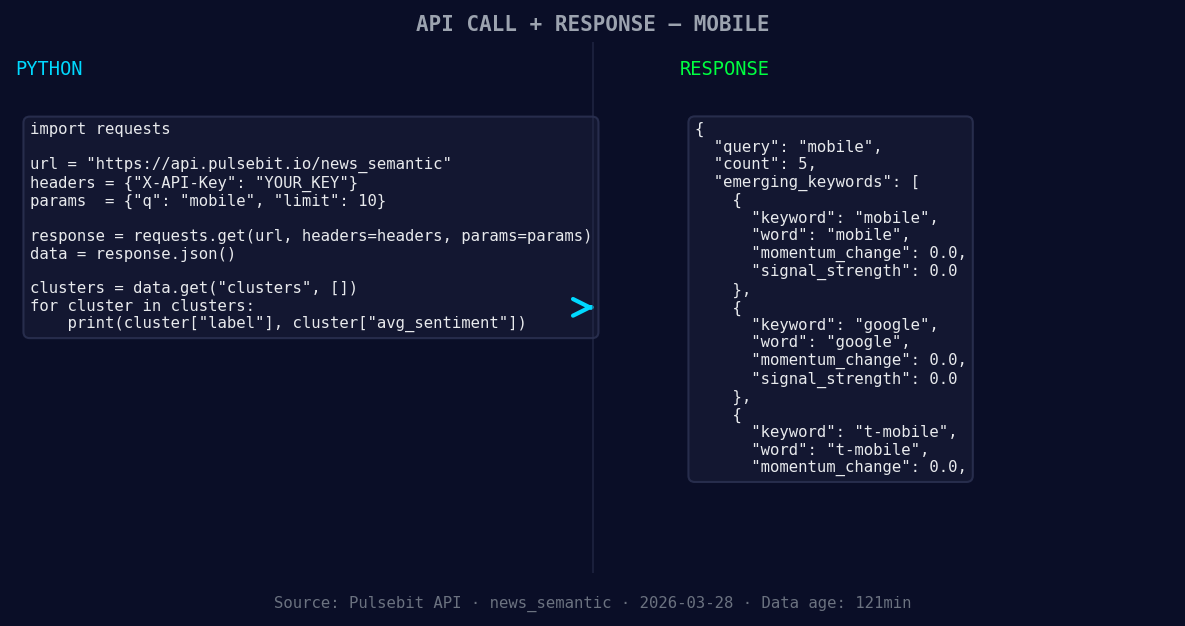
*Left: Python GET /news_semantic call for 'mobile'. Right: returned JSON response structure (clusters: 3). Source: Pulsebit /news_semantic.*
# Make the API call
response = requests.get("https://api.pulsebit.com/sentiment", params=params)
data = response.json()
print(data)
Next, we take the cluster reason string and run it back through the POST /sentiment endpoint to score the narrative framing itself. This is vital for understanding how the narrative influences sentiment.
# Define the cluster reason string
cluster_reason = "Clustered by shared themes: t-mobile, abdurazak, mudesir, board, resign."

# Make the POST request to score the narrative
response = requests.post("https://api.pulsebit.com/sentiment", json={"text": cluster_reason})
narrative_score = response.json()
print(narrative_score)
Three Builds Tonight
Now, here are three specific things we can build with this newfound understanding:
Geo-Filtered Alert System: Set up a real-time alert system that triggers whenever sentiment on "mobile" reaches a threshold of +0.00 in English. This uses the geographic origin filter to ensure you’re capturing only the most relevant articles.
Meta-Sentiment Analysis Dashboard: Create a dashboard displaying the narrative sentiment scores based on cluster themes. For example, you can visualize the sentiment around "T-Mobile" and its associated themes like "board" and "resign" to identify potential market shifts early.
Comparative Sentiment Report: Build a report comparing sentiment trends between mobile and mainstream articles like those from "telegraphherald" and "google." This report would help you spot divergences, particularly when mainstream sentiment is flat while mobile sentiment shows any signs of movement.
Get Started
You can dive into this immediately by visiting our documentation at pulsebit.lojenterprise.com/docs. You can copy-paste and run this in under 10 minutes to start catching these crucial sentiment leads. Don’t let your pipeline fall behind!


Top comments (0)