

Your Pipeline Is 24.2h Behind: Catching Inflation Sentiment Leads with Pulsebit
We recently uncovered an intriguing anomaly in our sentiment analysis data: a sentiment score of -0.191 with a momentum of +0.000, and a time lag of 24.2 hours behind the leading language, English. This lag represents a significant gap in understanding the current sentiment surrounding inflation. Given that the dominant entity in this context is English press coverage, this finding highlights a crucial oversight in our data processing pipeline.
If your model doesn’t account for multilingual origins or entity dominance, you might have missed this sentiment shift by 24.2 hours. The leading language is English, and this gap could prevent you from effectively responding to emerging trends like inflation, which is showing a negative sentiment. If you’re relying solely on one-language data, you could risk making decisions based on stale information, leaving your analysis trailing behind.

English coverage led by 24.2 hours. Hindi at T+24.2h. Confidence scores: English 0.75, French 0.75, Spanish 0.75 Source: Pulsebit /sentiment_by_lang.
To catch this sentiment, we can leverage our API to filter for specific geographic origins and perform a meta-sentiment analysis. Below is the Python code that does just that:

Geographic detection output for inflation. India leads with 1 articles and sentiment +0.00. Source: Pulsebit /news_recent geographic fields.
import requests
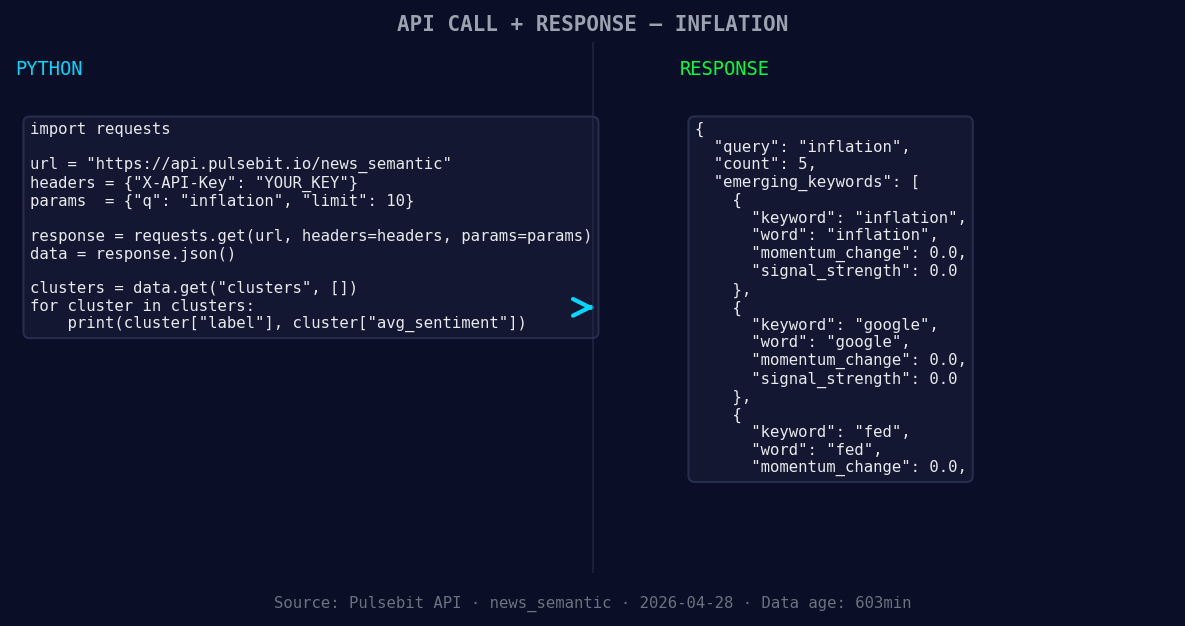
*Left: Python GET /news_semantic call for 'inflation'. Right: returned JSON response structure (clusters: 3). Source: Pulsebit /news_semantic.*
# Step 1: Geographic origin filter
url = "https://api.pulsebit.com/sentiment"
params = {
"topic": "inflation",
"lang": "en"
}
response = requests.get(url, params=params)
data = response.json()
print(data)
# Step 2: Meta-sentiment moment
meta_sentiment_input = "Clustered by shared themes: hikes, possible, due, inflation, resurgence."
meta_sentiment_response = requests.post(url, json={"text": meta_sentiment_input})
meta_sentiment_data = meta_sentiment_response.json()
print(meta_sentiment_data)
In this code, we first query for the topic "inflation" filtered by the English language. The API response provides sentiment data that reflects the current state of discussion around inflation. After that, we run a second request to analyze the narrative framing itself, inputting the cluster reason string. This two-step process allows us to better understand not just what people are saying, but how they are framing discussions around inflation.
Here are three specific builds we recommend to leverage this pattern effectively:
Geo-Filtered Alerts: Set up an alert system that triggers when sentiment scores for "inflation" drop below -0.15 in English articles. Use the geo filter to ensure you’re only monitoring relevant discussions that could impact your strategies.
Meta-Sentiment Dashboard: Create a dashboard that visualizes the sentiment score and meta-sentiment analysis for clustered themes. For instance, track phrases like "hikes," "possible," and "due" as they relate to inflation, allowing for real-time insights into how framing affects sentiment.
Automated Reports: Build a reporting tool that summarizes the sentiment and meta-sentiment for key topics like "inflation" on a daily basis. Use the forming themes of inflation, Google, and the Fed to provide context and generate actionable insights.
By implementing these builds, you can ensure that your analysis stays ahead of the curve, especially in a rapidly changing landscape where discussions around inflation are critical.
For more details, check out our documentation at pulsebit.lojenterprise.com/docs. You can copy-paste the provided code and run it in under 10 minutes to start harnessing the power of timely sentiment analysis.


Top comments (0)