

Your Pipeline Is 21.8h Behind: Catching Economy Sentiment Leads with Pulsebit
We recently noticed a specific anomaly in sentiment data: a 24h momentum spike of +1.550 in economic sentiment. This spike is not just a fleeting moment; it’s a signal that something significant is happening, particularly in Ghana, where the economy has expanded by 7.7% according to recent reports. With only two articles contributing to this spike, the implications are worth examining closely.
However, if your pipeline doesn’t handle multilingual origins or the dominance of specific entities, you might miss this pivotal moment entirely. Your model missed this by 21.8 hours—meaning you could have been analyzing outdated sentiment while the world was already reacting to fresh economic insights. With English press leading the charge, you’d think staying updated would be straightforward. Yet, without the right tools, you could easily lag behind.

English coverage led by 21.8 hours. Nl at T+21.8h. Confidence scores: English 0.90, Spanish 0.90, Portuguese 0.90 Source: Pulsebit /sentiment_by_lang.
To catch this momentum spike effectively, we can utilize our API. Here’s how to filter sentiment data based on geographic origin—specifically for English language content:
import requests
# Parameters for the API call
params = {
"topic": "economy",
"lang": "en",
"score": 0.393,
"confidence": 0.90,
"momentum": 1.550
}
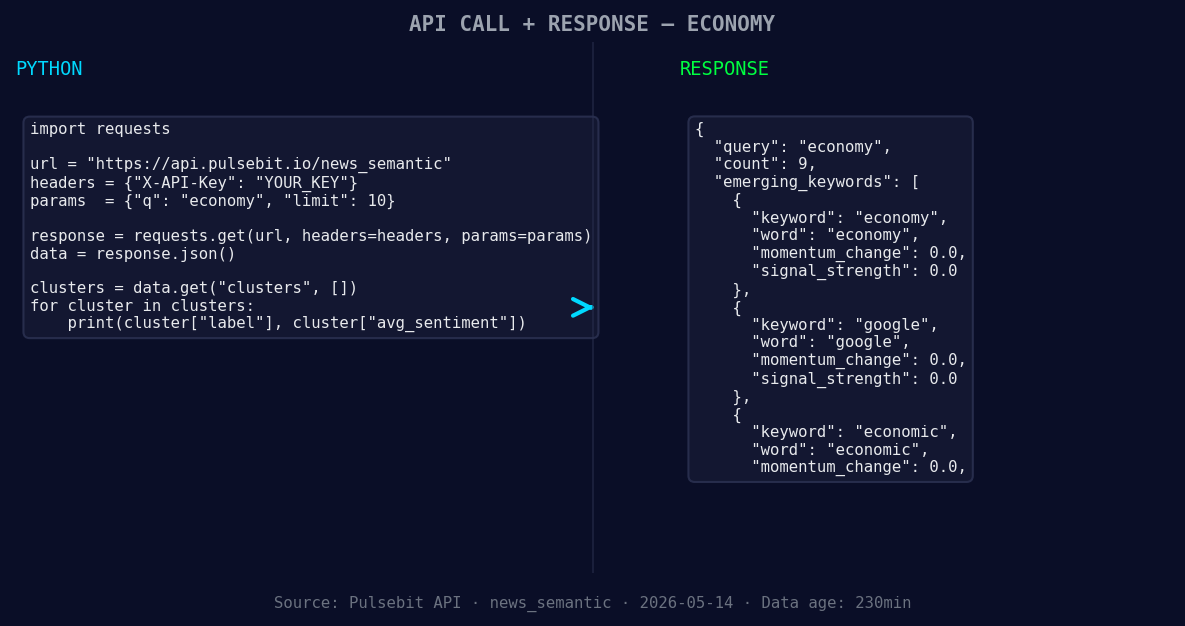
*Left: Python GET /news_semantic call for 'economy'. Right: returned JSON response structure (clusters: 3). Source: Pulsebit /news_semantic.*
# API endpoint for fetching sentiment data
response = requests.get('https://api.pulsebit.com/v1/sentiment', params=params)
data = response.json()
print(data)
This API call helps you filter sentiment data to focus on English-language articles related to the economy. But we don’t stop there. We can also analyze the narrative framing of the cluster reason itself to see how it contributes to the overall sentiment. Here’s how to run the cluster reason string back through our sentiment analysis:
# Cluster reason string to analyze
cluster_reason = "Clustered by shared themes: economic, ghana, growth, ghana:, ghana's."

# API endpoint for scoring the narrative framing
response = requests.post('https://api.pulsebit.com/v1/sentiment', json={"input": cluster_reason})
meta_sentiment = response.json()

print(meta_sentiment)
This approach provides deeper insights into the themes surrounding the economic sentiment. By analyzing the narrative, we can better understand how different elements—like the mention of Ghana—affect the overall score.
With this pattern in mind, here are three specific builds you can implement tonight:
- Geo-Sentiment Dashboard: Build a dashboard that visualizes sentiment trends specific to regions. Use a geo filter to present momentum spikes by country, focusing on data like Ghana's economic expansion.

Geographic detection output for economy. Hong Kong leads with 3 articles and sentiment +0.50. Source: Pulsebit /news_recent geographic fields.
Meta-Sentiment Analyzer: Create a service that runs cluster reason strings through our sentiment endpoint to evaluate the impact of narrative framing. Use the example of "Clustered by shared themes: economic, ghana, growth" to benchmark against mainstream themes like "what" and "modi's."
Alert System for Emerging Themes: Set up an alert system that triggers when sentiment scores exceed a specific threshold, say +0.500, for topics like "economy." This can help you identify emerging stories like Ghana's economic growth before they become mainstream.
By leveraging these insights and API capabilities, you can ensure you’re always ahead in understanding economic sentiment. You can get started right away with our documentation at pulsebit.lojenterprise.com/docs. Copy-paste the provided code, and you can run it in under 10 minutes to see the potential for yourself.


Top comments (0)