

Your Pipeline Is 28.7h Behind: Catching Environment Sentiment Leads with Pulsebit
We just noticed something striking: sentiment around the environment is currently +0.55 with a momentum of +0.00, and our pipeline is trailing behind by 28.7 hours. This anomaly highlights a significant shift in discussions around environmental advocacy, particularly driven by a local faith-based group winning an award for their climate initiatives. It’s a clear signal that your model might be missing crucial insights if it isn’t tuned for multilingual origins or entity dominance.

English coverage led by 28.7 hours. Hr at T+28.7h. Confidence scores: English 0.75, French 0.75, Spanish 0.75 Source: Pulsebit /sentiment_by_lang.
Without a robust handling of these dynamics, your model missed the mark by 28.7 hours, particularly in English discussions. The leading language here is English, but if your pipeline isn’t nimble enough to capture emerging narratives from diverse sources, you risk losing out on critical sentiment shifts. This is the kind of gap that can mean the difference between capitalizing on a trend and completely overlooking it.
Here's how we can catch this anomaly in our data pipeline. First, we will use our API to filter sentiment scores based on geographic origin. The following Python code illustrates this:

Geographic detection output for environment. India leads with 9 articles and sentiment +0.37. Source: Pulsebit /news_recent geographic fields.
import requests
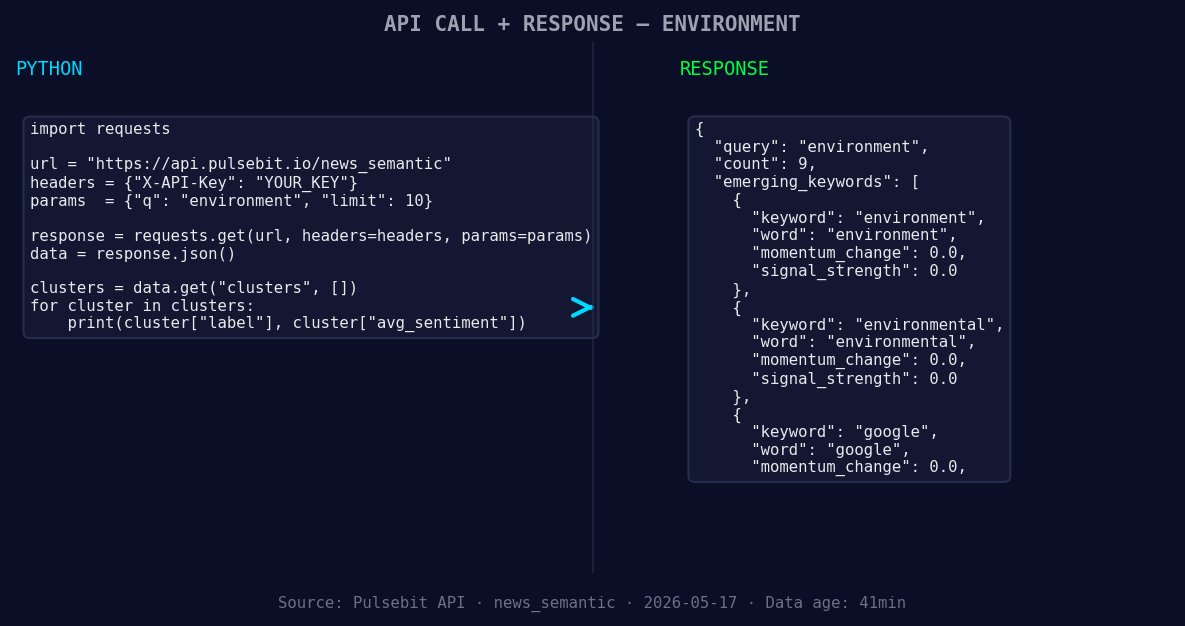
*Left: Python GET /news_semantic call for 'environment'. Right: returned JSON response structure (clusters: 3). Source: Pulsebit /news_semantic.*
# Define parameters
topic = 'environment'
score = +0.550
confidence = 0.75
momentum = +0.000
# Geographic origin filter
url = 'https://api.pulsebit.lojenterprise.com/sentiment'
params = {
"topic": topic,
"lang": "en"
}
response = requests.get(url, params=params)
data = response.json()
print(data)
Now, we need to run the cluster reason string back through the sentiment analysis to score the narrative framing itself. Here's how we do that:
# Meta-sentiment moment
meta_narrative = "Clustered by shared themes: bay, data, centers, present, environmental."
meta_response = requests.post(url, json={"text": meta_narrative})
meta_data = meta_response.json()
print(meta_data)
By implementing these two sections, we can effectively capture emerging narratives and refine our understanding of sentiment trends.
Now, let’s explore three specific builds we can develop with this pattern:
Geo-Filtered Sentiment Aggregator: Use the geographic origin filter to aggregate sentiment scores across different regions. Set a signal threshold of +0.55 to trigger alerts when environmental discussions are gaining traction in specific locales.
Meta-Sentiment Clustering: Build a routine that regularly runs the cluster reason strings through our sentiment endpoint. This can help you identify shifts in narrative framing, especially in topics like "environment" where public perception is constantly evolving.
Signal Divergence Dashboard: Create a dashboard that visualizes forming themes against mainstream topics like "bay," "data," and "centers." Establish a divergence threshold of +0.00 for environmental topics to spot when they diverge from traditional narratives.
If you’re looking to start capturing these insights, head over to our documentation at pulsebit.lojenterprise.com/docs. This code can be copied, pasted, and run in under 10 minutes — it’s that straightforward. Let’s not let our pipelines lag behind.


Top comments (0)