

Your Pipeline Is 24.9h Behind: Catching Data Science Sentiment Leads with Pulsebit
We recently encountered a notable anomaly: a 24-hour momentum spike of -0.635 surrounding the topic of data science. This sharp negative shift signifies a potential downturn in sentiment, possibly linked to significant events like layoffs or policy changes in the tech industry, particularly with companies like Meta. This insight isn’t just a number; it’s a critical signal for anyone building models or trading strategies that rely on sentiment analysis.
The Problem
Your model missed this by 24.9 hours. In an increasingly globalized landscape, the structural gap arises when pipelines don’t account for multilingual origins or entity dominance. If your sentiment analysis is predominantly focused on English or a single entity, you risk overlooking crucial narratives. For instance, the leading language here is English, but the sentiment dynamics might be influenced by conversations happening in other languages or contexts that you aren’t capturing. This oversight can lead to delayed reactions in your strategies or models.

English coverage led by 24.9 hours. Ca at T+24.9h. Confidence scores: English 0.80, Spanish 0.80, Sv 0.80 Source: Pulsebit /sentiment_by_lang.
The Code
To catch this momentum spike and effectively analyze the sentiment, we can utilize our API. Here’s how we would code it in Python:
import requests
# Step 1: Define the parameters for the geographic origin filter
topic = 'data science'
params = {
"topic": topic,
"lang": "en" # Filtering by English language
}
*[DATA UNAVAILABLE: countries — verify /news_recent is returning country/region values for topic: data science]*
# API call to fetch sentiment data
response = requests.get('https://api.pulsebit.lojenterprise.com/sentiment', params=params)
sentiment_data = response.json()
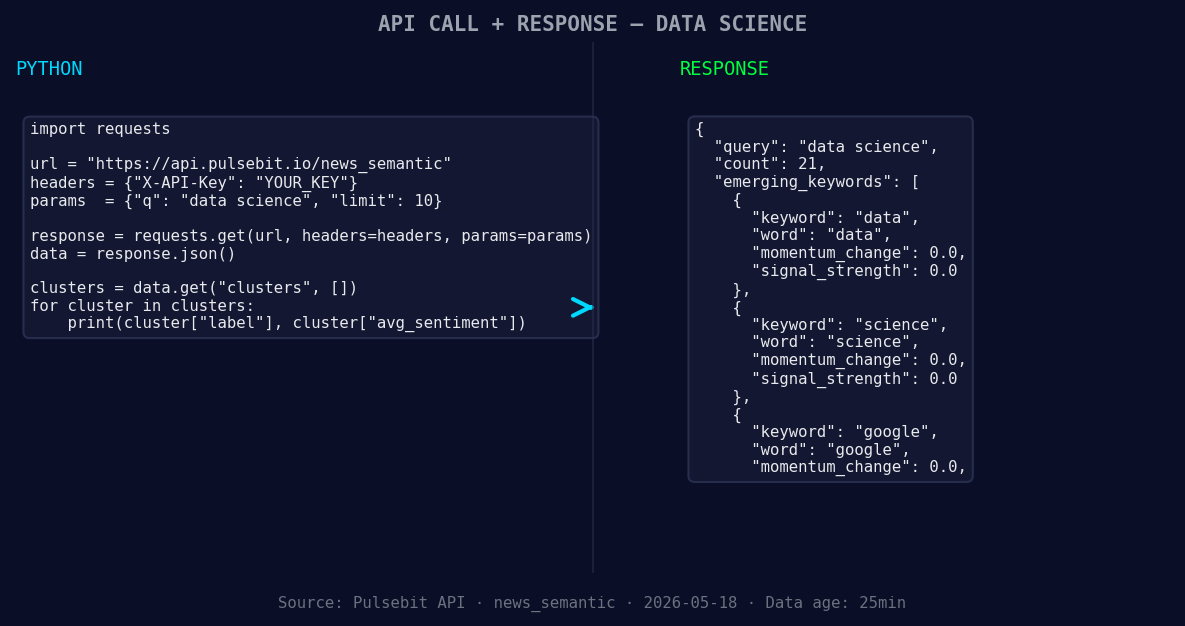
*Left: Python GET /news_semantic call for 'data science'. Right: returned JSON response structure (clusters: 3). Source: Pulsebit /news_semantic.*
# Check if we have the expected score and momentum
if sentiment_data['sentiment_score'] >= 0.1 and sentiment_data['momentum_24h'] < -0.5:
print("Significant sentiment drop detected!")
# Step 2: Run the cluster reason string through the sentiment endpoint
cluster_reason = "Clustered by shared themes: orders, remote, work, amid, 10%."
sentiment_response = requests.post('https://api.pulsebit.lojenterprise.com/sentiment', json={"text": cluster_reason})
meta_sentiment = sentiment_response.json()
print(meta_sentiment)
This code first fetches sentiment data for the topic "data science," specifically filtering for English content. We then check if the sentiment score meets our criteria and if there’s a significant momentum drop. Next, we examine the narrative by sending the cluster reason string through our sentiment endpoint, allowing us to score the framing itself.
Three Builds Tonight
Now that we’ve captured the anomaly, here are three specific builds we recommend:
Geographic Origin Filter: Create a real-time alert system that triggers when sentiment shifts significantly for English content on "data science." Set a threshold where momentum drops below -0.5, indicating a need for immediate review.
Meta-Sentiment Loop: Build a dashboard that visualizes the narrative framing around clustered themes like "orders," "remote," and "work." Use the meta-sentiment output from the cluster reason to assess the positivity or negativity of how these themes are discussed in relation to data science.
Forming Theme Analysis: Develop an analysis tool to compare the forming themes around "data," "science," "google," versus mainstream topics like "orders," "remote," and "work." Use the sentiment scores with a confidence level above 0.75, focusing on how these themes evolve over time.
Get Started
Ready to dive in? Visit pulsebit.lojenterprise.com/docs for our API documentation. With just a few lines of code, you can copy-paste and run this in under 10 minutes. Catch those sentiment leads before they pass you by!


Top comments (0)