

Your Pipeline Is 28.4h Behind: Catching Energy Sentiment Leads with Pulsebit
We recently uncovered a fascinating anomaly: a 24h momentum spike of +0.400 in energy sentiment. This spike, originating from the English press, was notably led by a 28.4-hour window of coverage regarding NextEra Energy's pursuit of the acquisition of Dominion Energy. With only two articles in the cluster, this finding raises questions about how sentiment pipelines might be lagging behind crucial developments in real-time.
The issue here is clear: if your pipeline does not account for multilingual sources or the dominance of specific entities, you're potentially missing out on significant opportunities. Your model missed this by 28.4 hours, an eternity in the fast-paced world of sentiment analysis. The leading language in this case was English, yet the thematic relevance spans beyond just one language, which could distort the overall sentiment picture if not properly captured.

English coverage led by 28.4 hours. Da at T+28.4h. Confidence scores: English 0.90, Spanish 0.90, French 0.90 Source: Pulsebit /sentiment_by_lang.
To catch this momentum spike, we can leverage our API to filter data effectively and assess sentiment framing. Below is a Python snippet that demonstrates how to query for this specific spike:
import requests
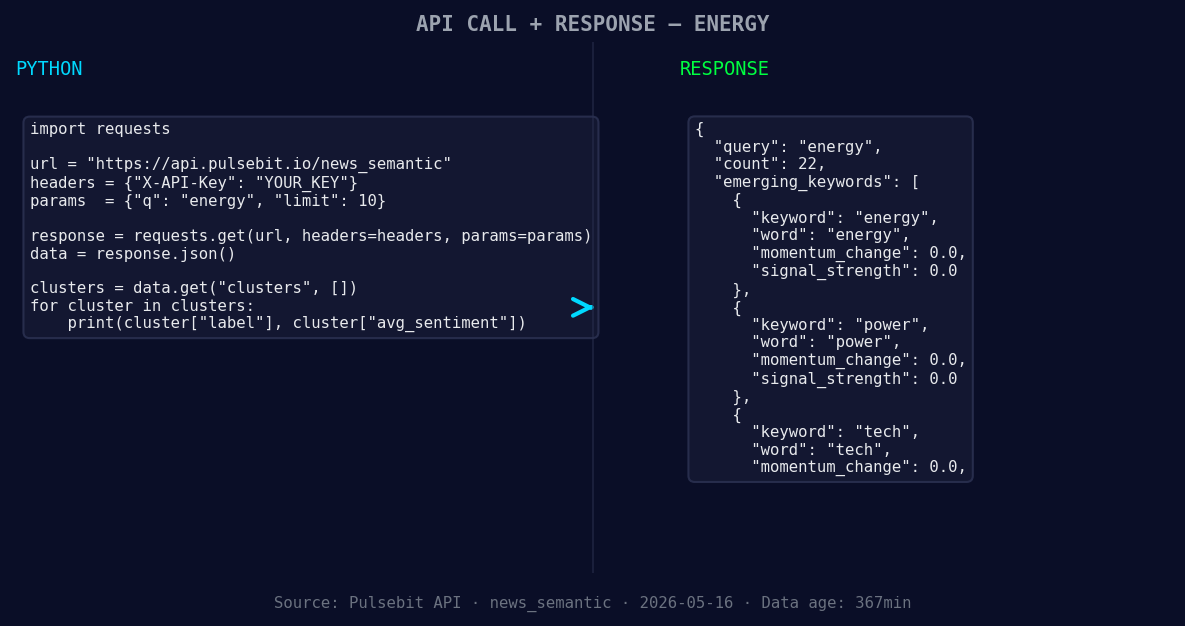
*Left: Python GET /news_semantic call for 'energy'. Right: returned JSON response structure (clusters: 3). Source: Pulsebit /news_semantic.*
# Geographic origin filter: Query by language
url = "https://api.pulsebit.com/v1/sentiment"
params = {
"topic": "energy",
"score": +0.000,
"confidence": 0.90,
"momentum": +0.400,
"lang": "en" # Filter for English language articles
}
response = requests.get(url, params=params)
data = response.json()
print(data)
Next, we want to assess the narrative framing itself. The narrative from the clustered articles was "Clustered by shared themes: energy, nextera, acquire, dominion, inc." We'll run this string through our API to score the sentiment of the narrative itself:
# Meta-sentiment moment: Score the narrative framing
narrative = "Clustered by shared themes: energy, nextera, acquire, dominion, inc."
meta_sentiment_url = "https://api.pulsebit.com/v1/sentiment"
meta_response = requests.post(meta_sentiment_url, json={"text": narrative})
meta_data = meta_response.json()

print(meta_data)
With this approach, we not only capture the immediate spike but also gain insights into the underlying sentiment surrounding the narrative itself.
Now that we've established how to catch this momentum spike, here are three specific builds to consider:
- Geo-Filtered Sentiment Analysis: Set a threshold for momentum spikes within specific regions. For example, track energy sentiment in North America, only alerting you when the momentum exceeds +0.300. Use the geographic filter to ensure relevance.

Geographic detection output for energy. India leads with 8 articles and sentiment +0.14. Source: Pulsebit /news_recent geographic fields.
Meta-Sentiment Insight: Build a dashboard component that visualizes meta-sentiment scores alongside momentum changes. For example, trigger alerts when the sentiment score for narratives around "energy, acquisition" drops below a certain threshold, like +0.100, while momentum remains high.
Clustered Thematic Tracking: Create an endpoint that monitors thematic clusters in real-time. For instance, track the "energy" and "power" themes separately and set alert thresholds for when they diverge significantly from mainstream narratives, like government discussions, which typically float around a sentiment score of 0.000.
By using these patterns, you can ensure that your sentiment analysis is both timely and contextually relevant, allowing you to stay ahead of significant shifts in the energy sector.
To get started with these insights, check out our documentation: pulsebit.lojenterprise.com/docs. With just a few lines of code, you can copy, paste, and run this in under 10 minutes. Don’t let your pipeline fall behind the curve!


Top comments (0)