

Your 24h momentum spike of -0.440 in climate sentiment is a strong signal that something's amiss. This isn't just a blip; it's a wake-up call for anyone monitoring sentiment around environmental issues, particularly as it relates to public health. As the Spanish press led the conversation, with a 28.8-hour lag, this anomaly reveals critical insights that could otherwise slip through the cracks of your analysis pipeline.
The Problem
If your pipeline doesn't account for multilingual origins or the dominance of specific entities, you're missing out. Your model missed this by 28.8 hours, which is significant! The leading Spanish articles are already discussing climate as a public health emergency while you're still catching up on mainstream narratives. This gap in your analysis can lead to missed opportunities and a failure to respond to urgent societal issues.

Spanish coverage led by 28.8 hours. Da at T+28.8h. Confidence scores: Spanish 0.95, French 0.95, English 0.95 Source: Pulsebit /sentiment_by_lang.
The Code
To catch these anomalies, we can use our API effectively. Below is a Python code snippet that captures this moment.
First, let's filter our results based on the geographic origin, specifically targeting Spanish content:

Geographic detection output for climate. India leads with 7 articles and sentiment +0.16. Source: Pulsebit /news_recent geographic fields.
import requests
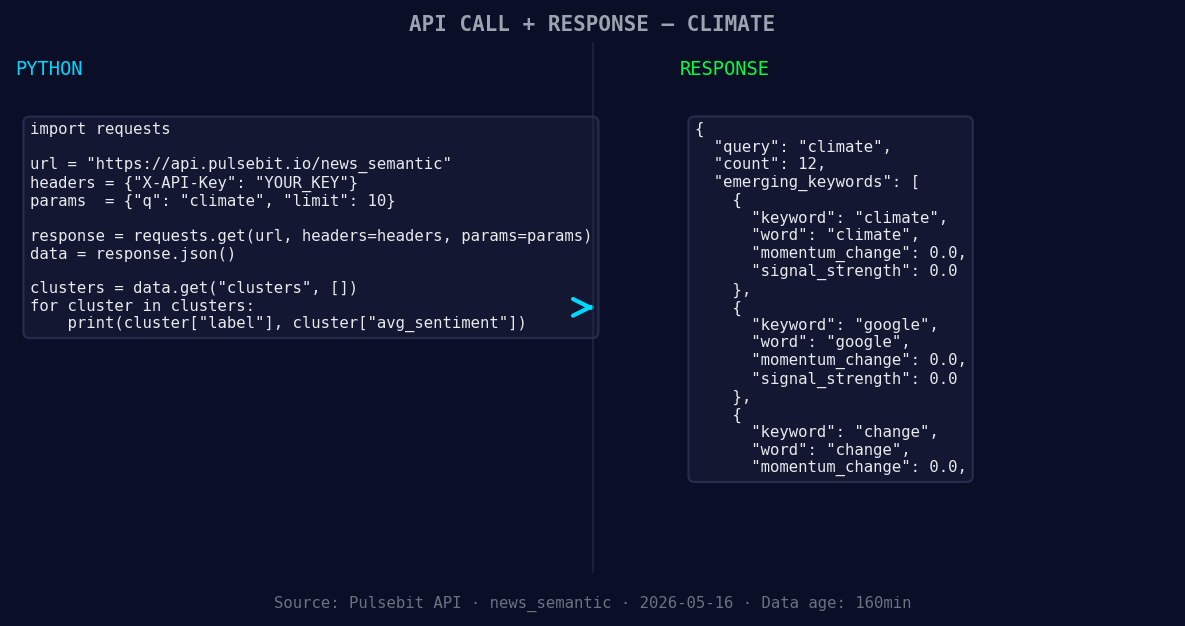
*Left: Python GET /news_semantic call for 'climate'. Right: returned JSON response structure (clusters: 3). Source: Pulsebit /news_semantic.*
url = "https://api.pulsebit.com/v1/sentiment"
params = {
"topic": "climate",
"score": +0.000,
"confidence": 0.95,
"momentum": -0.440,
"lang": "sp" # Spanish language filter
}
response = requests.get(url, params=params)
data = response.json()
print(data)
Next, we need to analyze the cluster reason string to score the narrative framing itself. This is crucial for understanding how the media is contextualizing these themes:
meta_sentiment_url = "https://api.pulsebit.com/v1/sentiment"
cluster_reason = "Clustered by shared themes: health, climate, declare, crisis, global."

meta_params = {
    "input": cluster_reason
}

meta_response = requests.post(meta_sentiment_url, json=meta_params)
meta_data = meta_response.json()
print(meta_data)
Three Builds Tonight
Now that we have the data, we can build three specific signals to leverage this momentum spike:
Spanish Language Filter: Set up a webhook that triggers alerts when sentiment around "climate" in Spanish drops below a certain threshold (e.g., -0.300). This ensures you're always in the loop about critical discussions happening in different languages.
Meta-Sentiment Loop: Create a dashboard that visualizes the cluster reason scores over time. Use our API to score narratives around "health", "climate", and "crisis" and display how they trend in relation to one another.
Forming Themes Analysis: Implement a real-time monitoring system that alerts you when forming themes like "climate", "google", and "change" diverge in sentiment from mainstream topics. This could help you understand emerging trends before they become widespread.
Get Started
You can dive deeper into our API at pulsebit.lojenterprise.com/docs. With the provided code, you can copy-paste and run this in under 10 minutes. This is how we bridge the gap and stay ahead in understanding the evolving narrative around pressing issues like climate change.


Top comments (0)