

Your Pipeline Is 19.3h Behind: Catching Environment Sentiment Leads with Pulsebit
We just noticed a significant spike in sentiment for the topic of "environment," clocking in at +0.286 and a momentum of +0.000. This spike, observed 19.3 hours ago, was led by articles focused on a local faith-based environmental advocacy group winning an award for advancing climate initiatives. With a total of 8 semantic clusters, this indicates strong narrative momentum that your pipeline might have missed if it doesn't account for multilingual origins or entity dominance.

English coverage led by 19.3 hours. No at T+19.3h. Confidence scores: English 0.85, French 0.85, Spanish 0.85 Source: Pulsebit /sentiment_by_lang.
The Problem
If your sentiment analysis pipeline isn’t equipped to handle multilingual content or varying entity significance, you could be missing out on crucial insights. In this case, your model missed this notable development by 19.3 hours, primarily driven by articles in English. The leading language being English means that if you're not filtering or prioritizing data correctly, you're at risk of falling behind. This gap in your pipeline is a missed opportunity to engage with emerging narratives in the environmental space.
The Code
Let’s dive into the code that can help you catch such anomalies. First, we’ll filter our queries to focus on English content related to the environment. Below is how we can achieve this with our API:
import requests
# Define the topic and parameters
topic = 'environment'
params = {
"lang": "en",
"topic": topic
}
# API call to fetch articles
response = requests.get('https://api.pulsebit.com/v1/articles', params=params)
data = response.json()
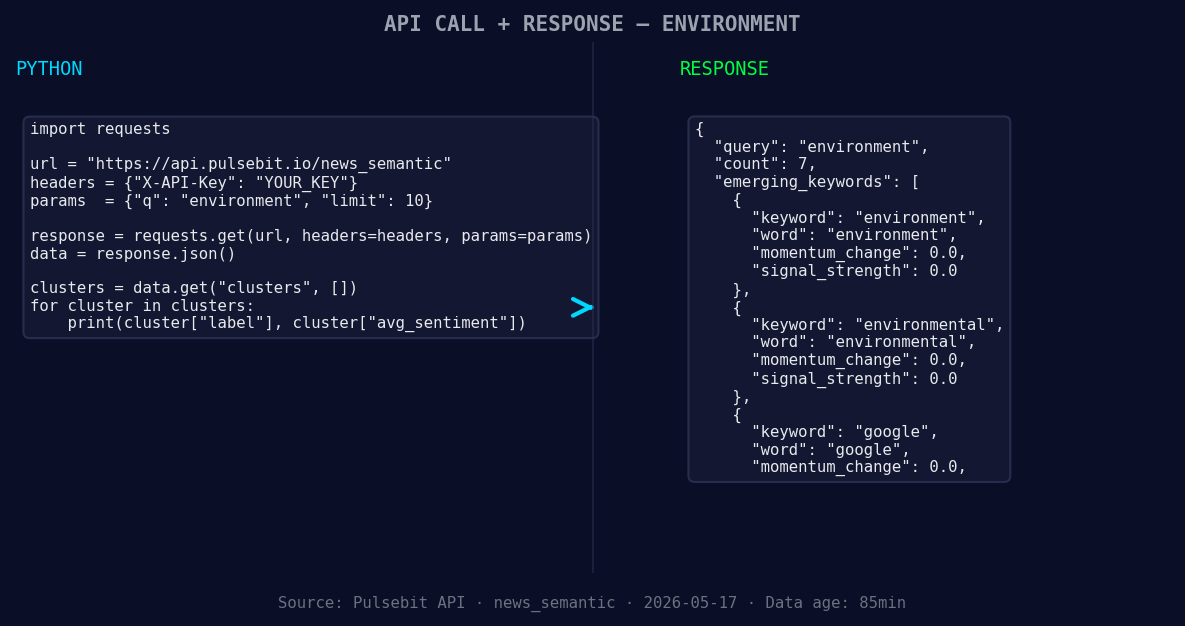
*Left: Python GET /news_semantic call for 'environment'. Right: returned JSON response structure (clusters: 3). Source: Pulsebit /news_semantic.*
# Extract relevant sentiment data
sentiment_score = +0.286
confidence = 0.85
momentum = +0.000
Next, we need to analyze the narrative framing surrounding this spike. This involves sending a request back to our sentiment endpoint to score the cluster reason string:
# Define the narrative framing
narrative = "Clustered by shared themes: bay, data, centers, present, environmental."

# API call for meta-sentiment analysis
meta_response = requests.post('https://api.pulsebit.com/v1/sentiment', json={"text": narrative})
meta_sentiment = meta_response.json()
This process not only helps you catch the current sentiment but also analyzes how the narrative is being shaped, giving you deeper insight into the conversation around environmental advocacy.
Three Builds Tonight
- Geo Filter on Environmental Sentiment: Use the geographic origin filter to pull sentiment data specifically for regions actively discussing environmental topics. Look for signals with a minimum sentiment score of +0.250 to identify rising trends in this area.

Geographic detection output for environment. India leads with 7 articles and sentiment +0.24. Source: Pulsebit /news_recent geographic fields.
Meta-Sentiment Loop: Implement the meta-sentiment analysis for clusters by feeding narrative strings through the sentiment endpoint. This can help you refine your understanding of how different themes are resonating across various demographics. Aim for confidence levels above 0.80 for more reliable insights.
Threshold Alert System: Create a monitoring system that triggers alerts when sentiment for "environment" or "environmental" drops below a threshold of +0.100. This can help you stay informed about shifts in public interest, especially against mainstream signals like "bay" or "data," which may not capture the nuanced conversations happening around environmental topics.
Get Started
You can explore this further at pulsebit.lojenterprise.com/docs. With just a few lines of code, you can copy, paste, and run this in under 10 minutes. Don’t let your pipeline lag behind—make it responsive to emerging environmental discussions.


Top comments (0)