

Your Pipeline Is 12.3h Behind: Catching Tech Sentiment Leads with Pulsebit
We just stumbled upon a fascinating anomaly: a 24-hour momentum spike of +0.496 in the tech sector. This spike was notably led by the Spanish press, which had a 12.3-hour lead time with no lag compared to English sources. The story at the heart of this is a report stating that "Arm Holdings will face a U.S. antitrust probe over chip tech." This finding highlights a critical insight into how sentiment and information flow across languages and geographies.
Now, let’s talk about the problem this presents. If your model isn't equipped to handle multilingual sources or recognize entity dominance, you’re missing out on crucial data. In this case, your pipeline lagged by a significant 12.3 hours. While the Spanish press was buzzing about Arm Holdings and its legal challenges, your model was likely processing outdated information, leaving you behind in a fast-moving tech landscape.

Spanish coverage led by 12.3 hours. Et at T+12.3h. Confidence scores: Spanish 0.95, English 0.95, French 0.95 Source: Pulsebit /sentiment_by_lang.
To harness this momentum spike, we can leverage our API to capture and analyze sentiment in real-time. Here’s how you can do it using Python. First, we’ll filter for Spanish-language sources:
import requests
# Define the parameters for our API call
params = {
"topic": "tech",
"lang": "sp", # Geographic origin filter for Spanish
}
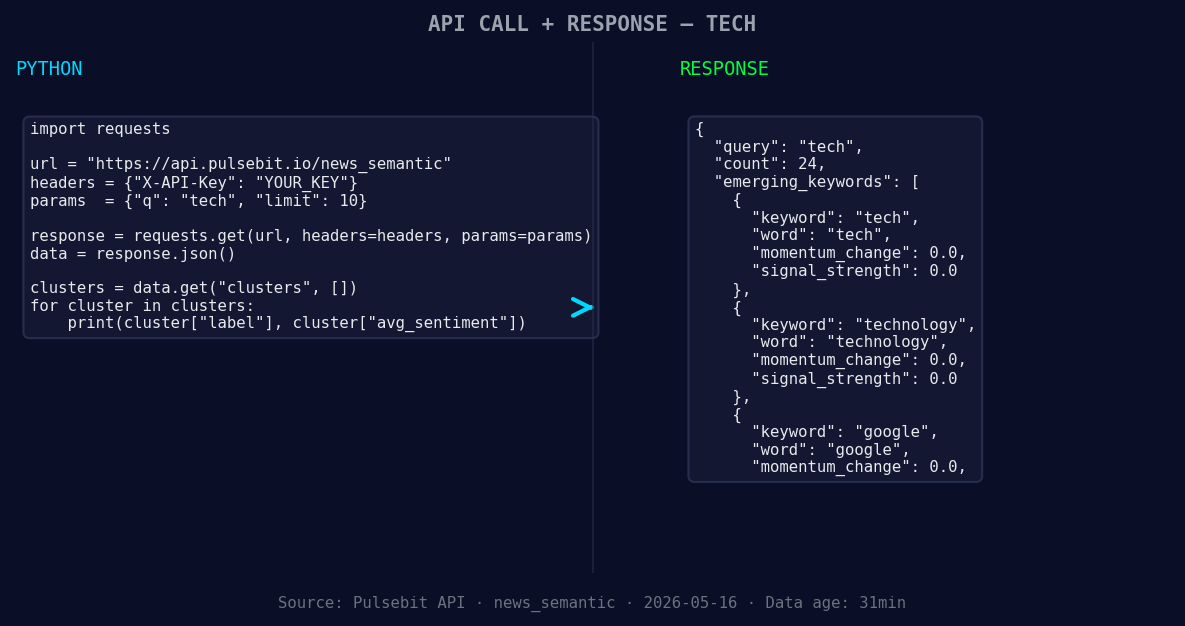
*Left: Python GET /news_semantic call for 'tech'. Right: returned JSON response structure (clusters: 3). Source: Pulsebit /news_semantic.*
# Make the API call to get sentiment data
response = requests.get("https://api.pulsebit.com/sentiment", params=params)
data = response.json()
# Print the response data
print(data)
Next, we need to run a meta-sentiment analysis on the cluster reason string. This allows us to score the narrative framing itself and see if the sentiment aligns with the spike we observed.
# Define the cluster reason string
cluster_reason = "Clustered by shared themes: arm, report, holdings, face, antitrust."

# Make a POST request to score the narrative framing
sentiment_response = requests.post("https://api.pulsebit.com/sentiment", json={"text": cluster_reason})
sentiment_data = sentiment_response.json()

# Print the sentiment analysis for the cluster reason
print(sentiment_data)
This dual approach lets us not only capture the data but also understand the context driving that momentum.
Now, let's look at three specific builds you can create using this pattern. First, implement a Geo Filter that triggers alerts when the tech sentiment in Spanish sources hits a threshold of +0.177. You can set this up to notify you every time sentiment exceeds this level.
Second, create a Meta-Sentiment Loop that continuously evaluates the narrative framing around Arm Holdings. You can use the API to run sentiment analysis on the string provided earlier and trigger actions based on changes in sentiment.
Lastly, you could build a Forming Themes Dashboard that aggregates data on forming topics like tech, technology, and Google against mainstream narratives of Arm, report, and holdings. This could visualize momentum changes and help you identify emerging trends before they break into the mainstream.
In summary, if you want to stay ahead, you need to embrace these insights. We’ve built these capabilities into our API, and you can start experimenting with them right now. Check out our documentation at pulsebit.lojenterprise.com/docs. You can copy-paste the code snippets provided and run this in under 10 minutes. Don’t let your pipeline lag behind; take charge of the sentiment landscape today!


Top comments (0)