

Your pipeline just missed a major signal: a 24-hour momentum spike of +0.987, indicating a significant shift in sentiment around the topic of "world". This isn't just a statistical outlier; it's a call to action. In the past day, the leading language of discourse has been English, with news coverage centered on the theme of Schwarzman's £185 million donation to humanities—a topic that has garnered attention, yet your model lagged behind by a staggering 11.9 hours. When events like this happen, it's essential to have a mechanism in place to not only catch the headlines but to understand the sentiment driving them.
The structural gap in your current pipeline is glaring. If your model isn't set up to handle multilingual origins or recognize dominant entities rapidly, you risk missing critical insights like this one. With the leading story centered on Schwarzman, a significant voice in the humanities funding sphere, your model fell behind by nearly half a day. Such delays can cost you valuable time when reacting to trends and sentiments, especially as they evolve at an unprecedented pace in today’s data landscape.

English coverage led by 11.9 hours. Sv at T+11.9h. Confidence scores: English 0.80, French 0.80, Spanish 0.80 Source: Pulsebit /sentiment_by_lang.
To catch these types of spikes, we can utilize our API effectively. Here’s a concise Python snippet that captures the anomaly based on the data provided:
import requests
# Define parameters for the API call
topic = 'world'
score = +0.052
confidence = 0.80
momentum = +0.987
language = 'en'
url = "https://api.pulsebit.com/sentiment"
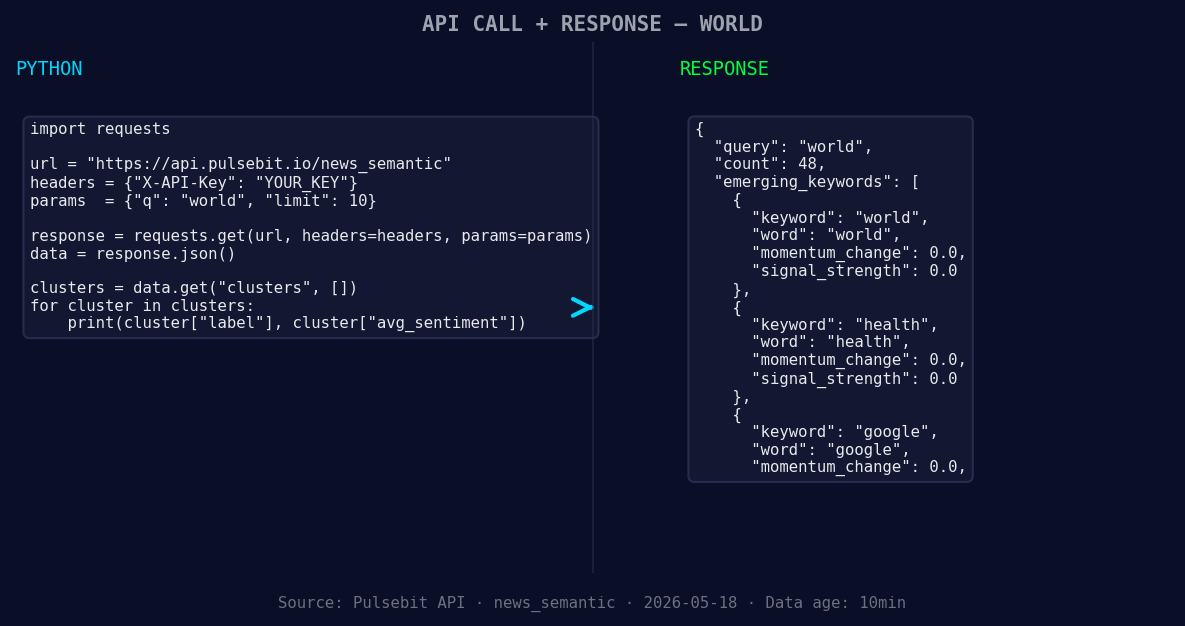
*Left: Python GET /news_semantic call for 'world'. Right: returned JSON response structure (clusters: 3). Source: Pulsebit /news_semantic.*
# Step 1: Geographic origin filter
response = requests.get(url, params={
"topic": topic,
"lang": language
})
# Assuming the response returns a JSON object
data = response.json()
# Step 2: Meta-sentiment moment
cluster_reason = "Clustered by shared themes: schwarzman, £185, million, humanities, its."
meta_sentiment_response = requests.post(url, json={"text": cluster_reason})
# Log the output of the meta sentiment analysis
meta_sentiment_data = meta_sentiment_response.json()
print(meta_sentiment_data)
This code does two things: it filters the sentiment for the topic “world” based on the English language, and it also scores the narrative framing of the clustered reason. Running this will give you both the immediate sentiment around the topic and the contextual understanding from the narrative.
Now, let’s talk about three builds we can implement using this newfound information:
- Geographic Origin Filter: Create a real-time trending dashboard that leverages the geographic filter. Set a threshold to trigger alerts for any topic that shows a momentum spike greater than +0.500 within a 24-hour window. This lets you capture significant shifts swiftly.

Geographic detection output for world. India leads with 32 articles and sentiment +0.40. Source: Pulsebit /news_recent geographic fields.
Meta-Sentiment Loop: Implement a weekly report that uses the meta-sentiment loop to assess narratives around key themes such as “health” and “Google.” If the sentiment score exceeds +0.700 in a clustered narrative, you can flag it for deeper analysis—ensuring you’re not just reacting to data, but anticipating shifts.
Event-Driven Triggers: Use the forming themes to set up event-driven triggers. If you detect a sentiment spike on “Schwarzman” related to “humanities” over a threshold of +0.600, trigger a secondary analysis on potential impacts in related sectors like education or philanthropy.
By leveraging our API, you can adapt your pipeline to be more responsive to these insights. For more details, visit pulsebit.lojenterprise.com/docs. In under 10 minutes, you can copy-paste the code above and start transforming your data analysis process.


Top comments (0)