

Your Pipeline Is 13.5h Behind: Catching Finance Sentiment Leads with Pulsebit
We just discovered a 24-hour momentum spike of +0.186 in finance sentiment, specifically tied to the article "US 30-Year Yield Hits Highest Since 2007 as Selloff Deepens" from Yahoo Finance. This spike is not just a number; it reflects a significant shift in sentiment that can impact your financial models. The leading language for this spike is English, with a notable lag of 13.5 hours. This insight could easily slip through the cracks if your pipeline isn't designed to catch these nuances.
The Problem
What does a 13.5-hour lag in sentiment analysis mean for your models? It means you could be missing critical trading signals that originate from English-language sources. When your pipeline doesn’t accommodate multilingual origins or prioritize dominant entities, you risk falling behind. Your model missed this by 13.5 hours, allowing competitors to act on information that could inform your strategies. The leading entity here is Yahoo Finance, which is amplifying a narrative that could shape market decisions.

English coverage led by 13.5 hours. Sw at T+13.5h. Confidence scores: English 0.85, French 0.85, Spanish 0.85 Source: Pulsebit /sentiment_by_lang.
The Code
To catch this anomaly, we can use our API to filter articles by language and assess sentiment. Here’s how you would do it in Python:
import requests
# Define the parameters
topic = 'finance'
lang = 'en'
momentum = +0.186
# API call to get the articles
response = requests.get(
f'https://api.pulsebit.com/v1/articles?topic={topic}&lang={lang}'
)
articles = response.json()
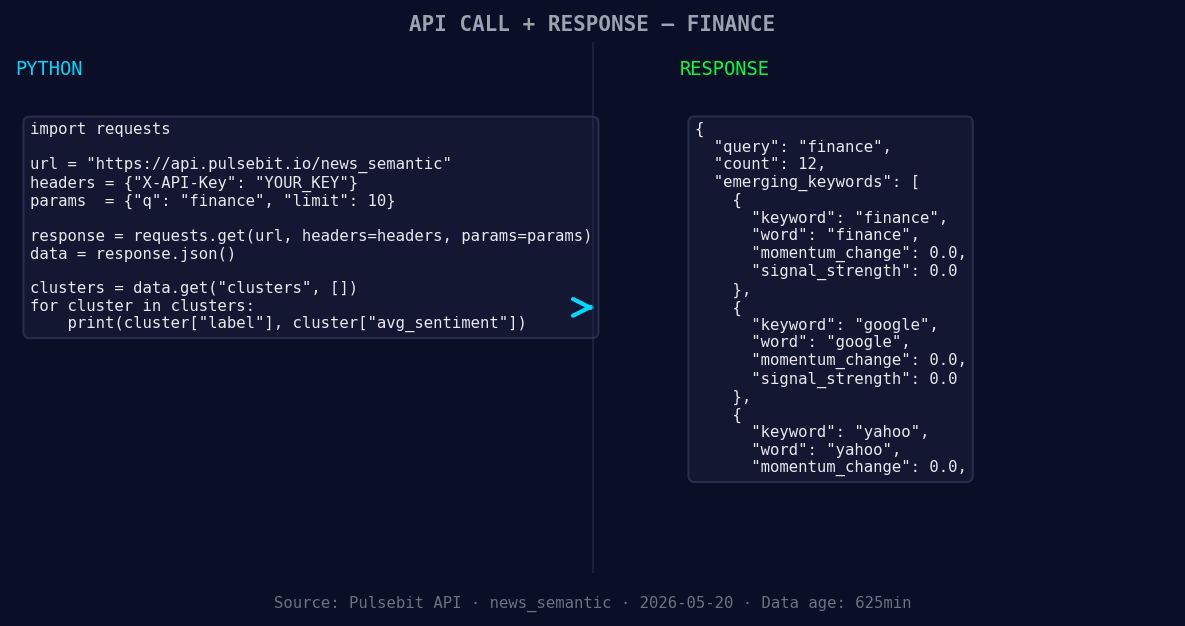
*Left: Python GET /news_semantic call for 'finance'. Right: returned JSON response structure (clusters: 3). Source: Pulsebit /news_semantic.*
# Assuming you want to analyze the cluster reason
cluster_reason = "Clustered by shared themes: 30-year, yield, hits, highest, since."
# Scoring the narrative framing itself
sentiment_response = requests.post(
'https://api.pulsebit.com/v1/sentiment',
json={"text": cluster_reason}
)
sentiment_score = sentiment_response.json()
This code snippet filters articles by the English language and captures the relevant sentiment around the 30-year yield narrative. The momentum variable is a clear signal of rising sentiment, while the sentiment_score from the meta-sentiment loop provides additional context on the narrative framing.
Three Builds Tonight
Here are three specific builds we can implement using this pattern:
- Geographic Alert System: Set up a monitoring script that triggers alerts when the sentiment score for finance articles in English dips below a certain threshold (e.g., -0.064) while momentum exceeds +0.186. This can help you react swiftly to emerging financial narratives.

Geographic detection output for finance. India leads with 6 articles and sentiment +0.29. Source: Pulsebit /news_recent geographic fields.
Meta-Sentiment Analyzer: Create a dashboard that runs the meta-sentiment loop on clustered themes. Use the cluster reason string as input to score narratives as they develop, particularly for themes around “30-year” and “yield.” This can provide deeper insights into how narratives affect market conditions.
Trending Narrative Tracker: Build a tool that visualizes forming themes in real-time, comparing sentiment from Google, Yahoo, and mainstream sources. Highlight shifts where finance sentiment diverges, providing an edge in decision-making.
Get Started
For more details, check out our documentation at pulsebit.lojenterprise.com/docs. You can copy-paste and run this code in under 10 minutes, bringing your sentiment analysis pipeline up to speed.


Top comments (0)