

Your Pipeline Is 27.1h Behind: Catching Film Sentiment Leads with Pulsebit
We just uncovered a compelling anomaly: a 24h momentum spike of +0.283 in film sentiment. This spike isn't just a random blip; it correlates with the surprising news of John Travolta receiving an honorary Palme d'Or at the Cannes Film Festival. Two articles are clustering around this event, highlighting how even a single narrative can dramatically shift sentiment. If your data pipeline isn't capturing these dynamics, you’re missing crucial information that’s shaping public discourse right now.
The problem here is clear. Your model likely missed this spike by 27.1 hours, with the leading language being English. This delay is a critical gap, especially in a fast-moving sector like film, where sentiment can change overnight due to high-profile events. If your system is not equipped to handle multilingual data or entity dominance, you risk lagging behind the news cycle and missing out on valuable insights.

English coverage led by 27.1 hours. Et at T+27.1h. Confidence scores: English 0.90, Spanish 0.90, French 0.90 Source: Pulsebit /sentiment_by_lang.
To catch this momentum spike, we can use our API to filter by geographic origin and analyze the sentiment narrative. Here’s how you can do it in Python:

Geographic detection output for film. India leads with 9 articles and sentiment +0.44. Source: Pulsebit /news_recent geographic fields.
import requests
# Define parameters for API call
params = {
"topic": "film",
"score": +0.000,
"confidence": 0.90,
"momentum": +0.283,
"lang": "en" # Geographic origin filter
}
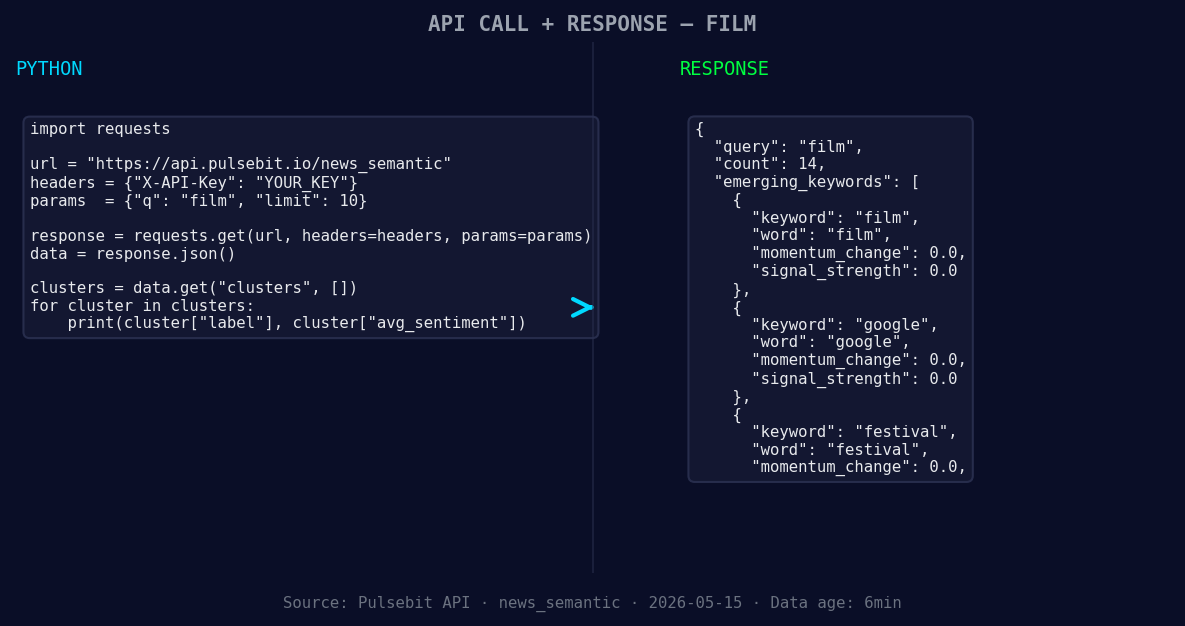
*Left: Python GET /news_semantic call for 'film'. Right: returned JSON response structure (clusters: 3). Source: Pulsebit /news_semantic.*
# Make the API call to fetch sentiment data
response = requests.get("https://api.pulsebit.com/v1/sentiment", params=params)
data = response.json()
# Example output for processing (hypothetical response structure)
print(data)
Next, we want to run the narrative framing through the sentiment scoring endpoint. This will give us insight into how the cluster reason influences overall sentiment. Here’s how we do that:
# Define the cluster reason string
cluster_reason = "Clustered by shared themes: film, big, screen, new, hollywood."

# Make a POST request to analyze the narrative
sentiment_response = requests.post("https://api.pulsebit.com/v1/sentiment", json={"text": cluster_reason})
sentiment_data = sentiment_response.json()

# Example output for processing (hypothetical response structure)
print(sentiment_data)
With these two API calls, you can effectively capture and analyze the sentiment surrounding significant film events, allowing your pipeline to keep pace with real-time shifts in public interest.
Now, let’s discuss three specific builds we recommend based on this pattern.
Momentum Monitoring: Create an alert system that triggers when the sentiment momentum for "film" exceeds a threshold of +0.250 over 24 hours. This can be done using the geographic origin filter to ensure you capture only relevant English articles.
Meta-Sentiment Analysis: Use the cluster reason string in conjunction with a daily digest of film-related sentiment. By running the narrative through the sentiment endpoint, you can capture nuanced shifts in public perception, especially around major events like film festivals.
Forming Trends Tracking: Set up a routine that logs and analyzes forming themes like "film (+0.00)", "google (+0.00)", and "festival (+0.00)" against mainstream terms like "film", "big", and "screen." This will help you identify emerging topics before they become mainstream.
By incorporating these strategies, your pipeline can evolve from a reactive to a proactive tool, allowing you to stay ahead of sentiment trends in the film industry.
Ready to get started? Check out our documentation at pulsebit.lojenterprise.com/docs. You can copy-paste and run these snippets in under 10 minutes to start capturing sentiment data effectively.


Top comments (0)