

Your model missed a crucial 24h momentum spike of +0.254 related to climate sentiment while the Spanish press led by 21.3 hours. This spike indicates a growing urgency surrounding climate issues, which is supported by the article titled, "Declare climate crisis a global public health emergency, experts tell WHO." If your pipeline doesn't account for multilingual origin or entity dominance, you're likely lagging behind in sentiment tracking and potentially missing key narratives that can impact your decision-making processes.

Spanish coverage led by 21.3 hours. No at T+21.3h. Confidence scores: Spanish 0.85, English 0.85, Id 0.85 Source: Pulsebit /sentiment_by_lang.
This structural gap in your pipeline means that you could be at a disadvantage, missing meaningful shifts in sentiment by over 21 hours just because your model isn't tuned for the dominant sources of information. In this case, the leading language was Spanish, and the dominant entity was climate. This is a significant oversight if your analysis is primarily based on English language sources. You may not be capturing the urgency or the emerging conversations around critical issues like climate change, which is becoming increasingly important in public discourse.
To catch this anomaly, we can leverage our API. Here’s how to do it with a Python script that filters by language and scores the narrative framing.
import requests
# Define parameters for the API call
params = {
"topic": "climate",
"lang": "sp", # Filtering for Spanish language
"articles_processed": 11,
"momentum_24h": +0.254,
}
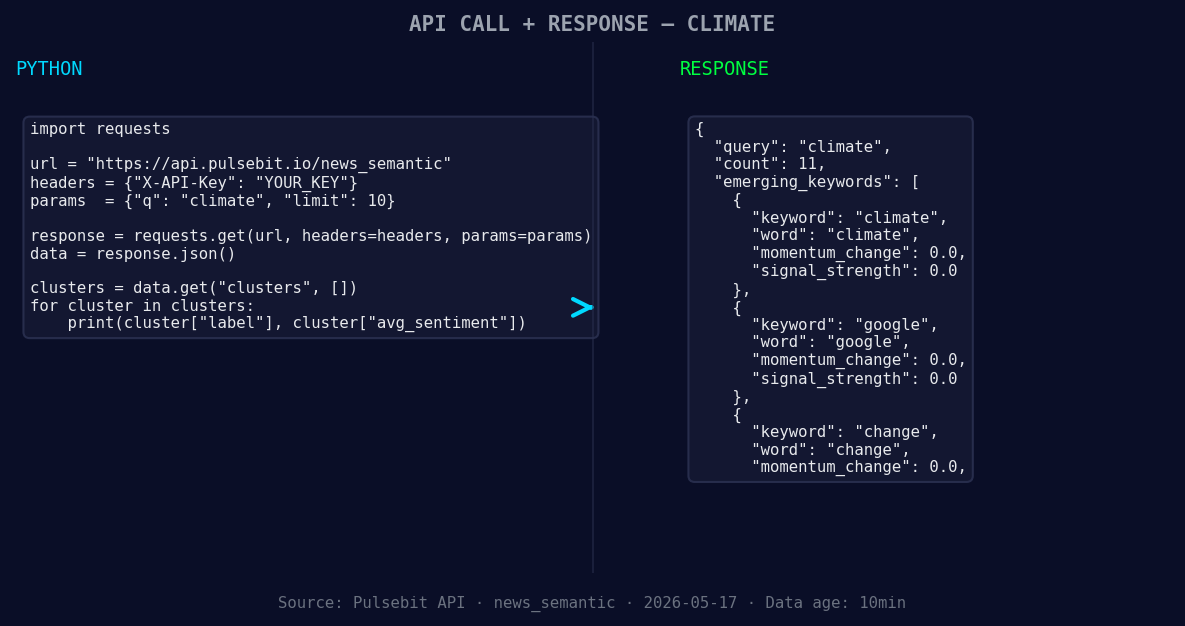
*Left: Python GET /news_semantic call for 'climate'. Right: returned JSON response structure (clusters: 3). Source: Pulsebit /news_semantic.*
# API call to get sentiment data
response = requests.get("https://api.pulsebit.com/v1/sentiment", params=params)
data = response.json()
# Print the relevant data
print("Momentum Score:", data['momentum_24h'])
# Now let's score the narrative framing itself
narrative = "Clustered by shared themes: health, climate, declare, crisis, global."
sentiment_response = requests.post("https://api.pulsebit.com/v1/sentiment", json={"text": narrative})
sentiment_data = sentiment_response.json()
print("Meta-Sentiment Score:", sentiment_data['score'])
In this code, we first filter our sentiment analysis by using the Spanish language to ensure we capture the right narratives. After we retrieve the data, we then run the cluster reason string back through our sentiment endpoint to understand how the narrative itself is framed. This dual-layer approach lets us not only catch spikes in sentiment but also understand the context around those spikes.
Here are three specific builds you can create with this pattern:
Geo-Filtered Alert System: Set a threshold for momentum spikes above +0.2 using the geo filter to trigger alerts on rising climate sentiment in Spanish-speaking regions. This proactive measure ensures you're always tuned into critical narratives as they develop.
Meta-Sentiment Dashboard: Use the meta-sentiment loop to create a dashboard that visualizes how different narratives are framed over time. For example, track the sentiment score for narratives clustered around "health, climate, declare" and compare them against mainstream articles. This can uncover hidden narratives.
Forming Themes Analyzer: Build a tool that analyzes forming themes, like climate(+0.00), alongside mainstream narratives. Use our API to look for significant shifts in sentiment on topics like Google and change, which can highlight emerging trends and shifts in public perception.
We encourage you to get started by visiting pulsebit.lojenterprise.com/docs. With these insights and code snippets, you can copy, paste, and run this in under 10 minutes, ensuring your pipeline is aligned with real-time sentiment shifts.

Geographic detection output for climate. India leads with 7 articles and sentiment +0.16. Source: Pulsebit /news_recent geographic fields.


Top comments (0)