

Your Pipeline Is 27.4h Behind: Catching Climate Sentiment Leads with Pulsebit
We recently uncovered a striking anomaly: a 24-hour momentum spike of -0.275 in climate sentiment. This sharp downturn signals a significant shift in public sentiment surrounding climate-related issues, as evidenced by the leading language of English press articles clustered around a call to declare the climate crisis a global public health emergency. With headlines emerging just 27.4 hours ago, it's a clear indication that our usual models might be lagging behind in capturing these critical moments.
The Problem
This finding exposes a major flaw in pipelines that don’t account for multilingual origins or the dominance of specific entities. Your model missed this spike by 27.4 hours. If you're not integrating data from multiple languages or if you're emphasizing mainstream narratives, you're likely overlooking crucial sentiment shifts, like the one seen in the English-language discourse surrounding climate and health. This can lead to missed opportunities or misguided strategies when responding to emerging trends.

English coverage led by 27.4 hours. Ca at T+27.4h. Confidence scores: English 0.95, Id 0.95, French 0.95 Source: Pulsebit /sentiment_by_lang.
The Code
To catch this momentum spike effectively, we can leverage our API to filter sentiment data by geographic origin and assess the framing of narratives. Here’s how you can do it in Python:

Geographic detection output for climate. India leads with 7 articles and sentiment +0.16. Source: Pulsebit /news_recent geographic fields.
import requests
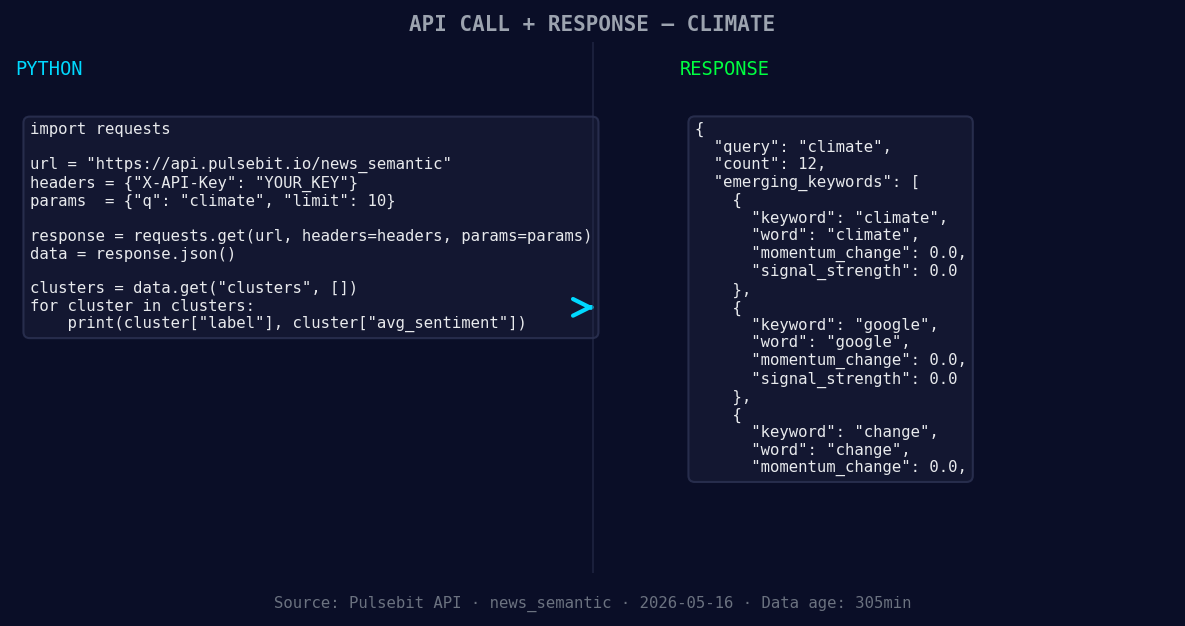
*Left: Python GET /news_semantic call for 'climate'. Right: returned JSON response structure (clusters: 3). Source: Pulsebit /news_semantic.*
# Step 1: Geographic origin filter for English language
response = requests.get(
'https://api.pulsebit.com/sentiment',
params={
'topic': 'climate',
'score': +0.000,
'confidence': 0.95,
'momentum': -0.275,
'lang': 'en'
}
)
data = response.json()
print(data)
Next, we’ll run the cluster reason string through our meta-sentiment endpoint to evaluate how the narrative is being framed:
# Step 2: Meta-sentiment moment
meta_sentiment_response = requests.post(
    'https://api.pulsebit.com/sentiment',
    json={
        'input': "Clustered by shared themes: health, climate, declare, crisis, global."
    }
)

meta_sentiment_data = meta_sentiment_response.json()
print(meta_sentiment_data)
This code provides a dual approach: first, filtering sentiment data by language to isolate key insights, and second, analyzing how the narratives around climate and health are constructed. This is essential for understanding the full picture and making data-driven decisions.
Three Builds Tonight
Based on this discovery, we can outline three specific builds that can help you capitalize on this sentiment shift:
Geographic Sentiment Filter: Use the geo filter to capture signals from English-language articles specifically discussing “climate” with a threshold of momentum below -0.250. This allows you to focus on areas where sentiment is rapidly declining.
Meta-Sentiment Analysis: Implement a routine that pulls the cluster narrative string and assesses its sentiment. For example, evaluate any input string with themes such as "health," "climate," "declare," and "crisis" to gauge public framing around these issues. This can help you understand the emotional context behind the headlines.
Forming Gap Insights: Monitor forming themes like “climate” (+0.00), “google” (+0.00), and “change” (+0.00) versus mainstream narratives like “health” and “climate.” Set alerts for when these gaps widen, indicating a potential shift in public focus that could be leveraged for timely responses.
Get Started
You can find more details on how to implement these strategies in our documentation at pulsebit.lojenterprise.com/docs. The best part? You can copy-paste and run this code in under 10 minutes. Don't let your pipeline fall behind; start catching these critical sentiment shifts today.


Top comments (0)