

Your Pipeline Is 21.5h Behind: Catching Agriculture Sentiment Leads with Pulsebit
We recently observed a striking anomaly: a 24h momentum spike of +0.248 in the agriculture topic. This spike was primarily driven by two articles discussing the concerns of a farm leader after Trump left China without an agriculture deal. The leading language for this sentiment was English, with a 21.5-hour lead—highlighting a significant delay in capturing this critical information.
The Problem
Your model likely missed this vital information by 21.5 hours. Why? If your pipeline doesn’t account for multilingual origin or entity dominance, you’ll find yourself reacting to events long after they've already begun to shape sentiment. In this case, the English press was leading the sentiment narrative, while other languages lagged behind. If you’re not capturing these nuances, you’re effectively flying blind.

English coverage led by 21.5 hours. Sv at T+21.5h. Confidence scores: English 0.75, Spanish 0.75, French 0.75 Source: Pulsebit /sentiment_by_lang.
The Code
Here’s a straightforward way to capture this data using our API. We can start by querying sentiment related to agriculture in English:
import requests
# Define the parameters for the API call
params = {
"topic": "agriculture",
"lang": "en"
}
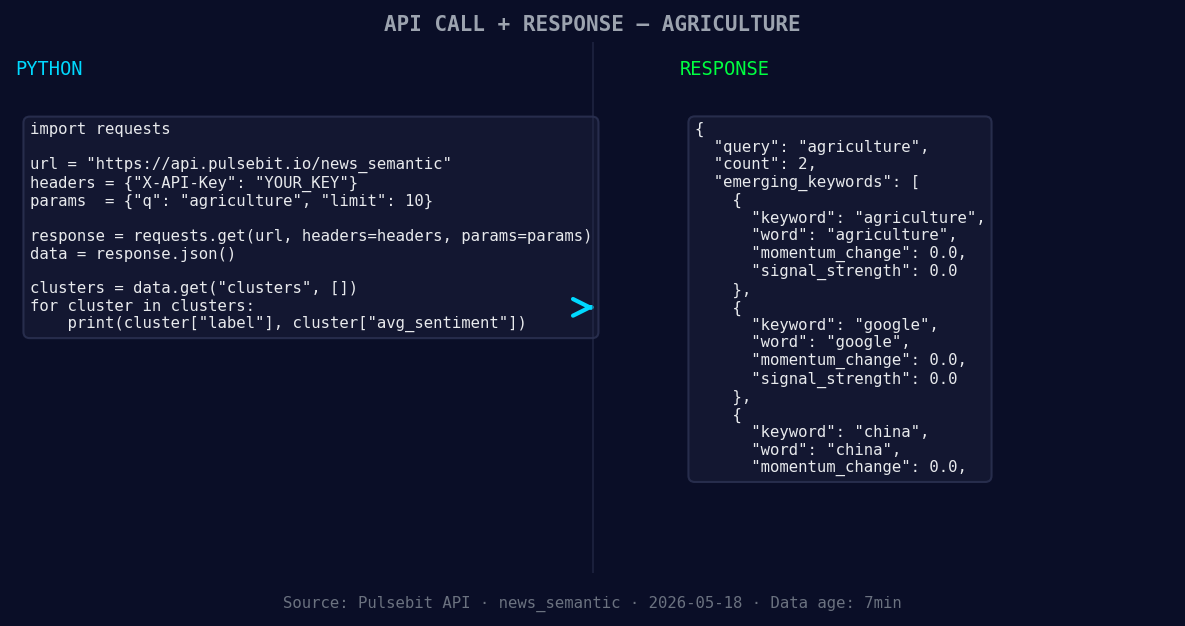
*Left: Python GET /news_semantic call for 'agriculture'. Right: returned JSON response structure (clusters: 3). Source: Pulsebit /news_semantic.*
# Make the API call to get sentiment data
response = requests.get("https://api.pulsebit.com/sentiment", params=params)
data = response.json()
# Print the response data for debugging
print(data)
Now, let’s take the cluster reason string and run it back through our sentiment endpoint to score the narrative itself. Here’s how we can do that:
# Define the cluster reason string
cluster_reason = "Clustered by shared themes: agrees, buy, billions, agriculture, products."

# Make an API call to score the narrative framing
sentiment_response = requests.post(
    "https://api.pulsebit.com/sentiment",
    json={"text": cluster_reason}
)

sentiment_data = sentiment_response.json()

# Print the sentiment data for debugging
print(sentiment_data)
This will help us gauge how the framing of the news influences overall sentiment in the agriculture sector. By leveraging these two endpoints, you can significantly enhance your understanding of sentiment dynamics.
Three Builds Tonight
- Geo-Filtered Sentiment Analysis: Use the geographic origin filter to capture sentiment around agriculture in the U.S. specifically. Set a threshold score of +0.460 to focus on rising sentiment. This will help you identify regional spikes more effectively.

Geographic detection output for agriculture. France leads with 1 articles and sentiment +0.75. Source: Pulsebit /news_recent geographic fields.
```python
params = {
    "topic": "agriculture",
    "lang": "en",
    "geo": "US",
    "threshold": +0.460
}
```
Meta-Sentiment Loop: Implement the meta-sentiment loop using the cluster reason string. This helps you understand not just what is being said, but how it is being framed. Set a confidence threshold of 0.75 for actionable insights.
Forming Themes Analysis: Focus on the forming themes such as agriculture, Google, and China. Create a signal to trigger alerts when sentiment around these topics diverges significantly from mainstream narratives that include terms like "agrees," "buy," and "billions."
Get Started
Ready to dive deeper? Visit pulsebit.lojenterprise.com/docs. You can copy-paste the code snippets above and run them in under 10 minutes. This is our way of making sure you’re not just catching up with the news; you’re ahead of the curve.


Top comments (0)