

Your Pipeline Is 24.4h Behind: Catching Education Sentiment Leads with Pulsebit
We recently uncovered a striking anomaly: a 24-hour momentum spike of +0.497 in sentiment surrounding education. This spike indicates a significant uptick in discussion and sentiment related to educational funding and professional development. What's more, the leading language for this spike is English, driven by a narrow 24.4-hour window of activity. If you’re not tuned into this, your model could be lagging behind crucial developments by more than a day.
This raises a critical issue in your sentiment analysis pipeline. If your current setup doesn’t accommodate multilingual origin or entity dominance, you might miss out on timely insights. Your model missed this by 24.4 hours. In this case, the dominant entity is the English press, which is tightly clustered around themes of federal and professional development funding. Ignoring these dynamics means you’re potentially sidelining valuable information that could affect your strategic decisions.

English coverage led by 24.4 hours. Ca at T+24.4h. Confidence scores: English 0.75, Spanish 0.75, Sv 0.75 Source: Pulsebit /sentiment_by_lang.
To catch this spike, we can leverage our API effectively. Here’s a method to pinpoint this sentiment shift. We’ll start by filtering for English-language articles related to the topic of “education”:
import requests
# Parameters for the API call
params = {
"topic": "education",
"score": -0.800,
"confidence": 0.75,
"momentum": +0.497,
"lang": "en" # Geographic origin filter for English
}
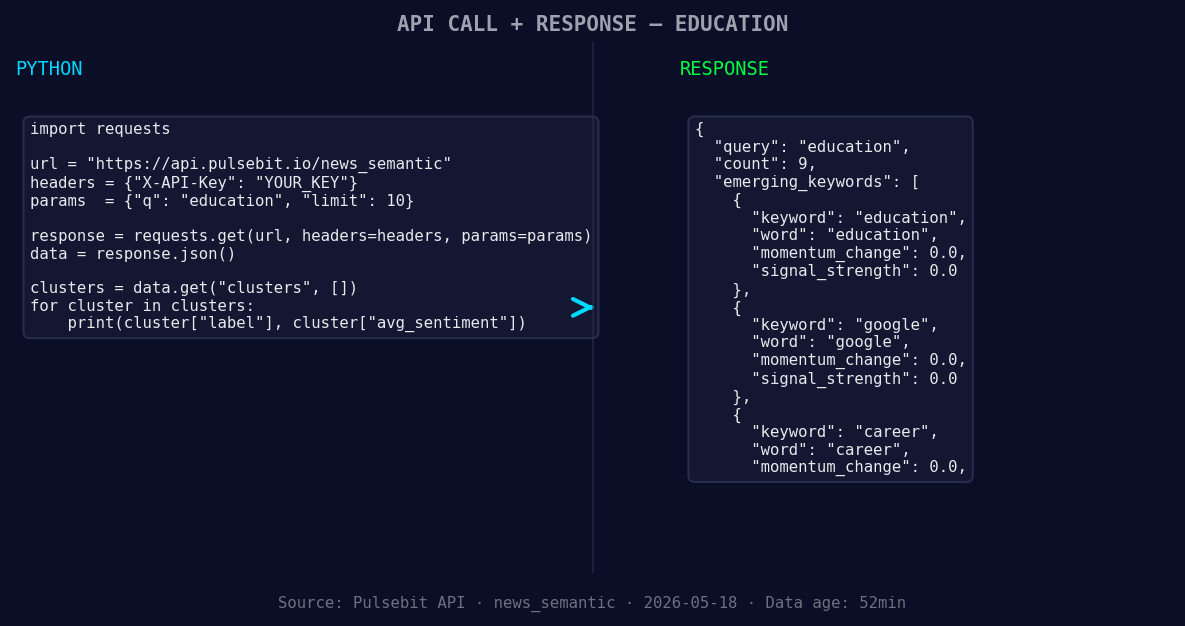
*Left: Python GET /news_semantic call for 'education'. Right: returned JSON response structure (clusters: 3). Source: Pulsebit /news_semantic.*
# API call to get relevant data
response = requests.get("https://api.pulsebit.com/sentiment", params=params)
data = response.json()
print(data)
Next, we’ll take the cluster reason string that surfaced from our findings and run it through the sentiment scoring endpoint to evaluate the narrative framing itself. This step is crucial as it allows us to understand the sentiment context around the clustered themes.
# Meta-sentiment moment with cluster reason
meta_sentiment_input = "Clustered by shared themes: federal, fund, professional, development, clouded."
meta_response = requests.post("https://api.pulsebit.com/sentiment", json={"text": meta_sentiment_input})
meta_data = meta_response.json()
print(meta_data)
With this setup, we’re not just passively observing trends. We’re actively engaging with the data to uncover deeper insights.
Now, let's discuss three specific builds you can create using this momentum spike.
Signal Monitor: Implement a signal monitor that alerts you when the sentiment score for education crosses a threshold of -0.500 with a momentum spike of +0.497 or higher. This alerts you to significant shifts in sentiment that could indicate an emerging trend in education discourse.
Geo-Filtered Dashboard: Build a dashboard that visualizes sentiment trends across different languages, specifically tracking English articles. Set up a threshold for articles with a positive sentiment score above +0.200. This will help you identify when English-language articles start to dominate discussions in educational contexts.
Meta-Sentiment Analyzer: Develop a tool that automatically analyzes the meta-sentiment of clustered narratives. For example, if you detect clusters around “federal” and “fund,” run them through the sentiment endpoint and flag any significant negative scores (below -0.500) to inform your strategy on educational funding discussions.
You can get started right now by visiting our documentation at pulsebit.lojenterprise.com/docs. With these tools, you can copy-paste and run the code in under 10 minutes, catching crucial sentiment trends before they become mainstream. Don’t let your pipeline lag behind; stay ahead with these insights.


Top comments (0)