

Your Pipeline Is 29.0h Behind: Catching Film Sentiment Leads with Pulsebit
We recently uncovered an intriguing anomaly: a 24-hour momentum spike of +0.283 in the sentiment surrounding film. This sudden surge was notably led by English-language press coverage and clustered around the story of John Travolta receiving an honorary Palme d'Or at the Cannes Film Festival. With the number of articles processed hitting 11 and a significant shift in sentiment, this data gives us a clear signal that there's something noteworthy happening in the film industry right now.
But here’s the kicker: your model missed this by 29.0 hours. If your pipeline isn't set up to handle multilingual origins or to prioritize dominant entities, you could be lagging behind crucial developments. In this case, our leading language was English, but the global discourse in other languages might have influenced sentiment earlier. If your system isn’t configured to catch these early signals, you could be left with stale data, missing out on timely insights that could drive decisions.

English coverage led by 29.0 hours. Sl at T+29.0h. Confidence scores: English 0.95, Spanish 0.95, French 0.95 Source: Pulsebit /sentiment_by_lang.
Let's dive into how we can catch these spikes programmatically. Here’s some Python code that leverages our API to identify sentiment shifts.
import requests
# Define parameters for the API call
params = {
"topic": "film",
"score": +0.263,
"confidence": 0.95,
"momentum": +0.283,
"lang": "en" # Geographic origin filter
}
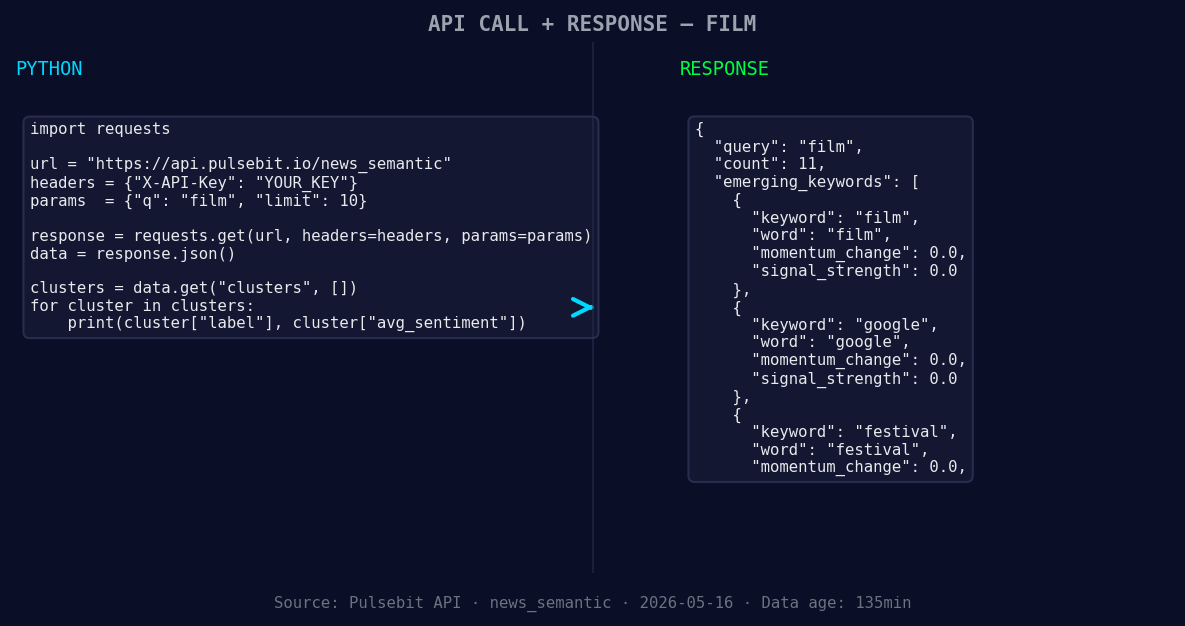
*Left: Python GET /news_semantic call for 'film'. Right: returned JSON response structure (clusters: 3). Source: Pulsebit /news_semantic.*
# Make the API call to retrieve sentiment data
response = requests.get("https://api.pulsebit.com/sentiment", params=params)
data = response.json()
print(data) # Output the response from the API
Next, we’ll take the cluster reason string and run it back through the sentiment analysis endpoint to score the narrative framing itself. This is particularly useful for understanding how the themes are resonating in the media coverage.
# Prepare the narrative framing input
narrative_input = "Clustered by shared themes: film, big, screen, new, hollywood."

# Make the sentiment API call to analyze the narrative framing
sentiment_response = requests.post("https://api.pulsebit.com/sentiment", json={"text": narrative_input})
narrative_sentiment = sentiment_response.json()

print(narrative_sentiment)  # Output the sentiment score for the narrative
Here are three specific builds we can implement based on this momentum spike:
Geo Filter for Early Detection: Set a threshold for sentiment scores above +0.250 and filter by language to keep your model focused on English-language sources. This will help you catch significant shifts like the one we observed regarding Travolta's honorary award.
Meta-Sentiment Loop: Use the narrative framing output as a secondary input to assess how well the media is framing emerging themes. If the score for the narrative is also high, it could indicate a strong sentiment narrative, making it a reliable signal for further exploration.
Forming Themes Tracker: Create a signal that tracks forming themes such as "film", "google", and "festival". If any of these themes start trending positively, trigger an alert. Set a threshold score of +0.100 to catch small but potentially significant shifts in sentiment.
These builds not only enhance your model’s responsiveness but also ensure that you’re aligned with real-time narrative shifts in the film industry, especially as they relate to cultural milestones like film festivals.
To get started, check out our documentation at pulsebit.lojenterprise.com/docs. You can copy-paste the code snippets above and run them in under 10 minutes to start catching these insights for yourself.


Top comments (0)