

Your Pipeline Is 27.0h Behind: Catching Blockchain Sentiment Leads with Pulsebit
We recently discovered a striking anomaly: a 24-hour momentum spike of +0.163 in blockchain sentiment. This surge is particularly compelling given that the leading language is English, and the conversation is being dominated by a cluster story on "Blockchain Solar Dryers to Combat Food Loss in Nigeria." It’s a clear signal that something significant is happening, and you need to be on top of it.
But here’s the catch: your model missed this by 27.0 hours. That’s a substantial gap when you consider that the conversation is being led by a single language and entity. If your pipeline doesn’t account for multilingual origins or entity dominance, you're at risk of falling behind. The narrative is unfolding in real-time, and without the right tools, you're left playing catch-up while the market moves on.

English coverage led by 27.0 hours. Ca at T+27.0h. Confidence scores: English 0.85, French 0.85, Spanish 0.85 Source: Pulsebit /sentiment_by_lang.
Let’s dive into the code that will help you catch these momentum shifts before it’s too late. Here’s how we can use our API to filter for sentiment in English and analyze the narrative framing.
import requests
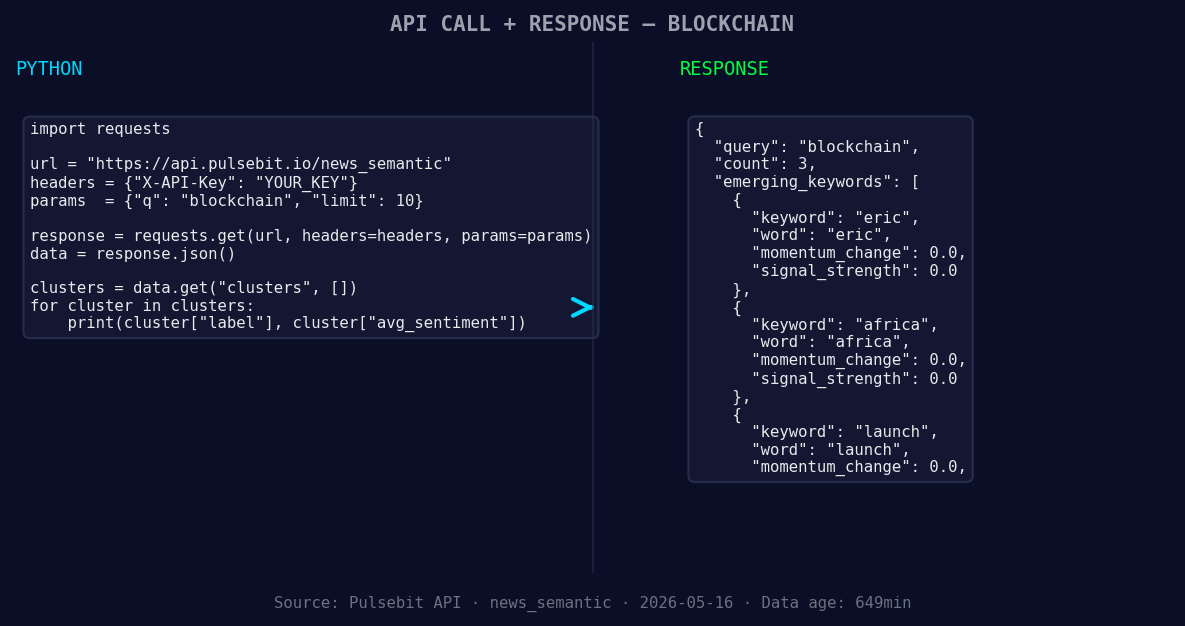
*Left: Python GET /news_semantic call for 'blockchain'. Right: returned JSON response structure (clusters: 3). Source: Pulsebit /news_semantic.*
# Step 1: Geographic origin filter
topic = 'blockchain'
score = +0.000
confidence = 0.85
momentum = +0.163
url = 'https://api.pulsebit.lojenterprise.com/sentiment'
params = {
'topic': topic,
'score': score,
'confidence': confidence,
'momentum': momentum,
'lang': 'en'
}
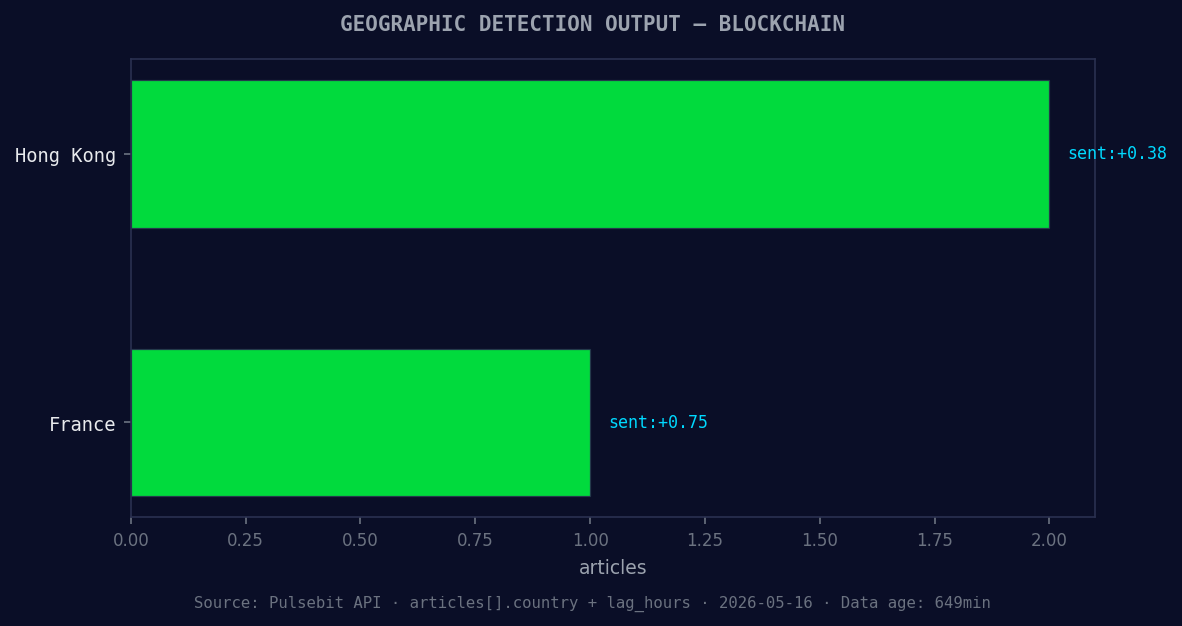
*Geographic detection output for blockchain. Hong Kong leads with 2 articles and sentiment +0.38. Source: Pulsebit /news_recent geographic fields.*
response = requests.get(url, params=params)
sentiment_data = response.json()
print(sentiment_data)
Now that we have filtered our sentiment data, let’s take it a step further. We need to assess the narrative framing of our clustered topics using our meta-sentiment loop.
# Step 2: Meta-sentiment moment
cluster_reason = "Clustered by shared themes: africa, nspri, launch, blockchain-powered, solar."
meta_sentiment_response = requests.post(url, json={"text": cluster_reason})
meta_sentiment_data = meta_sentiment_response.json()
print(meta_sentiment_data)
By running the narrative through our API, we not only capture the sentiment but also understand how the framing can influence the perception of the entire story.
Now that we have our foundation laid, let’s explore three specific builds we can implement using this data pattern:
Geo-Filtered Sentiment Alerts: Set a threshold for momentum spikes (e.g., +0.100) specifically for the African region. This will allow you to catch significant shifts in sentiment tied to local stories that can gain traction globally.
Dynamic Sentiment Analysis for Meta-Insights: Implement a function that continuously scores narratives around emerging themes (like ‘africa’, ‘nspri’, ‘launch’) whenever a momentum spike is detected. If the sentiment around the framing is positive, you can prioritize content in your pipeline.
Forming Gap Analysis: Create a real-time dashboard that highlights themes showing no momentum against mainstream topics, like ‘eric(+0.00)’ or ‘launch(+0.00)’. This will give you insights into potential growth areas or topics that may require deeper analysis.
By employing these strategies, you’ll not only catch up but also position yourself to lead in sentiment-driven narratives.
If you’re ready to get started with these powerful capabilities, check out our documentation. You can copy-paste and run this in under 10 minutes. Let’s not let another 27-hour gap happen again.


Top comments (0)