

Your Pipeline Is 15.9h Behind: Catching Hardware Sentiment Leads with Pulsebit
We recently uncovered a striking anomaly: a 24h momentum spike of +1.100 in the sentiment surrounding hardware topics. This spike, especially in the context of Microsoft’s aggressive stance on Forza Horizon 6 leaks, reveals that there’s a significant shift in sentiment that you might be missing. With the leading language being English and a reported lag of 15.9 hours, it’s clear there’s an opportunity to capitalize on this momentum if we can bridge the gap in our analysis pipelines.
What's the problem here? If your sentiment analysis pipeline doesn’t account for multilingual origins or the dominance of specific entities, you’re going to miss crucial insights. In this case, your model missed this significant hardware sentiment spike by a staggering 15.9 hours. That’s a considerable delay when it comes to making timely decisions based on sentiment data. The dominant entity in this narrative is Microsoft, and if your system isn’t tuned to capture such nuances, you're effectively running on outdated information.

English coverage led by 15.9 hours. Sv at T+15.9h. Confidence scores: English 0.85, French 0.85, Spanish 0.85 Source: Pulsebit /sentiment_by_lang.
To catch this momentum spike, we can leverage our API effectively. Here’s how you can pull in relevant data:
import requests
# Define parameters for the API call
topic = 'hardware'
score = +0.000
confidence = 0.85
momentum = +1.100
params = {
"lang": "en", # Geographic origin filter
"topic": topic,
"score": score,
"confidence": confidence,
"momentum": momentum
}
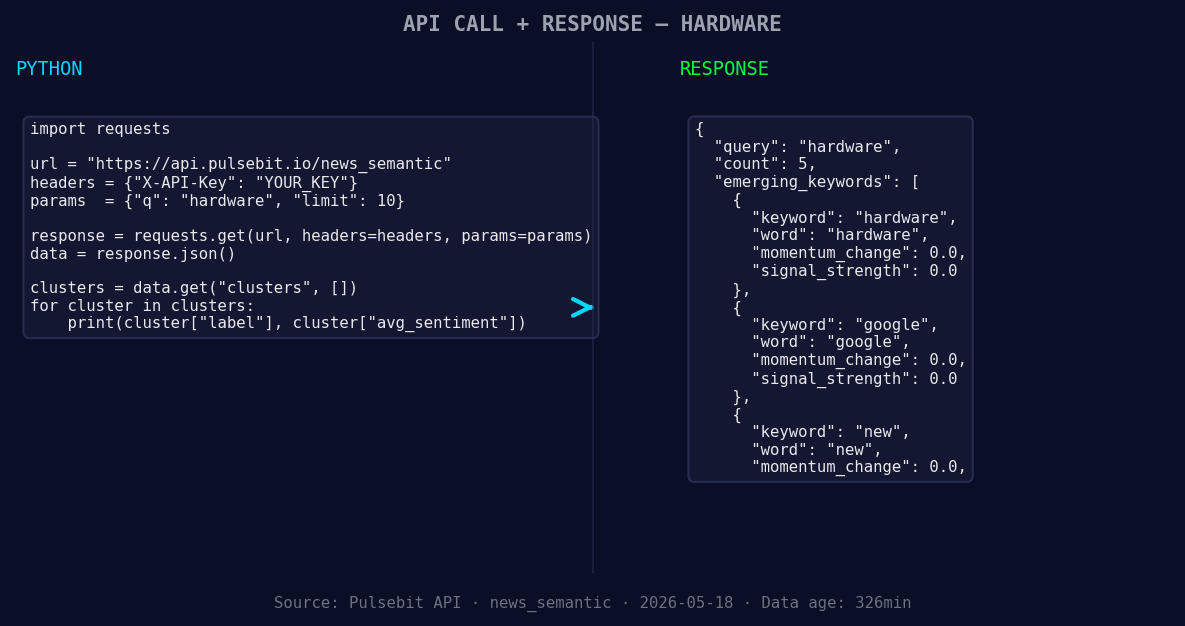
*Left: Python GET /news_semantic call for 'hardware'. Right: returned JSON response structure (clusters: 3). Source: Pulsebit /news_semantic.*
# Make the API call to get relevant articles
response = requests.get("https://api.pulsebit.com/v1/articles", params=params)
articles = response.json()
Now, let’s run the cluster narrative through our sentiment analysis endpoint to score the framing:
# Define the cluster reason string for meta-sentiment analysis
cluster_reason = "Clustered by shared themes: hardware, avnet, global, startups, new."

# Make a POST request to analyze the sentiment of the cluster reason
meta_sentiment_response = requests.post(
    "https://api.pulsebit.com/v1/sentiment",
    json={"text": cluster_reason}
)
meta_sentiment_score = meta_sentiment_response.json()
This approach not only captures the momentum spike but also evaluates how the narrative itself is framed. The combination of these steps allows us to create a more robust sentiment analysis pipeline.
With this data, here are three specific builds you can implement tonight:
Geographic Origin Filter: Build a sentiment tracking endpoint that focuses on hardware sentiment in English-speaking populations. Set a threshold for momentum spikes above +1.000 and trigger alerts when this occurs. Connect it to your dashboard to visualize trends in real time.
Meta-Sentiment Loop: Create an automated process that not only pulls articles but also scores the narrative framing of the clusters. Use the sentiment scores to dynamically adjust your content strategy based on what’s trending. If the meta sentiment score drops below +0.500, it could be a signal to pivot your focus.
Theme Formation Analysis: Set up a regular job that runs every 24 hours to analyze emerging themes. Incorporate a check for forming themes like hardware (+0.00), google (+0.00), and new (+0.00) against mainstream topics. Use these insights to inform your product development or marketing strategies.
By leveraging our capabilities effectively, you can ensure your analysis pipeline captures the latest insights and sentiment shifts efficiently.
For more details, check out our documentation at pulsebit.lojenterprise.com/docs. You can copy, paste, and run these snippets in under 10 minutes to start catching those valuable insights today.


Top comments (0)