

Your Pipeline Is 29.1h Behind: Catching Business Sentiment Leads with Pulsebit
We just uncovered a fascinating anomaly: a 24h momentum spike of +0.142 in business sentiment. This isn't just a random data point; it signals a significant shift in how business-related narratives are being framed, especially in English press. With the leading language showing a lag of 29.1 hours, it raises an urgent question for your sentiment analysis pipeline: Are you keeping pace with these rapid shifts?
The problem is clear. If your pipeline isn’t equipped to handle multilingual origins or recognize entity dominance, you’re missing critical signals. In this case, your model is trailing by 29.1 hours, failing to respond to emerging narratives around business, especially in English. This could lead to lost opportunities, as crucial trends and sentiments are evolving without your pipeline’s awareness. The question isn’t just about the data; it’s about how quickly you can act on it.

English coverage led by 29.1 hours. Nl at T+29.1h. Confidence scores: English 0.85, Spanish 0.85, French 0.85 Source: Pulsebit /sentiment_by_lang.
Let’s dive into some code to catch this momentum spike. We can use our API to filter for English language articles and extract relevant sentiment data. Here’s how you could do it:
import requests
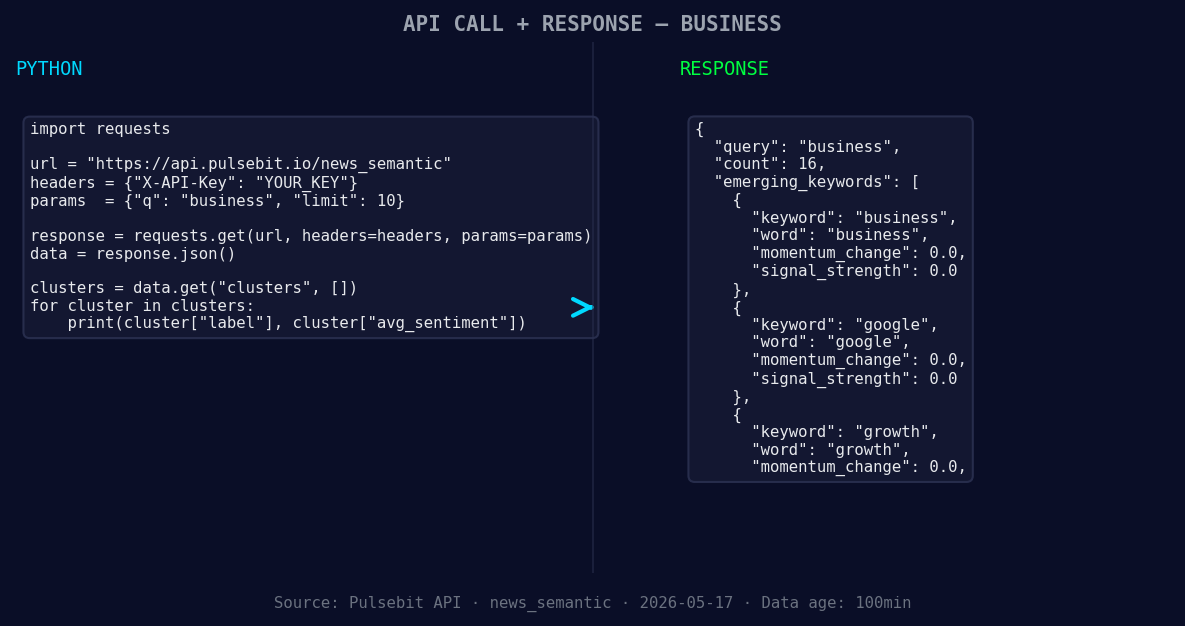
*Left: Python GET /news_semantic call for 'business'. Right: returned JSON response structure (clusters: 3). Source: Pulsebit /news_semantic.*
# Step 1: Geographic origin filter
response = requests.get(
'https://api.pulsebit.com/v1/articles',
params={
'topic': 'business',
'lang': 'en',
'momentum': 0.142,
'articles_processed': 16,
}
)
articles = response.json()
# Step 2: Meta-sentiment moment
cluster_reason = "Clustered by shared themes: hidden, tech, ethiopia’s, awakening, african."
sentiment_response = requests.post(
'https://api.pulsebit.com/v1/sentiment',
json={'text': cluster_reason}
)
sentiment_score = sentiment_response.json()
print(f'Sentiment Score for Cluster: {sentiment_score}')
In the above code, we filter articles related to the topic of "business" in English and focus on the recent spike in momentum. We then run the cluster reason string through our sentiment analysis endpoint to assess how the narrative is being framed. This combination of filtering and scoring allows us to capture the essence of what’s happening right now in the business world.
Now let’s talk about three specific builds you can implement with this pattern:
- English Filtered Business Spike: Create a signal that alerts you whenever there’s a momentum spike greater than +0.1 for the topic of business in English. Use the geographic filter to ensure you’re only processing relevant articles.

Geographic detection output for business. Hong Kong leads with 3 articles and sentiment +0.07. Source: Pulsebit /news_recent geographic fields.
Meta-Sentiment Loop: Build a routine that runs the cluster reason strings through the sentiment endpoint every hour. Set a threshold that triggers an alert if the sentiment score dips below -0.02 for narratives related to business, tech, or growth.
Comparative Analysis Endpoint: Set up an endpoint that compares forming themes like business(+0.00), google(+0.00), and growth(+0.00) against mainstream themes such as hidden, tech, and ethiopia’s. This will provide you with a clearer picture of shifting public sentiment and where your focus should be.
By building these specific alerts and analyses, you can ensure your pipeline is not just reactive but proactive in capturing emerging trends.
If this sounds like something you want to implement, head over to our documentation at pulsebit.lojenterprise.com/docs. We promise you can copy-paste and run this in under 10 minutes, putting you right at the forefront of sentiment analysis.


Top comments (0)