

Your Pipeline Is 11.9h Behind: Catching Finance Sentiment Leads with Pulsebit
We recently uncovered a striking anomaly: a 24h momentum spike of -1.287. This observation is critical, especially when we consider the leading language of the coverage—English—has a lag of 11.9 hours. It’s clear that if your pipeline isn’t tuned to handle multilingual origins and the dominance of certain entities, you’re missing out on timely insights that could inform your strategies.

English coverage led by 11.9 hours. Et at T+11.9h. Confidence scores: English 0.90, French 0.90, Spanish 0.90 Source: Pulsebit /sentiment_by_lang.
Imagine this: your model missed this critical shift by 11.9 hours, leaving you behind the curve in finance sentiment. The leading stories, clustered around "Arvest Bank's Summer Financial Guidance," are being driven by themes of bank services, travel, and financial tips—but if your model is only looking at mainstream topics like series and films, you're effectively blind to these emerging narratives.
Here’s how we can quickly catch this type of momentum shift using our API. The following Python code demonstrates how to filter for English-language articles related to finance and score the narrative framing:
import requests
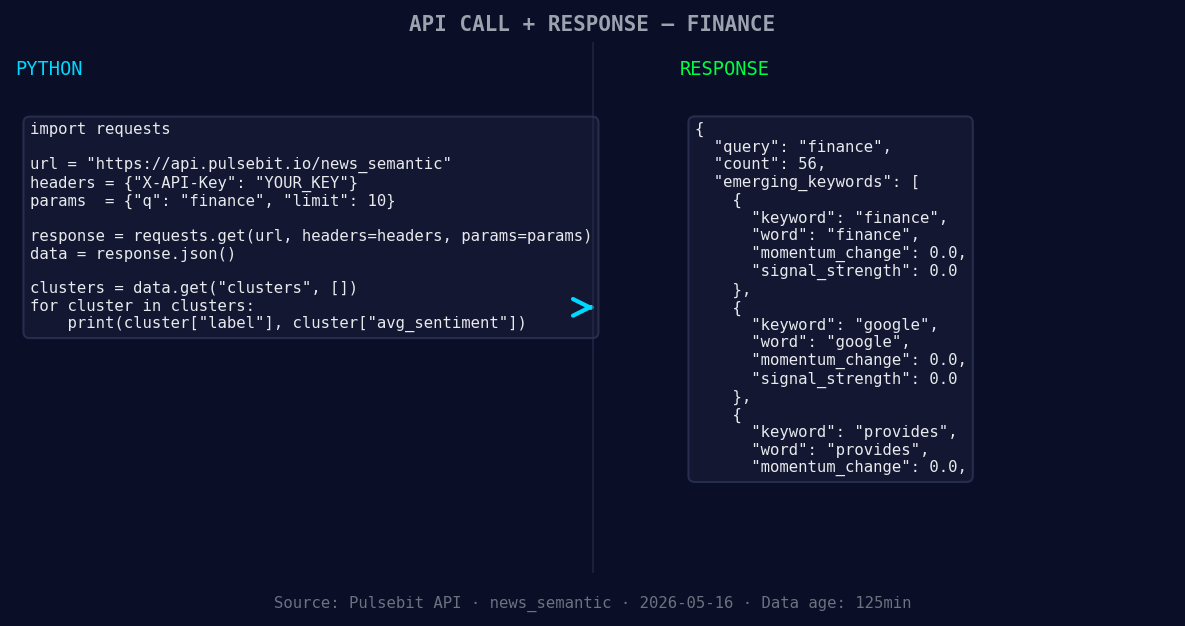
*Left: Python GET /news_semantic call for 'finance'. Right: returned JSON response structure (clusters: 3). Source: Pulsebit /news_semantic.*
# Step 1: Get the latest sentiment data
response = requests.get(
'https://api.pulsebit.com/articles',
params={
'topic': 'finance',
'lang': 'en',
'momentum': -1.287,
'score': +0.087,
'confidence': 0.90
}
)
data = response.json()
# Step 2: Run the cluster reason string back through the sentiment scoring
cluster_reason = "Clustered by shared themes: bank, provides, summer, travel, tips."
sentiment_response = requests.post(
'https://api.pulsebit.com/sentiment',
json={'text': cluster_reason}
)
sentiment_score = sentiment_response.json()
print(sentiment_score)
In this code, we first query our API to filter articles by the topic finance, specifying the language as en. We then take the cluster reason and run it through our sentiment scoring to assess how the narrative is framing itself. This dual approach allows us to not only catch the sentiment shift but also understand the underlying themes driving the conversation.
Now, let’s discuss three practical builds you can implement with this pattern:
Geo-Filtered Alerts: Set a threshold to trigger alerts when the momentum score for finance articles drops below -1.5 within the English-speaking demographic. This will ensure you stay ahead of significant shifts in sentiment.
Meta-Sentiment Analysis Integration: Create a system that triggers a deeper analysis when the cluster reason includes terms like "summer" or "travel". This can help identify seasonal trends in finance-related conversations that may influence your strategies.
Thematic Divergence Tracking: Build an endpoint that compares the sentiment scores of clustered themes like finance (+0.00) and mainstream topics like séries and films. If the divergence exceeds a certain threshold—say, a sentiment score difference of 0.1—flag this for deeper investigation.
By harnessing these patterns, you can ensure that your pipeline is responsive and tuned to catch critical financial sentiment shifts, even when they originate from less dominant narratives.
Ready to dive in? Check out our docs at pulsebit.lojenterprise.com/docs. You can copy-paste and run this code in under 10 minutes. Get started and enhance your sentiment analysis capabilities today!

Geographic detection output for finance. India leads with 6 articles and sentiment +0.19. Source: Pulsebit /news_recent geographic fields.


Top comments (0)