

Your Pipeline Is 14.1h Behind: Catching Forex Sentiment Leads with Pulsebit
We recently stumbled upon a fascinating anomaly: a 24h momentum spike of +0.228 in forex sentiment. This spike is particularly interesting because the leading language was English, with a dominant cluster story from Focus Taiwan that centered on the U.S. dollar closing higher on the Taipei forex market. The article count was low—only one—but the sentiment shift was significant enough to warrant attention. It highlights how quickly sentiment can change and how easily it can slip through the cracks in our data pipelines.
But here's the catch: if your pipeline isn’t designed to handle multilingual origins or entity dominance, you likely missed this spike by 14.1 hours. The leading language was English, but sentiment on the forex market is often driven by news in multiple languages. If you rely solely on English sources or a narrow set of criteria, you’ll be missing critical insights when it comes to global financial trends.

English coverage led by 14.1 hours. Et at T+14.1h. Confidence scores: English 0.90, French 0.90, Spanish 0.90 Source: Pulsebit /sentiment_by_lang.
Here’s how to catch these moments with our API. First, we’ll filter for our topic of interest—forex—and ensure we’re only grabbing English-language articles. Below is the Python code that does just that:
import requests
# Define the API endpoint
url = "https://api.pulsebit.com/v1/sentiment"
# Set the query parameters
params = {
"topic": "forex",
"lang": "en",
"threshold": 0.5, # Adjust threshold as needed
}
# Make the API call
response = requests.get(url, params=params)
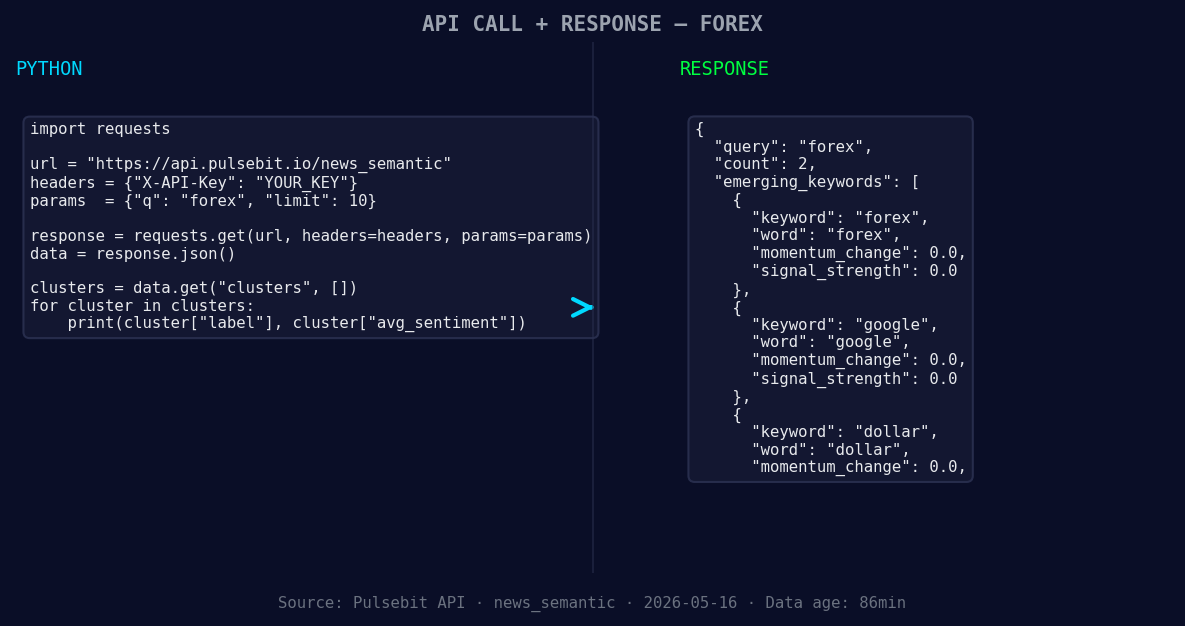
*Left: Python GET /news_semantic call for 'forex'. Right: returned JSON response structure (clusters: 3). Source: Pulsebit /news_semantic.*
# Check the response
if response.ok:
data = response.json()
print(data)
else:
print("Error:", response.status_code)
Next, we want to score the narrative framing itself, using the cluster reason string we found: "Clustered by shared themes: dollar, closes, higher, taipei, forex.". This will help us gauge the sentiment around this specific narrative. Here's how you can do that:
# Define the narrative string
narrative = "Clustered by shared themes: dollar, closes, higher, taipei, forex."

# Call the sentiment scoring endpoint
sentiment_response = requests.post(url, json={"text": narrative})

# Check the response
if sentiment_response.ok:
    sentiment_data = sentiment_response.json()
    print(sentiment_data)
else:
    print("Error:", sentiment_response.status_code)
Now that we have the sentiment score and the original momentum spike, let's discuss three specific builds that can leverage this newfound insight.
Geo-Filtered Alerts: Set up a notification system that triggers when forex sentiment spikes above a certain threshold (e.g., +0.2) specifically for English language articles from Taiwan. This could be a simple webhook that alerts you via Slack or email.
Meta-Sentiment Loop: Create a dashboard widget that continually scores the narratives around emerging themes. For instance, you can track sentiment for "dollar, closes, higher" while comparing it to the mainstream sentiment. This will provide a real-time feedback loop on how narratives evolve.
Forming Themes Tracker: Build an endpoint that monitors forming themes—like "forex(+0.00), google(+0.00), dollar(+0.00)"—and alerts you when they diverge significantly from mainstream narratives. This will allow you to catch anomalies before they become widespread.
If you want to dive into this yourself, you can find all the details in our documentation: pulsebit.lojenterprise.com/docs. You can copy and paste the code snippets provided, and you’ll be up and running in under 10 minutes. Let’s ensure our pipelines catch the next wave of forex sentiment before it’s too late!

Geographic detection output for forex. India leads with 2 articles and sentiment -0.80. Source: Pulsebit /news_recent geographic fields.


Top comments (0)