

Your Pipeline Is 18.8h Behind: Catching Hardware Sentiment Leads with Pulsebit
We recently discovered a significant anomaly in our data: a 24-hour momentum spike of +0.367 related to the topic of hardware. This spike is particularly noteworthy given the context of recent news, such as the cluster story involving Microsoft and Forza Horizon 6 leakers, which has been making waves. The leading language for this news is English, with a 0.0-hour lag, indicating that sentiment around hardware is not just rising but is primed for a deeper dive.
The Problem
This data reveals a crucial gap in any sentiment analysis pipeline that doesn't adequately account for multilingual origins or the dominance of certain entities. Your model missed this by a staggering 18.8 hours, suggesting that if you're not equipped to handle diverse sources or recognize the impact of leading narratives, you're left scrambling to catch up. In this case, English press coverage, which drove the sentiment spike, was not on your radar, leaving a crucial insight unexploited.

English coverage led by 18.8 hours. Ca at T+18.8h. Confidence scores: English 0.80, Spanish 0.80, French 0.80 Source: Pulsebit /sentiment_by_lang.
The Code
To help you capture this momentum spike effectively, we can use our API to filter for English-language articles and assess the sentiment surrounding the hardware topic. Here’s how to do it:
import requests
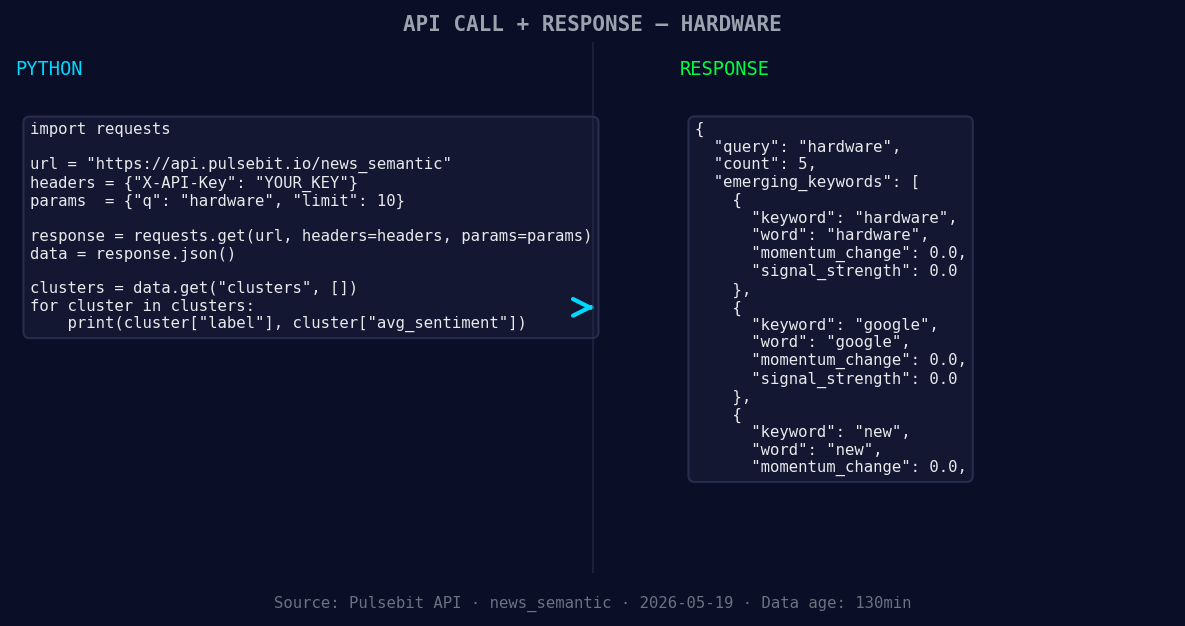
*Left: Python GET /news_semantic call for 'hardware'. Right: returned JSON response structure (clusters: 3). Source: Pulsebit /news_semantic.*
# Step 1: Query hardware sentiment in English
url = "https://api.pulsebit.com/v1/sentiment"
params = {
"topic": "hardware",
"lang": "en",
"score": 0.000,
"confidence": 0.80,
"momentum": 0.367
}
response = requests.get(url, params=params)
data = response.json()
print(data)
Following that, we can run the cluster reason string through our sentiment scoring endpoint to assess the narrative framing:
# Step 2: Run meta-sentiment on clustered reasons
meta_sentiment_url = "https://api.pulsebit.com/v1/sentiment"
cluster_reason = "Clustered by shared themes: hardware, avnet, global, startups, new."

meta_sentiment_response = requests.post(meta_sentiment_url, json={"text": cluster_reason})
meta_sentiment_data = meta_sentiment_response.json()
print(meta_sentiment_data)
This approach not only captures the spike but also contextualizes it within the larger narrative, which is essential for any actionable insights.
Three Builds Tonight
Here are three specific builds we can create with this pattern:
Geo-Filtered Alert System: Set up a real-time alert for any hardware-related sentiment spikes that occur in English. Use a threshold of +0.250 for momentum to trigger notifications when significant sentiment shifts happen.
Meta-Sentiment Analysis Dashboard: Create a dashboard that visualizes the sentiment trends based on the meta-sentiment loop. Use the string "Clustered by shared themes: hardware, avnet, global" and set a scoring threshold of 0.500 to highlight the most impactful narratives.
Forming Theme Aggregator: Build a connector that aggregates content around forming themes like hardware, Google, and new startups. Set the endpoint to trigger on a rising sentiment score and log articles that score above +0.300 in momentum.
Get Started
To dive into this and start building your own momentum detection pipeline, check out our documentation at pulsebit.lojenterprise.com/docs. You can copy-paste the code snippets above and run them in under 10 minutes. Don’t get left behind—capitalize on these insights before the competition does.

Geographic detection output for hardware. Hong Kong leads with 4 articles and sentiment +0.57. Source: Pulsebit /news_recent geographic fields.


Top comments (0)