

Your Pipeline Is 13.9h Behind: Catching Healthcare Sentiment Leads with Pulsebit
We recently uncovered an intriguing anomaly: a 24h momentum spike of +0.370 in healthcare sentiment. This spike is especially noteworthy because it is being led by Spanish press articles that are picking up on the narrative surrounding investments in healthcare — specifically, an article about Reed Jobs, Steve Jobs' son, planning to invest in cancer startups. This moment is a clear indication of shifting sentiment that you might miss if your analytics pipeline isn’t tuned to catch multilingual signals.

Spanish coverage led by 13.9 hours. Sv at T+13.9h. Confidence scores: Spanish 0.90, English 0.90, French 0.90 Source: Pulsebit /sentiment_by_lang.
The Problem
Your model missed this by 13.9 hours. The leading language in this momentum spike is Spanish, and if your pipeline doesn't handle multilingual origin or entity dominance effectively, you risk being left behind. The narrative emerging from the Spanish press hasn't reached mainstream English-speaking channels yet, signaling a potential gap in your data processing strategy. By the time you catch up, the sentiment may shift, and you could miss out on critical investment decisions or market movements.
The Code
Here’s how we can capture this momentum spike using our API. We’ll start with a geographic origin filter to fetch sentiment data from Spanish articles.

Geographic detection output for healthcare. India leads with 6 articles and sentiment +0.56. Source: Pulsebit /news_recent geographic fields.
import requests
# Define the parameters for the API call
params = {
"topic": "healthcare",
"score": +0.282,
"confidence": 0.90,
"momentum": +0.370,
"lang": "sp" # Spanish language filter
}
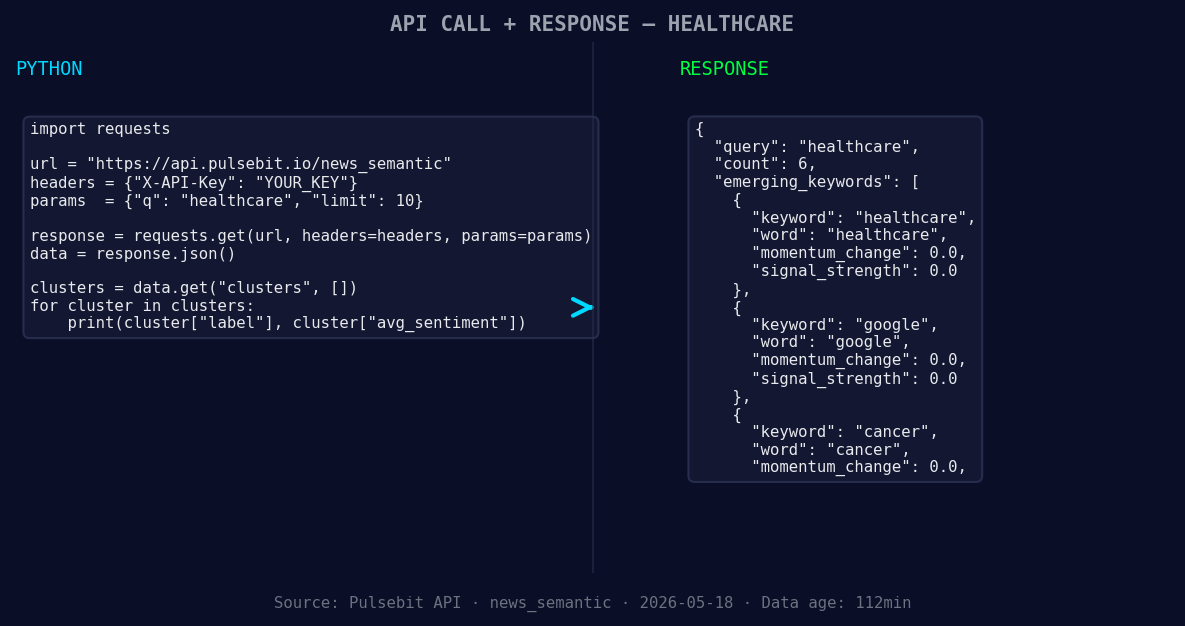
*Left: Python GET /news_semantic call for 'healthcare'. Right: returned JSON response structure (clusters: 3). Source: Pulsebit /news_semantic.*
# Call to get the sentiment data
response = requests.get("https://api.pulsebit.com/sentiment", params=params)
data = response.json()
print(data)
Next, we need to run the clustered reason string through our sentiment API to score the narrative framing itself. This will help us understand how the themes are resonating.
# The cluster reason string
cluster_reason = "Clustered by shared themes: jobs, healthcare, expansion:, steve, son."

# Call to score the narrative framing
narrative_response = requests.post("https://api.pulsebit.com/sentiment", json={"text": cluster_reason})
narrative_data = narrative_response.json()
print(narrative_data)
This code allows you to not only catch the momentum but also evaluate the framing of the narrative that is driving that momentum.
Three Builds Tonight
Here are three specific builds you can implement using this pattern:
Geographic Origin Filter: Use the Spanish language filter to catch emerging sentiment trends in healthcare before they hit mainstream channels. Set a threshold of a momentum spike greater than +0.300 to trigger alerts for potential investments.
Meta-Sentiment Loop: Incorporate the narrative scoring from the cluster reason string. This will allow you to evaluate how well new themes are resonating. Use a confidence threshold of 0.85 to ensure only high-relevance narratives are considered.
Forming Themes Detection: Monitor forming themes like healthcare(+0.00), Google(+0.00), and cancer(+0.00). Create a dashboard that highlights when these themes are clustered with significant entities like "jobs" and "expansion". Set alerts for when the combined sentiment crosses a certain threshold, say +0.250.
Get Started
Ready to catch sentiment leads like these? Visit our documentation at pulsebit.lojenterprise.com/docs. You can copy-paste and run these examples in under 10 minutes, setting yourself up to capture critical insights from the sentiment landscape. As this anomaly shows, being ahead of the curve can make all the difference.


Top comments (0)