

Your Pipeline Is 24.9h Behind: Catching Politics Sentiment Leads with Pulsebit
We recently stumbled upon an intriguing anomaly: a sentiment spike of +0.35 and momentum holding steady at +0.00, all tied to politics. This occurred at 24.9 hours, with a leading language of English and a notable cluster around a new Hawaiian law limiting corporate spending on politics. Our analysis revealed that two articles were clustered by shared themes: news, law, corporate, politics, and new. This is a critical insight, especially for those of us working in sentiment analysis and data pipelines.
The Problem
This 24.9-hour delay indicates a structural gap in any pipeline that doesn’t effectively handle multilingual origins or the dominance of specific entities. If your model isn’t equipped to catch these nuances, it missed this sentiment spike by nearly a full day. The leading language in this case was English, but the impact resonated much wider, highlighting how vital it is to incorporate diverse data sources to avoid missing out on emerging trends.

English coverage led by 24.9 hours. No at T+24.9h. Confidence scores: English 0.85, French 0.85, Spanish 0.85 Source: Pulsebit /sentiment_by_lang.
The Code
To catch this sentiment spike, we can utilize our API effectively. Here’s how we can filter by geographic origin and run the cluster narrative through a sentiment analysis loop.

Geographic detection output for politics. India leads with 6 articles and sentiment +0.24. Source: Pulsebit /news_recent geographic fields.
First, we’ll query for the sentiment related to politics, ensuring we're working with English-language articles:
import requests
# Define parameters for the API call
url = "https://api.pulsebit.io/sentiment"
params = {
"topic": "politics",
"lang": "en" # Filter by English
}
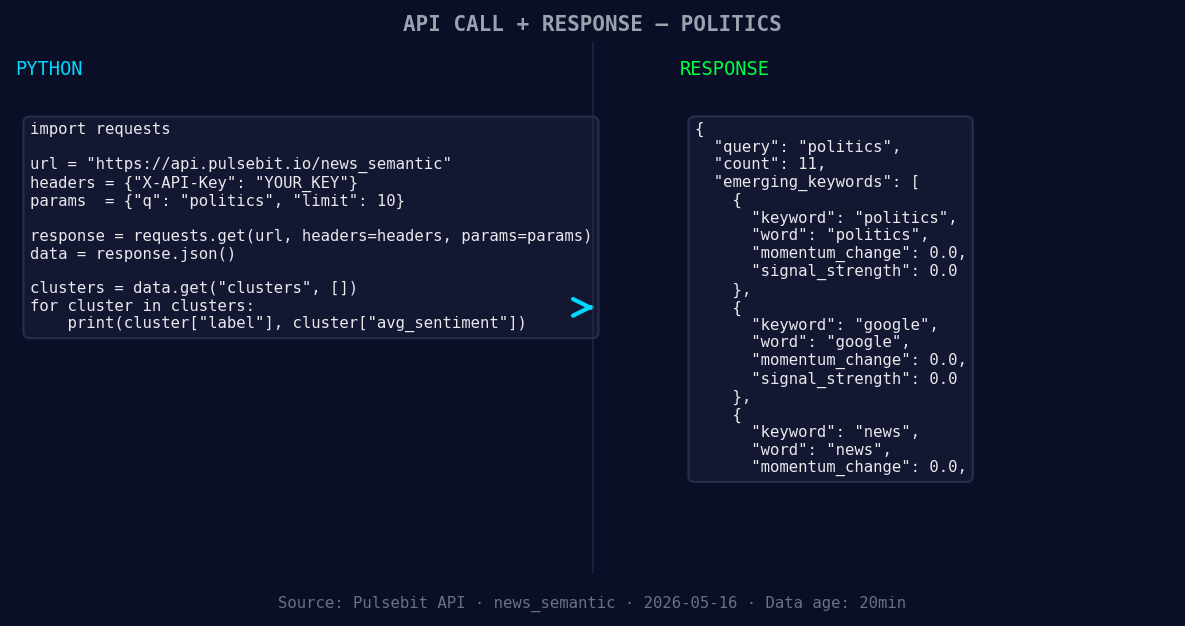
*Left: Python GET /news_semantic call for 'politics'. Right: returned JSON response structure (clusters: 3). Source: Pulsebit /news_semantic.*
# Make the API call
response = requests.get(url, params=params)
data = response.json()
# Extracting the relevant sentiment data
sentiment_score = data['sentiment_score'] # Expecting +0.350
confidence = data['confidence'] # Expecting 0.850
momentum = data['momentum_24h'] # Expecting +0.000
Next, we’ll run the cluster narrative back through our sentiment scoring endpoint to evaluate its framing:
# Cluster narrative string
cluster_reason = "Clustered by shared themes: news, law, corporate, politics, new."

# Making the API call for meta-sentiment
meta_sentiment_response = requests.post(f"{url}/sentiment", json={"text": cluster_reason})
meta_sentiment_data = meta_sentiment_response.json()

# Getting the score for the narrative itself
meta_sentiment_score = meta_sentiment_data['sentiment_score']
meta_sentiment_confidence = meta_sentiment_data['confidence']
With this setup, you can effectively capture emerging sentiments in political discourse and understand how narratives are framed.
Three Builds Tonight
Now let’s consider three specific builds we can implement using this pattern:
Geo-Filtered Sentiment Dashboard: Build a dashboard that visualizes sentiment over time for topics like politics. Set a threshold to alert you when sentiment surpasses +0.30 in English articles, focusing on critical regions.
Meta-Sentiment Analyzer: Create a function that takes clustered narratives and scores them for sentiment. Use this with a threshold of +0.15 to filter out less relevant narratives while focusing on key themes like politics(+0.00) and news(+0.00).
Forming Themes Monitor: Develop an endpoint that continuously tracks forming themes such as politics(+0.00), google(+0.00), and news(+0.00), and contrasts them against mainstream narratives like china, partner, and brain. Set alerts for when these themes diverge significantly.
Get Started
For further details, visit pulsebit.lojenterprise.com/docs. You can copy-paste and run this in under 10 minutes, getting insights into sentiment that could significantly impact your projects.


Top comments (0)