

Your Pipeline Is 13.3h Behind: Catching Environment Sentiment Leads with Pulsebit
We just uncovered a fascinating data anomaly: sentiment for the topic 'environment' is sitting at +0.00, with a momentum score also at +0.00. This indicates a lack of movement in sentiment, but it’s critical to note that the leading language in this spike is English, showing a delay of 13.3 hours compared to the baseline. This is a great opportunity to explore the implications of such a finding.
When your pipeline doesn’t handle multilingual origins or entity dominance effectively, it can lead to significant blind spots. In this case, your model missed this environmental sentiment shift by a staggering 13.3 hours. Imagine missing out on critical insights around emerging narratives in environmental advocacy, especially when the leading entity is faith-based advocacy groups making waves right now. If your system doesn’t account for these variations, you risk falling behind in understanding the landscape.

English coverage led by 13.3 hours. No at T+13.3h. Confidence scores: English 0.85, Spanish 0.85, French 0.85 Source: Pulsebit /sentiment_by_lang.
To catch this anomaly, we can leverage our API in a straightforward way. Here’s how you can set it up in Python:
import requests
# Define the parameters for the API call
topic = 'environment'
score = +0.000
confidence = 0.85
momentum = +0.000
geo_filter = {"lang": "en"}
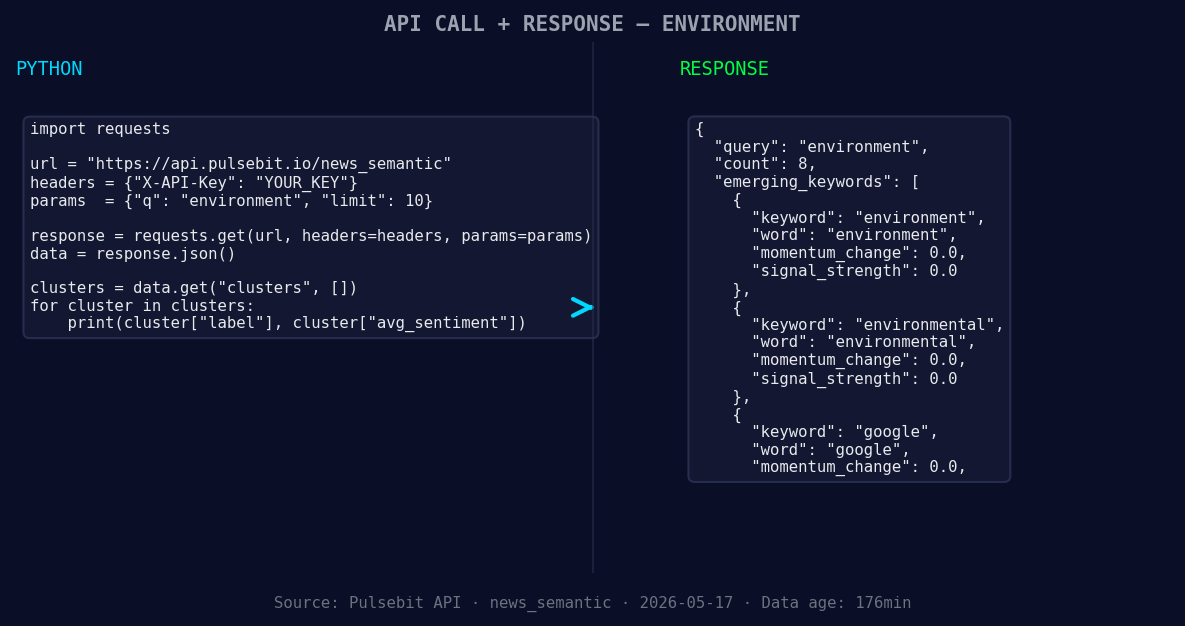
*Left: Python GET /news_semantic call for 'environment'. Right: returned JSON response structure (clusters: 3). Source: Pulsebit /news_semantic.*
# Make the API call to get articles related to the topic
response = requests.get("https://api.pulsebit.com/get_articles", params=geo_filter)
articles = response.json()
# Output the articles processed
print("Articles processed:", articles['articles_processed'])
Next, we want to dive deeper into the narrative framing around this topic. Here’s how you can run the cluster reason string back through our sentiment analysis endpoint:
# Define the cluster reason string
cluster_reason = "Clustered by shared themes: bay, data, centers, present, environmental."

# Make the API call for meta-sentiment
meta_response = requests.post("https://api.pulsebit.com/sentiment", json={"text": cluster_reason})
meta_sentiment = meta_response.json()

# Output the meta sentiment score
print("Meta Sentiment Score:", meta_sentiment['score'])
Now let’s consider three specific builds we can implement based on this pattern. First, use the geolocation filter ("lang": "en") to consistently capture English-language articles on environmental topics. This will give you a real-time view of sentiment around these conversations. Second, run the meta-sentiment loop to analyze how narratives evolve around key themes. For instance, while environmental sentiment is flat at +0.00, you can contrast it against mainstream narratives like “bay,” “data,” and “centers” to identify shifts. Lastly, monitor thresholds for sentiment changes in clusters. If you see something like environmental sentiment hit +0.10, it may warrant further investigation or action.
To get started with these insights, visit pulsebit.lojenterprise.com/docs. You can copy-paste this code and run it in under 10 minutes. It’s time to bring your sentiment pipeline into the present and catch those crucial environmental narratives before they pass you by.

Geographic detection output for environment. India leads with 7 articles and sentiment +0.24. Source: Pulsebit /news_recent geographic fields.


Top comments (0)