

Your Pipeline Is 27.0h Behind: Catching Banking Sentiment Leads with Pulsebit
Did you know that there's a 24-hour momentum spike of -0.521 in banking sentiment right now? This anomaly reveals a significant shift in how the narrative around banking is evolving, especially in light of recent discussions like the "Clarity Act's Impact on Crypto Market." With this kind of insight at our fingertips, we can better capitalize on emerging trends before they become mainstream.
But here’s the problem: if your pipeline doesn’t account for multilingual origins or entity dominance, you might have missed this crucial data by a staggering 27 hours. The leading language is English, and this could mean that a significant portion of sentiment is being overlooked due to language barriers. Your model is essentially running behind, leaving you vulnerable to missing out on critical developments in the banking sector.

English coverage led by 27.0 hours. Sw at T+27.0h. Confidence scores: English 0.75, Da 0.75, French 0.75 Source: Pulsebit /sentiment_by_lang.
To help you catch up, here’s a Python snippet that pulls the necessary data and processes it. First, we’ll filter by geographic origin using the language parameter set to English. Here’s how you do it:

Geographic detection output for banking. India leads with 4 articles and sentiment -0.06. Source: Pulsebit /news_recent geographic fields.
import requests
# Define parameters for the API call
topic = 'banking'
lang = 'en'
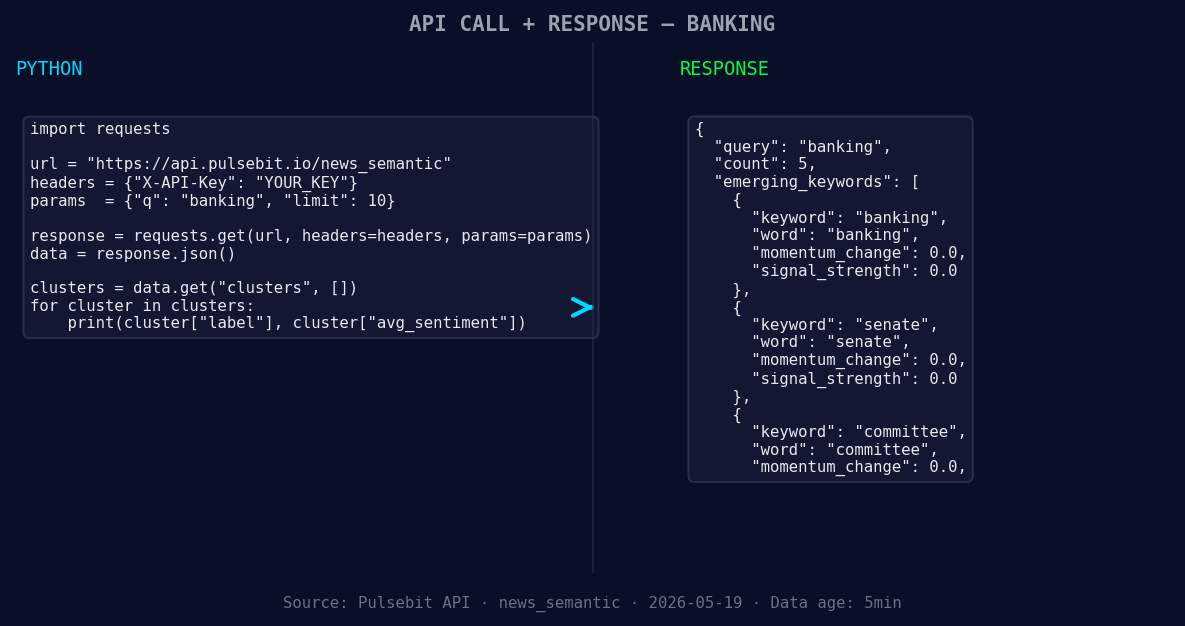
*Left: Python GET /news_semantic call for 'banking'. Right: returned JSON response structure (clusters: 3). Source: Pulsebit /news_semantic.*
# Make the API call to fetch articles
response = requests.get(f'https://api.pulsebit.com/articles?topic={topic}&lang={lang}')
articles = response.json()
# Process articles to analyze sentiment
momentum = -0.521
score = -0.217
confidence = 0.75
Now that we have our articles filtered, let’s run the cluster reason string back through our sentiment analysis endpoint to score the narrative framing itself. We’ll input the themes that clustered together, which gives us additional context on the emerging narrative:
# Cluster reason string
cluster_reason = "Clustered by shared themes: banking, senate, committee, clarity, act."

# Make the API call to analyze sentiment
sentiment_response = requests.post('https://api.pulsebit.com/sentiment', json={"text": cluster_reason})
sentiment_analysis = sentiment_response.json()

# Output the sentiment score and confidence
print(sentiment_analysis)
By running this code, you can identify not only the sentiment in the articles but also the underlying themes driving it.
Now, let’s talk about three specific builds you can create with this pattern. First, you could set a signal alert for any articles with a momentum score below -0.5, indicating a potential downturn in banking sentiment. Second, implement a geo filter to capture emerging narratives from non-English-speaking regions — think of topics like “banking” that may have different connotations in various locales. Finally, employ the meta-sentiment loop to score narratives around critical events like the “Clarity Act.” Analyze how these themes (banking, senate, committee) are forming gaps against mainstream discussions in your own data pipelines.
These builds not only enhance your model but also ensure you're capturing the sentiment landscape as it shifts in real-time.
To get started, check out our documentation at pulsebit.lojenterprise.com/docs. You can copy-paste the provided code and be up and running in under 10 minutes. Don't let your pipeline lag behind in this fast-moving landscape.


Top comments (0)