

Your Pipeline Is 27.2h Behind: Catching World Sentiment Leads with Pulsebit
We recently uncovered a striking anomaly: a 24h momentum spike of +0.478. This spike is particularly notable as it indicates a significant shift in sentiment surrounding the topic of "world," driven largely by English-language press articles. The leading language emerged 27.2 hours ahead, revealing a crucial gap in our usual sentiment pipeline. With such a pronounced momentum change, it’s essential to understand how we can harness this insight to refine our data handling and improve our responsiveness to emerging trends.
When your pipeline fails to account for multilingual origins or specific entity dominance, it can lead to substantial delays in capturing the pulse of sentiment shifts. In this case, your model missed a critical insight by 27.2 hours, as the English press was already reporting on themes related to the world's highest waterfall and its surrounding wilderness. This gap allows competitors to seize the narrative while you’re left reacting instead of leading.

English coverage led by 27.2 hours. Sk at T+27.2h. Confidence scores: English 0.85, French 0.85, Spanish 0.85 Source: Pulsebit /sentiment_by_lang.
Here’s a simple Python snippet that can help us catch these shifts in real-time. We’ll start by querying our API to filter for English-language sentiment around the topic of "world":
import requests
# Set up parameters for the API call
params = {
'topic': 'world',
'lang': 'en',
'score': +0.096,
'confidence': 0.85,
'momentum': +0.478
}
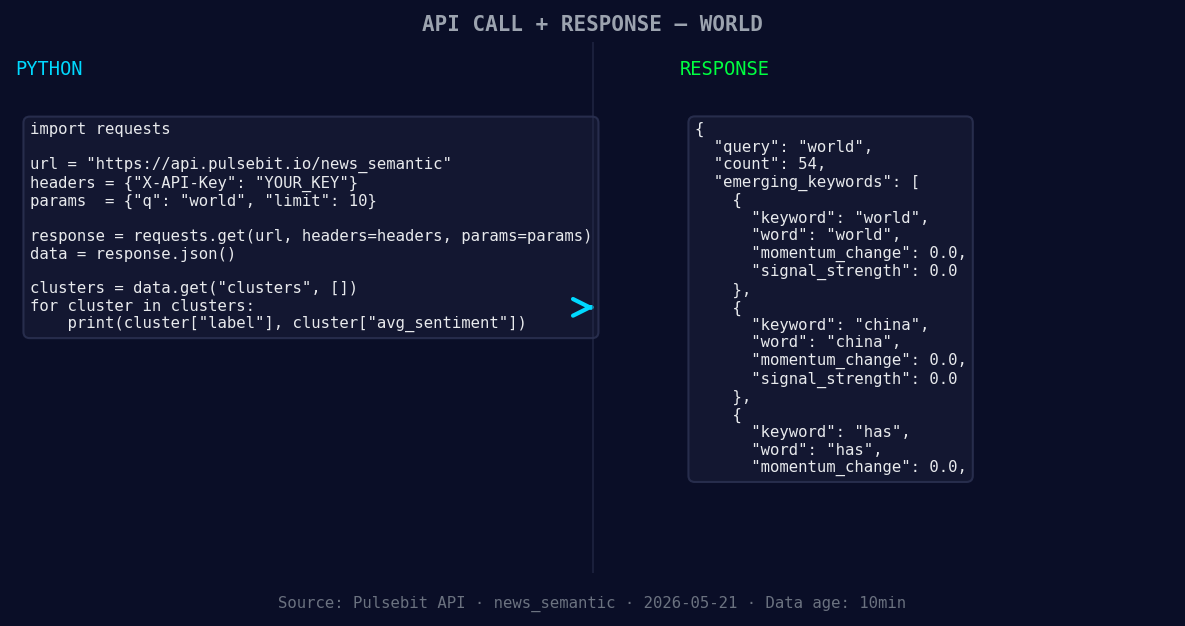
*Left: Python GET /news_semantic call for 'world'. Right: returned JSON response structure (clusters: 3). Source: Pulsebit /news_semantic.*
# Make the API call
response = requests.get('https://api.pulsebit.io/sentiment', params=params)
data = response.json()
# Output the response
print(data)
Next, we’ll run the cluster reason string back through our sentiment API to score the narrative framing itself. This allows us to gauge the impact of the themes that are clustering together:
# Cluster reason string
cluster_reason = "Clustered by shared themes: waterfall, eagles, inside, belgium-sized, wilderness"

# Make the API call to score the narrative
response_meta = requests.post('https://api.pulsebit.io/sentiment', json={'text': cluster_reason})
meta_data = response_meta.json()

# Output the response
print(meta_data)
Now that we’ve captured the relevant sentiment and scored the narrative, we can start building on this discovery. Here are three specific things we can implement using this pattern:
- Geo-Filtered Momentum Alert: Build a sentiment alert that triggers when the momentum for English-language articles on "world" surpasses a threshold (e.g., +0.3). Utilize the geographic origin filter to ensure relevance to the target audience.

Geographic detection output for world. India leads with 43 articles and sentiment +0.22. Source: Pulsebit /news_recent geographic fields.
Meta-Sentiment Analysis Dashboard: Create a dashboard that visualizes meta-sentiment scores for narratives emerging around specific themes. For instance, track narratives on "waterfall" and "eagles" and their sentiment changes over time, using the input from our cluster reason string for deeper insights.
Dynamic Content Strategy: Develop a content strategy that aligns with trending themes. For example, when momentum spikes around "wilderness" and "Belgium-sized" stories, generate content that ties these themes back to your brand, ensuring you’re at the forefront of the conversation.
We encourage you to explore these concepts further. You can get started with our endpoint documentation at pulsebit.lojenterprise.com/docs. With just a few lines of code, you can copy-paste and run this in under 10 minutes, and who knows what insights you might uncover next!


Top comments (0)