

Your pipeline just missed a significant anomaly with a 24-hour momentum spike of +0.689 in the finance sector. This isn’t just a minor fluctuation; it points to a noteworthy shift in sentiment that you should have caught. The leading language for this spike was English, with a precise lag of 28.3 hours, indicating a potential oversight in your sentiment analysis pipeline. This gap suggests that your model may not be effectively tracking multilingual origins or entity dominance, which can lead to missed opportunities in understanding emerging trends.

English coverage led by 28.3 hours. Sv at T+28.3h. Confidence scores: English 0.85, Spanish 0.85, French 0.85 Source: Pulsebit /sentiment_by_lang.
If your pipeline doesn't accommodate multilingual data or prioritize entities based on dominance, you're effectively lagging behind. In this case, your model missed this spike by 28.3 hours, which is considerable when it comes to finance sentiment. The leading language was English, and if you’re only focusing on a single language or entity, your analysis could be significantly skewed. Missing out on such spikes means you’re not capitalizing on critical insights that can shape your decision-making.
Here’s how to catch this spike using Python with our API. First, we need to filter the data by geographic origin, specifically focusing on English:
import requests
# Define parameters for the API call
params = {
"topic": "finance",
"lang": "en",
"score": 0.033,
"confidence": 0.85,
"momentum": 0.689
}
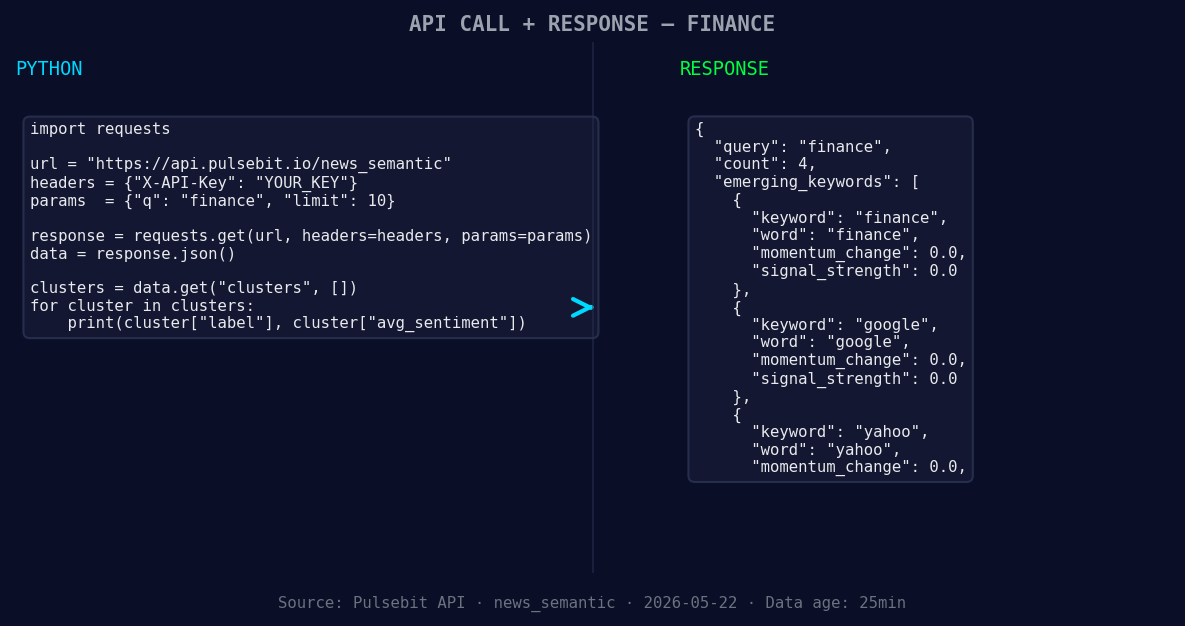
*Left: Python GET /news_semantic call for 'finance'. Right: returned JSON response structure (clusters: 3). Source: Pulsebit /news_semantic.*
# API endpoint for sentiment analysis
url = "https://api.pulsebit.com/v1/sentiment"
# Make the API call
response = requests.get(url, params=params)
# Print the response
print(response.json())
Next, we need to run the cluster reason string through the sentiment analysis endpoint to score the narrative framing itself:
# Meta-sentiment moment with the cluster reason
meta_sentiment_payload = {
    "text": "Clustered by shared themes: announces, proposed, enertopia, financing, yahoo."
}

# API endpoint for scoring narrative framing
meta_sentiment_url = "https://api.pulsebit.com/v1/sentiment"

# Make the POST request
meta_response = requests.post(meta_sentiment_url, json=meta_sentiment_payload)

# Print the meta-sentiment response
print(meta_response.json())
Now that we have the tools to identify and score the narrative, here are three specific builds you can implement with this pattern:
- Geo-Filtered Alerts: Set up an alerting mechanism that triggers when the sentiment score for finance in English spikes past a defined threshold (e.g., +0.05). Use the geographic filter to ensure you’re only capturing relevant signals from the English-speaking demographic.

Geographic detection output for finance. India leads with 3 articles and sentiment +0.85. Source: Pulsebit /news_recent geographic fields.
Meta-Sentiment Analysis Dashboard: Create a dashboard that visualizes sentiment scores alongside cluster narratives. Use the meta-sentiment loop to score narrative frameworks in real-time, making it easier to identify potential investment opportunities or risks in finance.
Entity Dominance Tracker: Integrate a feature that tracks the dominance of entities like Google and Yahoo within finance narratives. Use the forming themes to create comparative analyses that highlight which entities are gaining traction and their associated sentiment scores.
Ready to start building? Check out our documentation at pulsebit.lojenterprise.com/docs. You can copy, paste, and run this in under 10 minutes, putting you right in the center of the action. Don’t let your pipeline stay 28.3 hours behind; stay ahead of the curve with these insights.


Top comments (0)