

Your Pipeline Is 27.3h Behind: Catching Banking Sentiment Leads with Pulsebit
We recently stumbled upon a fascinating anomaly: a 24h momentum spike of -0.627 related to banking sentiment. This sharp decline caught our attention as it indicates a significant shift in sentiment around banking topics, especially in light of the RBI's recent liquidity injections into the banking system. The narrative is rich and layered, with the leading language being Slovenian (sl), which adds complexity to the data landscape we often navigate.
However, if your pipeline doesn’t account for multilingual origins or entity dominance, you might have missed this vital insight by 27.3 hours! The leading language, Slovenian, suggests a regional focus that could easily slip under the radar for models that primarily analyze dominant English-language content. This structural gap could leave your sentiment analysis stale, missing critical signals that are shaping conversations in other languages and regions.

Sl coverage led by 27.3 hours. Ro at T+27.3h. Confidence scores: Sl 0.80, English 0.80, Spanish 0.80 Source: Pulsebit /sentiment_by_lang.
To catch this anomaly, we can leverage our API effectively. Below is a snippet of Python code that demonstrates how to filter by geographic origin and assess sentiment.

Geographic detection output for banking. India leads with 5 articles and sentiment -0.06. Source: Pulsebit /news_recent geographic fields.
import requests
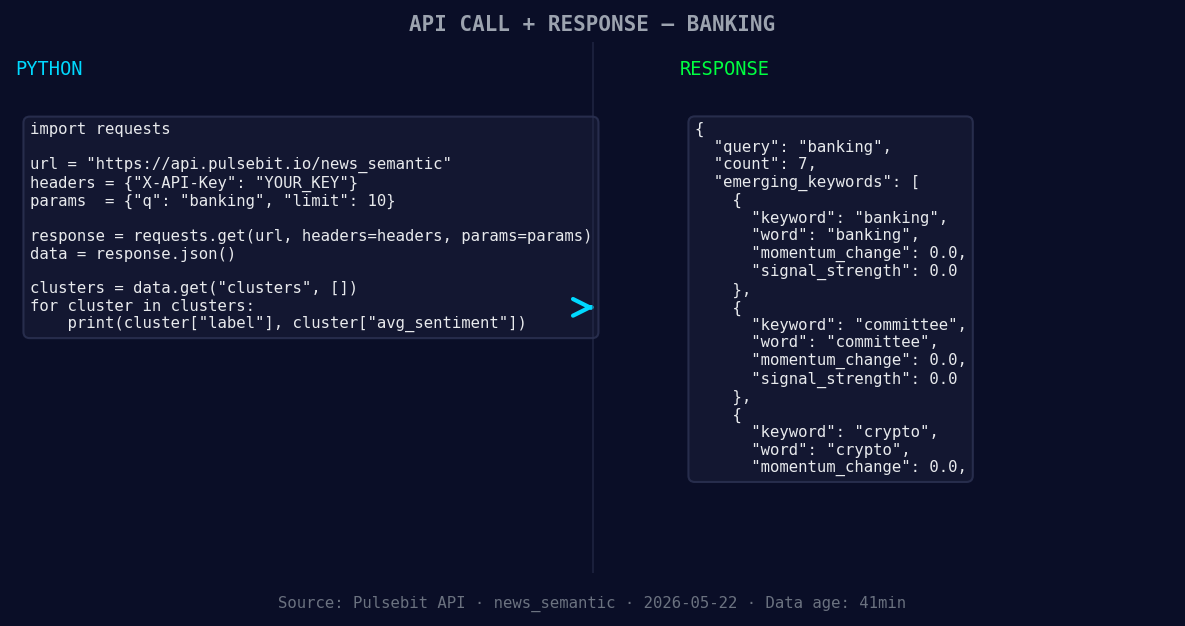
*Left: Python GET /news_semantic call for 'banking'. Right: returned JSON response structure (clusters: 3). Source: Pulsebit /news_semantic.*
# Step 1: Geographic origin filter
url = "https://api.pulsebit.com/v1/sentiment"
params = {
"topic": "banking",
"lang": "sl",
"score": "+0.404",
"confidence": 0.80,
"momentum": -0.627
}
response = requests.get(url, params=params)
data = response.json()
print(data) # Check the response to ensure we have the right data
# Step 2: Meta-sentiment moment
narrative = "Clustered by shared themes: rbi, liquidity, into, banking, system."
meta_response = requests.post(url, json={"text": narrative})
meta_data = meta_response.json()
print(meta_data) # Output the sentiment on the narrative framing
Here, we first make a GET request to filter our sentiment data by the Slovenian language. We then run our cluster reason string through a POST request to evaluate the sentiment framing itself, allowing us to understand the nuances behind the data. This two-step process is crucial for catching regional disparities and narrative shifts that could otherwise be overlooked.
With this anomaly in hand, we can build three specific applications that leverage this insight:
Banking Sentiment Tracker: Create an endpoint that continuously polls sentiment data on banking with a threshold of -0.5 momentum. This allows us to capture any significant downturns in sentiment and react quickly.
Committee Decisions Insight: Develop a cluster analysis that focuses on committee-related articles. Use a threshold of +0.00 sentiment score to identify when sentiment shifts positively or negatively around committee discussions in banking.
Crypto and Banking Correlation Monitor: Build a dual-sentiment monitor that tracks sentiments within both the banking and crypto sectors. Use the geo filter to include only Slovenian sources. Any spikes in either sector could indicate a larger trend worth investigating.
These builds will not only enhance your insight into banking sentiment but will also help bridge the gap created by language and regional focus.
To get started, dive into our documentation at pulsebit.lojenterprise.com/docs. You can copy, paste, and run this in under 10 minutes to see the power of sentiment analysis in action!


Top comments (0)